
台独

Search documents
国台办:“台独”与台海和平水火不容
Zhong Guo Xin Wen Wang· 2025-09-24 08:28
Core Viewpoint - The Chinese government asserts that Taiwan is an inseparable part of China and emphasizes that any attempts at "Taiwan independence" will not be tolerated, framing such actions as threats to peace in the Taiwan Strait [1] Group 1: Government Stance - The Chinese government, represented by the Taiwan Affairs Office, reiterates that there is only one China and that Taiwan's status as part of China is a historical and legal fact [1] - The spokesperson criticizes the Democratic Progressive Party (DPP) for its "Taiwan independence" stance, claiming it undermines peace and stability in the Taiwan Strait [1] Group 2: Regional Stability - The Chinese government calls for unity among Taiwanese compatriots to oppose "Taiwan independence" provocations and external interference, framing this as essential for maintaining peace in the region [1] - The statement highlights the belief that the DPP's actions, under the guise of maintaining peace, are actually efforts to pursue independence through external support [1]
国台办:民进党当局在所谓“备战谋独”上投入越多 给台湾带来的危害就越大
Zhong Guo Xin Wen Wang· 2025-09-24 08:28
Core Viewpoint - The Taiwanese authorities are reportedly enhancing their coast guard capabilities by acquiring six new patrol vessels, which has raised concerns about the potential militarization of the coast guard and the blurring of lines between law enforcement and military operations [1] Group 1 - The spokesperson for the Taiwan Affairs Office criticized the Democratic Progressive Party (DPP) for its persistent stance on "Taiwan independence," claiming it poses the greatest threat to peace and stability in the Taiwan Strait [1] - The DPP is accused of colluding with external forces to provoke tensions and is attempting to use military means to pursue independence, which is seen as detrimental to the welfare of the Taiwanese people [1] - The spokesperson warned that the DPP's militaristic approach would ultimately lead to greater harm for Taiwan, emphasizing that their efforts to achieve independence through military means are futile and self-destructive [1]
从字里行间读懂“北平锋”的微言大义
Xin Lang Cai Jing· 2025-09-24 07:50
Core Viewpoint - The "Beijing Sharp" articles have significantly increased in frequency since mid-September, aiming to clarify the central government's policies towards Taiwan and the international situation [1][2][3] Group 1: Article Frequency and Style - "Beijing Sharp" began publishing almost daily articles on Taiwan-related issues since mid-September, emphasizing the urgency of conveying the central government's stance [1][2] - The articles are characterized by their concise yet profound style, often delivering significant insights in a brief format [2][3] Group 2: Public and Media Reaction - The articles have garnered considerable attention from both domestic and international media, indicating their impact on public discourse [3] - A specific article titled "The Unstoppable Trend of National Reunification" received over 100,000 views within an hour of publication, showcasing its popularity [8] Group 3: Data-Driven Arguments - An article published on September 22 utilized data to argue against the current Taiwanese leadership, highlighting a significant increase in dissatisfaction with Lai Ching-te's handling of cross-strait relations, from 43% to 63% [13][14] - The article also noted a drop of 8% in the belief that the U.S. would intervene militarily in a cross-strait conflict, reflecting a shift in public sentiment [13][14] Group 4: Consensus Building - Some articles aim to foster consensus and empathy, using recent significant events in mainland China to illustrate a narrative of national pride and unity among Chinese people, including Taiwanese compatriots [20][21] - The articles blend assertive rhetoric with a more compassionate tone, indicating a strategic approach to engage with the audience emotionally [20][21]

国台办:赖清德如不思悔改,只会更加害惨台湾
Xin Hua Wang· 2025-09-24 06:42
Core Points - The article discusses the statements made by Lai Ching-te regarding Taiwan's defense and economic strategies, which are criticized by the Chinese government as promoting "Taiwan independence" and escalating tensions across the Taiwan Strait [1][2][3][4] - The Chinese government emphasizes that Taiwan is an inseparable part of China and rejects any claims of Taiwan's independence or separate existence [2][3][4] Group 1 - Lai Ching-te's three missions include enhancing defense budgets, protecting Taiwanese citizens, and shifting investments from mainland China to global markets [1] - The Chinese government accuses Lai of exacerbating cross-strait tensions and undermining the interests of Taiwanese businesses and citizens [1][3] - The Chinese government asserts that the historical and legal status of Taiwan as part of China is indisputable, referencing international agreements from World War II [2][3] Group 2 - The Chinese government warns that any attempts at "Taiwan independence" will ultimately fail and emphasizes the importance of the "1992 Consensus" as a basis for dialogue [4] - The article highlights the contradiction in the Taiwanese government's stance of seeking dialogue while simultaneously promoting independence narratives [4] - The Chinese government calls for unity among Taiwanese citizens against external interference and "Taiwan independence" movements [3][4]
赖清德又在渲染“大陆威胁” 国台办:充分暴露“台独”本性
Yang Shi Xin Wen Ke Hu Duan· 2025-09-24 03:32
Core Viewpoint - The spokesperson Chen Binhua criticized Lai Ching-te's recent claims regarding "three major missions," labeling him as a "Taiwan independence" proponent who exacerbates cross-strait tensions and undermines cooperation [1] Group 1: Political Stance - Lai Ching-te has consistently adhered to a "Taiwan independence" stance since taking office, disregarding the interests and welfare of the Taiwanese people and businesses [1] - The spokesperson accused Lai of obstructing and limiting cross-strait exchanges and cooperation, pushing for economic decoupling between Taiwan and the mainland [1] Group 2: External Influence - Lai is criticized for selling out Taiwan and catering to external forces, allowing them to manipulate Taiwan's situation [1] - The spokesperson highlighted that Lai's actions could lead Taiwan into a dangerous military conflict, jeopardizing the safety of the island [1] Group 3: Impact on Taiwan - Lai's rhetoric and actions have severely harmed the interests of local businesses and the general public in Taiwan [1] - The spokesperson warned that if Lai does not change his approach, the situation will worsen for Taiwan [1]
国台办:“以武谋独”“倚外谋独” 不会得逞 注定失败
Yang Shi Xin Wen Ke Hu Duan· 2025-09-24 03:32
Group 1 - The core viewpoint emphasizes that Taiwan is an inseparable part of China, and the notion of "Taiwan independence" is fundamentally flawed and counterproductive [1][2] - The spokesperson criticizes the Democratic Progressive Party (DPP) for its contradictory stance of claiming willingness for dialogue while promoting "Taiwan independence," indicating a lack of genuine intent for cross-strait communication [1] - The "1992 Consensus," which reflects the one-China principle, is highlighted as the political foundation for dialogue and negotiation between the two sides [1] Group 2 - The DPP's attempts to seek independence through external support and military means are described as a betrayal of the mainstream public opinion in Taiwan and detrimental to national interests [2] - The spokesperson asserts that the DPP's strategies are bound to fail and will not succeed in achieving their goals [2]
外交部:搞“台独”是死路一条 “挟洋谋独”不会得逞
Yang Shi Xin Wen· 2025-09-23 08:39
Core Viewpoint - The Chinese government emphasizes the one-China principle, asserting that Taiwan is an inseparable part of China, which is the political foundation for diplomatic relations between China and Austria [1]. Group 1 - The Chinese government firmly opposes any official exchanges between countries that have diplomatic relations with China and Taiwan [1]. - The Chinese government urges relevant countries to adhere to the one-China principle and stop providing platforms for "Taiwan independence" activities [1]. - The Chinese government warns that attempts to promote "Taiwan independence" are futile and will not succeed [1]. Group 2 - The Chinese government criticizes the Democratic Progressive Party's attempts to create a narrative of "two Chinas" or "one China, one Taiwan," stating that these efforts are destined to fail [1].
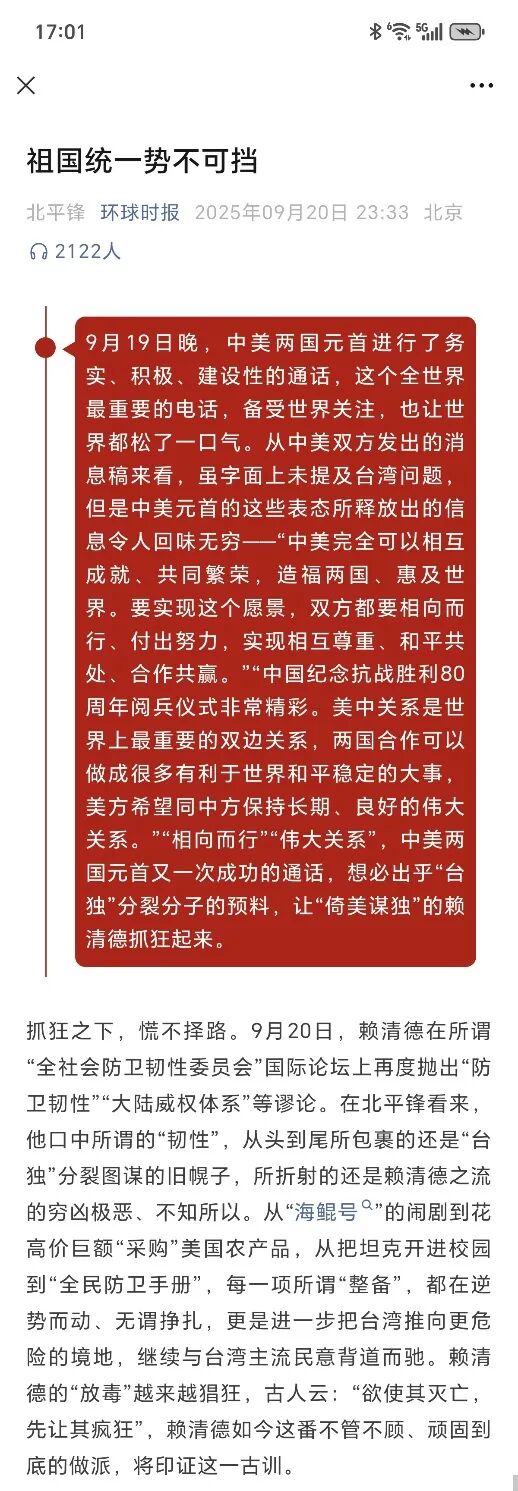
祖国统一势不可挡
Huan Qiu Wang· 2025-09-20 15:27
Group 1 - The core message from the recent phone call between the leaders of China and the U.S. emphasizes mutual respect, peaceful coexistence, and cooperation for common prosperity, despite not explicitly mentioning the Taiwan issue [1] - The dialogue is seen as a positive step towards stabilizing U.S.-China relations, which are considered crucial for global peace and stability [1] - The remarks made by the Chinese leader during the call are interpreted as a counter to the separatist sentiments in Taiwan, particularly against the backdrop of rising tensions [1] Group 2 - Taiwan's leadership, particularly Lai Ching-te, is criticized for promoting a narrative of "defense resilience" while allegedly pursuing separatist agendas, which could lead to increased tensions with mainland China [2][3] - Lai's claims about Taiwan facing challenges from "natural environment" and "authoritarian expansion" are viewed as attempts to justify military spending and procurement from the U.S., including a proposed defense budget reaching 5% of GDP by 2030 [3] - The commitment to purchase over $10 billion worth of U.S. agricultural products over the next four years is seen as a strategic move to strengthen ties with the U.S. amid ongoing tariff negotiations, raising concerns about the economic implications for Taiwan [4] Group 3 - The Taiwanese government's military procurement and defense strategies are criticized as ineffective and potentially harmful to the local economy, with claims that these measures serve more to consolidate power than to ensure genuine security [4][5] - The introduction of a new "National Defense Handbook" is perceived as a tool for instilling fear rather than providing real security guidance, with accusations that it politicizes ordinary issues and misrepresents the sources of threats [5] - Overall, the current approach of Taiwan's leadership is characterized as reckless and detrimental to the well-being of its citizens, with predictions of failure for their separatist ambitions [5][6]
邱垂正窜美声称中国大陆是台海和平稳定“最大威胁”,炒作所谓“大陆武力攻台”,外交部驳斥
Huan Qiu Wang· 2025-09-15 09:03
Core Points - The spokesperson of the Ministry of Foreign Affairs, Lin Jian, emphasized that there is only one China and Taiwan is an inseparable part of Chinese territory, asserting that the real situation in the Taiwan Strait is being threatened by "Taiwan independence" and external forces supporting it [1] - Lin Jian firmly opposed any form of official exchanges and military collusion between the US and Taiwan, urging the US to adhere to the One China principle and the three joint communiqués between China and the US [1] - The spokesperson criticized the Democratic Progressive Party (DPP) for attempting to leverage external forces for "Taiwan independence," stating that such actions cannot change the objective fact that both sides of the Taiwan Strait belong to one China [1] Summary by Sections Official Stance - The Chinese government maintains that the biggest threat to peace and stability in the Taiwan Strait comes from "Taiwan independence" and external support for it [1] - The Ministry of Foreign Affairs calls for the US to stop sending wrong signals to "Taiwan independence" forces and to respect China's sovereignty and territorial integrity [1] Political Commentary - Lin Jian described the actions of Taiwan's DPP as futile and likened their attempts to sell out national interests to "clowns" who will ultimately face failure [1]
邱垂正窜美炒作所谓“大陆武力攻台” 外交部驳斥
Zhong Guo Xin Wen Wang· 2025-09-15 09:01
Core Viewpoint - The Chinese government asserts that Taiwan is an inseparable part of China and views external support for Taiwan independence as the primary threat to peace and stability in the Taiwan Strait [1] Group 1: Taiwan's Political Situation - Taiwan's Mainland Affairs Council Chairman, Chiu Chui-cheng, recently visited the United States, where he met with bipartisan congressional members and claimed that mainland China poses the greatest threat to peace in the Taiwan Strait [1] - Chiu expressed gratitude for the U.S. reaffirming its commitment to Taiwan during his speech at the Heritage Foundation [1] Group 2: China's Response - The Chinese Foreign Ministry firmly opposes any form of official exchanges and military collusion between the U.S. and Taiwan, emphasizing the need to uphold the One China principle and the three joint communiqués between China and the U.S. [1] - The Chinese government criticized the Democratic Progressive Party's attempts to leverage external support for Taiwan independence, stating that such actions will not change the fact that both sides of the Taiwan Strait belong to one China [1]