
Economic Growth

Search documents
X @Bloomberg
Bloomberg· 2025-10-06 02:20
Economic Growth - Vietnam's economic growth accelerated more than expected in the third quarter [1] - Manufacturing and business activity cushioned the economy against higher tariffs [1] Trade Impact - Higher tariffs took effect early August [1]
Missing out is MORE Expensive
20VC with Harry Stebbings· 2025-10-05 14:00
Risk Aversion - The United States exhibits a higher degree of risk aversion compared to Europe [1] - The United States is particularly averse to mistakes of commission, where actions lead to errors [1] - Europe is more willing to accept the risk of omission, where inaction leads to errors [2] Economic Context - In a high-growth economy, the cost of missing opportunities (omission) outweighs the cost of making mistakes (commission) [2] Competitive Strategy - Europe seeks to compete through legislation [2]


X @Bloomberg
Bloomberg· 2025-10-05 05:50
Vietnam’s economy likely expanded 8.22% in the third quarter, driven by 10% growth in manufacturing, the government said https://t.co/06eRSRoZCs ...
X @The Economist
The Economist· 2025-10-04 23:20
Economic Trends - As wealth increases, consumer spending shifts towards services, leading to a decline in manufacturing [1] - The report questions whether China is prepared for this economic transition [1]
X @The Economist
The Economist· 2025-10-04 15:40
The Kurdistan Regional Government was once seen as “the other Iraq”: a haven of stability and economic growth, as the rest of the country fell into chaos. No longer https://t.co/c6tCbRAYZ6 ...
How Australia Can Keep Its Economy Growing
Bloomberg Television· 2025-10-04 10:01
Australian Economy & Resource Dependence - Australia's economic growth has been driven by natural resources for three decades, but future growth requires innovation and investment [1] - The Australian economy has a narrow base heavily reliant on mining and resources [10][11] - Commodity earnings are expected to fall to 271 billion US dollars (approximately 385 billion Australian dollars) due to falling prices and an uncertain global economy [12] Innovation & Investment - Australia spends only 1.7% of GDP on research and development, below the OECD average of 2.7% [15] - There is a lack of interested growth capital in Australia, with foreign direct investment making up 80% of a world record setting Series B funding round for one company [2] - Increased investment as a share of GDP is needed, potentially through lower taxes or a more competitive tax system and reduced regulation [13][14] Talent & Policy - Australia needs to invest in universities and research and development, while also sending clear policy signals that it is open for international students [23] - Encouraging skilled migration, particularly from young people, could add 30 billion dollars to the economy [24] - Deliberate and purposeful policies are needed to attract talented people to Australia, leveraging the livability of its cities [25][26] Quantum Technology & GPS Disruption - Quantum technology is an emerging field with applications in areas like navigation without GPS [5][7] - GPS reliability has diminished, with almost a thousand commercial aviation flights disrupted daily since March 2024 due to deliberate GPS jamming [6] - Q-Control is developing technology to navigate without GPS using quantum sensing [7]

X @The Economist
The Economist· 2025-10-04 05:40
Australia’s future no longer relies on shipping mountains of ore to China—but in chipping away doggedly at the obstacles that hold back its growth https://t.co/NyYpyvXTyC ...
X @Investopedia
Investopedia· 2025-10-03 18:30
Learn why some economists and policy makers believe that inflation is good, or even necessary, for economic growth, even though it can raise the cost of living for many. https://t.co/wfOot8ezaY ...
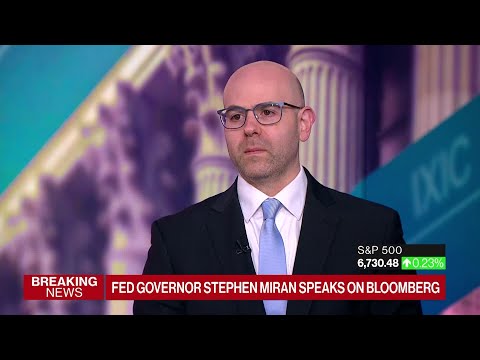
Fed's Miran Says He's Ready to Change His View on Inflation If Housing Jumps
Bloomberg Television· 2025-10-03 14:48
Monetary Policy & Economic Data - The FOMC (Federal Open Market Committee) typically meets every six weeks to vote on monetary policy [3] - Access to high-quality data is crucial for monetary policy decisions, but decisions aren't made daily [2] - The industry emphasizes forward-looking policies, considering future expectations for inflation and output gap [4][17] - Financial conditions are the channel through which monetary policy operates [27] - Monetary policy works with lags, making it inappropriate to solely rely on backward-looking data [16][17] Inflation & Housing - The industry expects a significant disinflation in the services component of inflation indices, driven by shelter costs [7] - Housing costs, particularly rent surges and shelter cost increases, are a major component of inflation indices [5][6] - Immigration shocks have impacted housing rents, initially pushing them up and potentially reversing to negative net migration [35] - Services inflation, particularly driven by housing/shelter costs, is considered the most persistent and sticky part of inflation [33] Neutral Rate & Economic Growth - The speaker's conception of the neutral rate is around 05% (a half), based on a weighted average of model-implied and market-implied rates [9] - Policies like deregulation can expand the potential output of the economy faster than actual output, creating a positive output gap [13][14] - Fiscal deficits in February through August are about $400 billion at an annualized rate below the comparable period in the previous fiscal year [28] Tariffs & Trade - The elasticity of demand in imports is much higher than the elasticity of supply, suggesting foreign producers bear the burden of tariffs [40] - Flat import prices could be due to a weaker dollar offsetting the decrease in dollar prices from tariffs [45] - The speaker compares prices of import-intensive core goods to overall core goods to assess the impact of tariffs on inflation [54]
U.S. Stocks Poised To Extend Recent Upward Trend In Early Trading
RTTNews· 2025-10-03 12:45
Market Overview - Stocks are expected to move higher in early trading, continuing the upward trend seen in recent sessions, with S&P 500 futures up by 0.1 percent [1] - Major averages have reached new record highs despite the ongoing U.S. government shutdown [1] Economic Impact of Government Shutdown - Traders appear to be unconcerned about the economic impact of the shutdown, although Treasury Secretary Scott Bessent warned it could negatively affect U.S. economic growth [2] - Bessent highlighted that the shutdown could lead to a decrease in GDP and impact working Americans [2] - The delay in the release of key U.S. economic data, including the Labor Department's monthly jobs report, is a significant concern for the markets [2][3] Market Sentiment and Predictions - There is an expectation that the government shutdown may last until mid-October, which could hinder the Federal Reserve's ability to make informed interest rate decisions [3] - The ISM's services PMI is anticipated to slightly decline to 51.7 in September from 52.0 in August, but a reading above 50 still indicates growth [4] Stock Performance - Major averages closed higher for the fifth consecutive session, with the Nasdaq up by 88.89 points (0.4 percent), the Dow rising by 78.62 points (0.2 percent), and the S&P 500 increasing by 4.15 points (0.1 percent) [5] - Mixed performance was observed in overseas trading, with Japan's Nikkei 225 Index rising by 1.9 percent and Hong Kong's Hang Seng Index falling by 0.5 percent [5] European Market Trends - Major European markets showed mixed results, with the U.K.'s FTSE 100 Index up by 0.5 percent, while the French CAC 40 Index and the German DAX Index fell by 0.1 percent and 0.2 percent, respectively [6] Commodity Prices - Crude oil futures increased by $0.25 to $60.73 per barrel after a previous decline [6] - Gold futures rose by $17.90 to $3,886 per ounce following a significant drop [6] Currency Exchange Rates - The U.S. dollar is trading at 147.35 yen, up from 147.23 yen, and valued at $1.1730 against the euro, compared to $1.1714 previously [7]
