GDP

Search documents
🔮All-In Crystal Ball: Hot GDP Print in Q2🔥
All-In Podcast· 2025-07-30 19:54
The US economy did grow at a much stronger than expected pace in the second quarter, powered by a turnaround in the trade balance and renewed consumer strength. >> What you're probably going to see in Q2 is a really hot GDP print. If I'm a betting man, which I am, I think the GDP print's going to come in above three.Not quite four, but above three. I said a couple weeks ago that I thought the GDP print was going to come in hot. I think everybody now is sort of where I am.I think it's going to be in the low ...


美联储主席鲍威尔:GDP与我们的预期完全一致,但由于净出口的波动,仍然难以解读。
news flash· 2025-07-30 19:11
Core Insights - The Federal Reserve Chairman Jerome Powell stated that the GDP aligns completely with expectations, but the fluctuations in net exports make it difficult to interpret the overall economic situation [1] Group 1 - The GDP performance is consistent with the Federal Reserve's expectations [1] - Net exports exhibit volatility, complicating the interpretation of economic data [1]
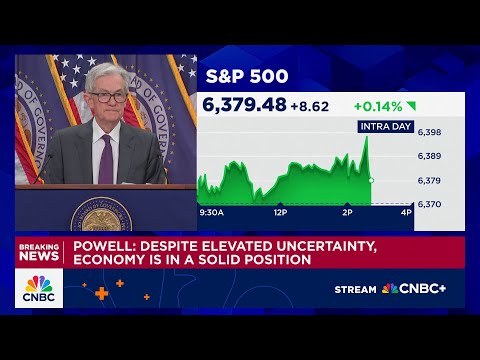
Fed Chair Powell: Labor market is still imbalanced
CNBC Television· 2025-07-30 19:06
Economic Activity & GDP - GDP and Private Domestic Final Purchases (PDFP) numbers aligned with expectations [1] - Economic activity data, including GDP and PDFP, slowed to slightly above 1%, specifically 1.2% for GDP in the first half of the year, compared to 25% the previous year, indicating a slowdown [2] Labor Market - Labor market remains balanced across various statistics, including quits, job openings, and the unemployment rate, similar to levels from a year prior [3] - Job creation is slowing, but so is the supply of workers, maintaining a labor market balance, though this balance is due to declines in both supply and demand, suggesting downside risk [4] - The primary focus is on inflation and maximum employment, with the labor market appearing solid [5] - Downside risks to the labor market are apparent [5] - Equilibrium job growth should be assessed by monitoring the unemployment rate, as both demand and supply for workers are decreasing in tandem [6] Monetary Policy & Inflation - Weakness in interest-sensitive sectors like residential investment and commercial structures raises questions about whether monetary policy is too restrictive [1] - Inflation remains above target, even when excluding tariff effects, justifying the current monetary policy stance [5]
Trump Repeats Call for Interest Rate Cut | Balance of Power : Early Edition 7/30/2025
Bloomberg Television· 2025-07-30 18:57
Live from Washington, D. C. This is balance of power with Joe Matthew and Kaylee Lyons.Counting down to the Fed just an hour away. Welcome to the Wednesday edition. As policymakers prepare an announcement today on interest rates here in Washington that will likely not please the president of the United States.A fresh reading on GDP to take with us into this meeting. I'm Joe Matthew alongside Kailey Leinz in washington. Thanks for joining us.We're about a half hour away, kelly, from our special coverage. And ...

X @Investopedia
Investopedia· 2025-07-30 17:00
The GDP grew at an annual rate of 3% in the second quarter after falling in the first, a swing economists attributed to President Donald Trump's wide-ranging trade war. https://t.co/wQVVpbm5dj ...
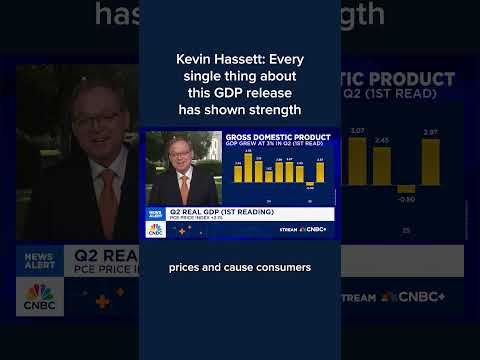
Kevin Hassett: Every single thing about this GDP release has shown strength
CNBC Television· 2025-07-30 17:00
You know, I think if there were a beauty contest for GDP releases that Miss July would probably be very close to the top of the list of the early betting because it got everything for everybody. There's really strong growth, really strong income growth. We've got a huge reduction in government spending, 5% drop in government spending, now 70,000 fewer federal employees.Uh, and we've got 127 billion in tariffs. And so the story, the anti-Trump story has been that we're going to have a recession or a depressi ...
X @GEM HUNTER 💎
GEM HUNTER 💎· 2025-07-30 16:14
RT unusual_whales (@unusual_whales)US Q2 GDP: +3.0%, expected: 2.4% https://t.co/Z5r4T4cHOj ...
Q2 Advance GDP Ticks in Unexpectedly High
ZACKS· 2025-07-30 16:05
Economic Indicators - Pre-market futures show slight increases with Dow up +20 points, S&P 500 up +8 points, and Nasdaq up +50 points, following economic news [1] - ADP reported +104K new private-sector jobs in July, a significant rebound from the revised -23K in June and exceeding the consensus estimate of +64K [3][6] - Q2 GDP growth was reported at +3.0%, surpassing the expected +2.3% and marking a recovery from the -0.5% in Q1 [7][8] Company Earnings - Kraft Heinz (KHC) exceeded bottom-line earnings estimates by +7.8%, reporting 69 cents per share [2] - V.F. Corp. (VFC) reported a smaller-than-expected loss, improving by +31.5% [2] - Etsy (ETSY) missed Zacks consensus estimates by -53.7% [2] Sector Performance - The job growth breakdown shows Goods-producing jobs at +30% and Services at +70%, with Leisure & Hospitality leading at +46K new jobs [4] - Small companies added +12K jobs, while medium and large businesses contributed +46K jobs [5] - The Core PCE Price Index rose to +2.5%, indicating stronger-than-expected economic growth without runaway inflation [8][9] Market Expectations - The Federal Open Market Committee (FOMC) is expected to maintain interest rates at +4.25-4.50% during the upcoming meeting [9] - Anticipation surrounds whether voting members will support or oppose Fed Chair Jerome Powell's stance on interest rates [10] - Major companies like Microsoft (MSFT) and Meta Platforms (META) are set to report earnings after the market closes [11]





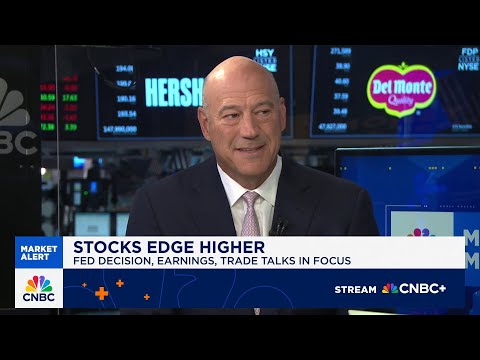
Gary Cohn: Snapshot of the economy looks good, but there are warnings below the surface
CNBC Television· 2025-07-30 16:04
Economic Overview - The economy presents a strong headline snapshot, but closer inspection reveals concerning underlying data [1][2] - GDP reading shows 3%, largely a reversal from the first quarter [1] - The economy is basically at full employment, satisfying one of the Fed's dual mandates [1] Consumer Spending & Investment - Consumer spending is described as "okay" rather than strong [1] - Investment number was down 15% [1] - Consumer-driven companies are not having robust quarters, indicating consumers are feeling the pinch [9] Labor Market - Jolt data indicates a loss of 280,000 jobs in the system [1] - There were 260,000 less hires last month [1] - 150,000 less people quit their jobs, suggesting a less optimistic view of the economy [1] Inflation & Pricing - PCE and CPI numbers were warm, slightly higher than expected, but within an acceptable range [1] - Import numbers offset each other, from -4.7% to +5% [1] - Costs will ultimately be passed down to the consumer, as companies will not decrease their profit margins [4][5] Company Performance Indicators - UPS is a good indicator of e-commerce activity and last-mile delivery performance [8][11] - Starbucks numbers reflect consumer discretionary spending [8] - Whirlpool numbers indicate consumer willingness to upgrade appliances [9]