
Monetary Policy

Search documents
【财经分析】债市利率年内能否继续下攻?市场期盼更多实质利好兑现
Xin Hua Cai Jing· 2025-11-13 07:18
Core Viewpoint - The bond market is experiencing a narrow fluctuation, with the 10-year government bond yield stabilizing around 1.81%, while expectations for monetary easing are increasing due to economic pressures [1][3][5]. Group 1: Market Trends - The interbank bond market yields have shown slight fluctuations, with the 3-month yield around 1.35%, the 2-year yield at 1.43%, and the 10-year yield at 1.81% [3]. - Analysts maintain an optimistic outlook for the bond market, citing the central bank's commitment to maintaining relatively loose financing conditions [3][4]. Group 2: Monetary Policy Expectations - There is a growing expectation for "double cuts" (interest rate cuts and reserve requirement ratio cuts) due to marginal increases in economic recovery pressures and liquidity constraints [5][6]. - The central bank's monetary policy report has shifted focus away from preventing capital idling, indicating a more optimistic stance on future liquidity conditions [3][4]. Group 3: Investment Strategies - Analysts suggest a "barbell" strategy for bond investments, balancing short-term safety with long-term trading opportunities to manage potential market volatility [9]. - The bond market is expected to enter a "chaotic period" with limited space for both bullish and bearish movements, as the market awaits clearer signals for direction [8].
波士顿联储行长Collins倾向于维持利率不变以抑制通胀
Sou Hu Cai Jing· 2025-11-12 21:48
Core Viewpoint - Boston Federal Reserve Bank President Susan Collins suggests maintaining interest rates amid strong growth that may hinder inflation reduction progress [1] Group 1: Interest Rate Policy - Collins indicates that keeping the policy interest rate unchanged for a period may be appropriate to balance inflation and employment risks in a highly uncertain environment [1] - The recent rate cut was described as a "prudent move" aimed at supporting a slowing labor market [1] - The current policy interest rate range of 3.75% to 4% is considered "moderately restrictive," given that inflation remains above the 2% target level [1] Group 2: Inflation Concerns - An increasing number of Federal Reserve officials, including Atlanta Fed President Raphael Bostic, signal that they do not support a quick return to rate cuts, emphasizing that inflation remains a more clear and urgent risk [1]
Boston Fed President Collins: Appropriate to keep policy rates at current level for 'some time'
CNBC Television· 2025-11-12 21:36
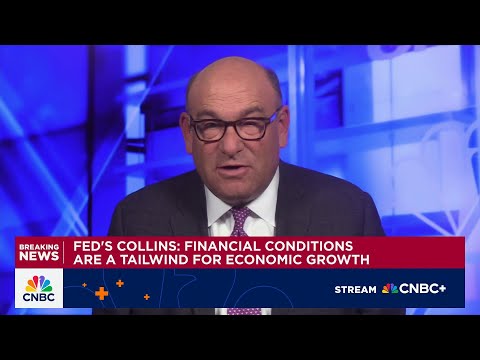
Yeah, interesting comments here from Boston Fed President Susan Collins, who is a voter this year. She's saying it's likely appropriate to keep policy rates at the current level for quote some time. Monetary policy, she says, is mildly restrictive and she wants it there.Talks about financial conditions, usually meaning the stock market, she says they're a tailwind for economic growth and economic activity has been holding up quite well. She says additional monetary support risks slowing or stalling the retu ...

Boston Fed President Collins: Appropriate to keep policy rates at current level for 'some time'
Youtube· 2025-11-12 21:36
Core Insights - Boston Fed President Susan Collins indicates that it is likely appropriate to maintain current policy rates for some time, describing monetary policy as mildly restrictive [1] - Collins highlights that financial conditions are supportive of economic growth, with economic activity remaining robust, but warns that additional monetary support could hinder the return of inflation to the Federal Reserve's 2% target [2] - There is a notable divide among Federal Reserve officials regarding potential rate cuts, with a critical mass opposing immediate cuts or advocating for a more cautious approach [4][6] Monetary Policy Stance - Collins expresses hesitance to ease monetary policy further without clear evidence of labor market weakening, emphasizing the need to assess the impact of previous rate cuts [3] - The current probability of a December rate cut has slightly decreased from 64% to 61% following Collins' comments, indicating market uncertainty [5] Labor Market and Inflation - Collins acknowledges downside risks to employment but notes that these risks have not increased since the summer, suggesting stability in the labor market [2] - The upcoming December inflation report, scheduled for release on December 17th, will be crucial for determining the Fed's next steps [5]

NY Fed's Perli encourages use of Standing Repo Facility to deal with liquidity needs
Yahoo Finance· 2025-11-12 20:54
Core Viewpoint - The Federal Reserve Bank of New York encourages firms to utilize the Standing Repo Facility (SRF) as needed, indicating that large-scale usage is acceptable and expected [1][2]. Group 1: SRF Usage and Economic Context - The SRF is designed to be used whenever it is economically sensible, allowing eligible financial firms to convert bonds into cash quickly to address market liquidity needs [2][5]. - Recent trends show rising money market rates and increased usage of the SRF, signaling tightening market liquidity levels [5][6]. - Despite notable usage in late October, it was less than anticipated, with some firms opting to borrow from markets at higher rates instead of utilizing the SRF [6]. Group 2: Market Dynamics and Future Expectations - The Federal Reserve has been reducing its bond holdings since 2022 to manage market liquidity and maintain control over the federal funds rate [4]. - As Wall Street becomes more familiar with the SRF, its usage is expected to increase, particularly if repo pressures persist or intensify, which would help alleviate upward rate pressure [7].
Atlanta Fed President Raphael Bostic to retire, giving Trump chance for more influence
New York Post· 2025-11-12 18:14
Core Viewpoint - Atlanta Federal Reserve President Raphael Bostic announced his retirement effective February 28, marking an unexpected departure amid President Trump's efforts to increase influence over the Federal Reserve [1][2]. Group 1: Leadership and Background - Bostic is noted as the first black and openly gay leader of one of the Federal Reserve's 12 regional banks, serving for eight and a half years [1][8]. - He holds a PhD in economics from Harvard University and previously worked at the Department of Housing and Urban Development [7]. Group 2: Economic Perspectives and Policies - Throughout his tenure, Bostic emphasized economic equity, particularly following the social justice protests in 2020, although this did not significantly alter his hawkish stance on monetary policy to combat inflation [4][5]. - His leadership was characterized by efforts to represent diverse economic perspectives within the Sixth Federal Reserve District [12]. Group 3: Controversies and Criticism - Bostic faced scrutiny regarding his personal investment activities, which raised concerns about potential conflicts of interest and trading on confidential information [6]. Group 4: Future Implications - A search committee will be established to find Bostic's successor, which may complicate the reappointment process for all regional Fed presidents amid the Trump administration's desire for greater influence [3][10].
BOK Governor Rhee on Policy Path, Market Volatility
Bloomberg Television· 2025-11-12 14:35
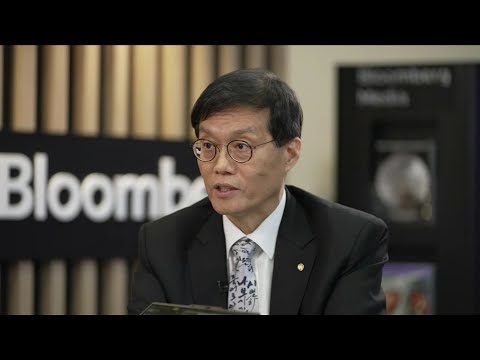
Monetary Policy & Economic Outlook - Bank of Korea believes monetary policy alone cannot control the housing crisis, but is mindful that ample liquidity wouldn't slow the fire [1] - Rate cuts are still on the table due to GDP performing higher than expected and resilient trade [3] - The forecast for this year's growth is 4.9%, well below potential GDP, and 1.6% for next year [4] - The official position is to maintain the easing monetary cycle given the negative output gap, but the magnitude and timing depend on new data [5] - Korea's potential GDP growth rate is probably between 1.8% and 2% due to rapid aging [6] Bond Market & Yields - Bond market yields are reacting not only to domestic factors but also global factors such as the possibility of the US Fed decision and the dollar's movements [7][8] - There is concern that surging yields will affect the monetary transmission mechanism [9] - The Bank of Korea has cut interest rates by 300 basis points since last October and anticipates an easing cycle [9] Trade & Investment - The trade deal between the US and Korea is considered a good development that helps reduce uncertainties regarding tariffs [11] - Implementing the trade deal requires parliamentary approval and enactment of new laws [12] - A commercially viable and win-win program for both the US and Korea is desired, potentially through joint ventures combining US science strengths with Korean application and manufacturing technology [13] - One key focus has been the $350 billion investment fund in the U S [13] Currency & Financial Stability - The Korean market is excessively sensitive to uncertainties affecting the exchange rate, including US stock prices, US economic shutdowns, US Fed policy, and US-China trade relationships [14][15][16] - Depreciation in the Korean Won is hard to judge due to numerous fundamentals [16] - The current level of the Korean Won exchange is mostly dominated by domestic investment abroad, and foreign currency debt level is stable, suggesting no immediate financial stability concerns [18] - The Bank of Korea is willing to intervene if there is excessive movement in the exchange rate [19] Stock Market - Korean stock prices, particularly in the semiconductor industry, are influenced by US technology stock prices, leading to potential volatility [21] - There are concerns about the potential unraveling of high-tech stock prices, especially for domestic retail investors [22] - The price-to-book ratio (PBR) is 1.1%, which is considered below other countries' levels, suggesting the stock market is not significantly overvalued [20]
BOK Governor Rhee on Policy Path, Market Volatility
Bloomberg Television· 2025-11-12 06:28
(Subtitles may contain inaccuracies) We had President Lee saying that the BOK did the right thing when it held rates steady instead of cutting rates because that would boost the property market further. Saying the property market is a ticking time bomb. What's your take on whether or not the property sector is in fact one of the considerations for your monetary policy decisions.Yes. Definitely property prices, especially in metropolitan area and Seoul, affect the financial stability. And price stability is ...

X @Bloomberg
Bloomberg· 2025-11-12 05:21
South Korea's central bank chief signaled that while the central bank remains in an easing cycle, the timing and size of any future rate moves — or the direction of policy — may shift depending on forthcoming data https://t.co/duYSDraNQs ...
Yen stablecoin issuer predicts growing presence in Japan's bond market
Yahoo Finance· 2025-11-12 01:46
By Leika Kihara TOKYO (Reuters) -Stablecoin issuers could become major buyers of Japanese government bonds in several years and influence the central bank's control over monetary policy, the head of Japan's first domestic issuer of yen-pegged stablecoins told Reuters. Japanese startup JPYC began issuing stablecoins pegged to the yen - also called JPYC - on October 27 in a significant move in a country where many consumers still prefer traditional payment methods such as cash and credit cards. The comp ...