劳动教育

Search documents
茶园、鸡舍变身“活课堂”,劳动教育密码这样解
Yang Zi Wan Bao Wang· 2025-05-02 12:10
Core Insights - The article highlights innovative approaches to labor education in rural and urban schools in Jiangsu Province, emphasizing the importance of hands-on experiences and community engagement in fostering students' growth and understanding of their environment [1][11]. Group 1: Labor Education in Rural Schools - In Liyang, students at Hongjian Primary School engage in tea picking, transforming the tea garden into a practical classroom, which promotes labor education as a vital part of their learning experience [2][3]. - The school principal, Yu Qinghe, has restructured the school environment to include various gardens, allowing students to learn through direct interaction with nature, thereby enhancing their understanding of agricultural practices [3][4]. - The integration of a points system for labor activities encourages students to take pride in their work, fostering a sense of responsibility and achievement beyond academic scores [4][10]. Group 2: Labor Education in Urban Schools - At Taizhou's Fenghuang Primary School, students participate in hands-on activities such as building chicken coops and growing plants, which serve as practical applications of their classroom learning [6][7]. - The school incorporates ecological and agricultural education into its curriculum, allowing students to experience the lifecycle of plants and animals, thereby instilling a respect for nature and teamwork [7][9]. - The principal, Liu Weijun, emphasizes that labor education is a means to integrate various subjects, promoting a holistic approach to student development [10][11]. Group 3: Common Themes and Future Directions - Both schools demonstrate that effective labor education transcends traditional academic metrics, focusing instead on personal growth, collaboration, and environmental stewardship [11]. - The article suggests that labor education can help students reconnect with their roots, whether in rural or urban settings, by providing them with meaningful experiences that cultivate their skills and values [10][11].


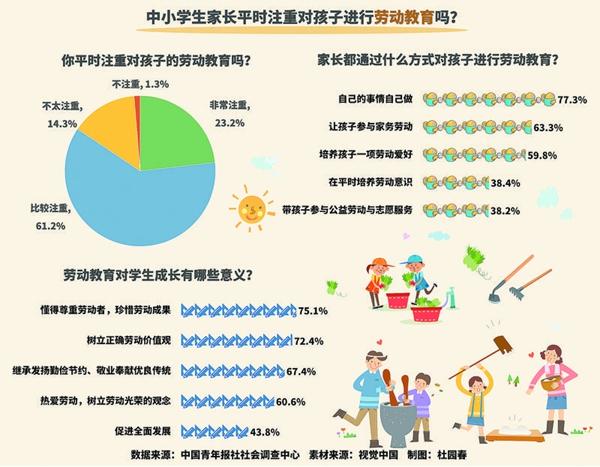
家长如何进行劳动教育 让孩子“自己的事情自己做”
Zhong Guo Qing Nian Bao· 2025-05-01 03:24
Group 1 - The core viewpoint emphasizes the importance of integrating labor education into children's daily lives to instill a sense of respect for labor and appreciation for the fruits of their work [2][6] - A survey conducted by the China Youth Daily Social Survey Center revealed that 84.4% of parents prioritize labor education for their children [2][4] - 77.3% of parents encourage their children to handle their own tasks, such as organizing their rooms, which fosters independence [4][5] Group 2 - Various methods of labor education are employed by parents, including allowing children to participate in household chores (63.3%) and encouraging hobbies related to labor (59.8%) [4] - There is still a significant number of parents who believe that children should focus solely on academic studies, indicating a need for a shift in traditional views on labor education [4][5] - The significance of labor education is highlighted by 75.1% of parents believing it helps children respect laborers and value labor outcomes [6] Group 3 - Labor education is seen as crucial for developing children's independence and self-sufficiency, with parents noting that over-reliance on them can lead to difficulties in adapting to life away from home [5][6] - The psychological benefits of labor education include fostering a sense of responsibility and enhancing parent-child relationships [6] - The broader implications of labor education are tied to national development, emphasizing the need for innovation and addressing core technological challenges [6]
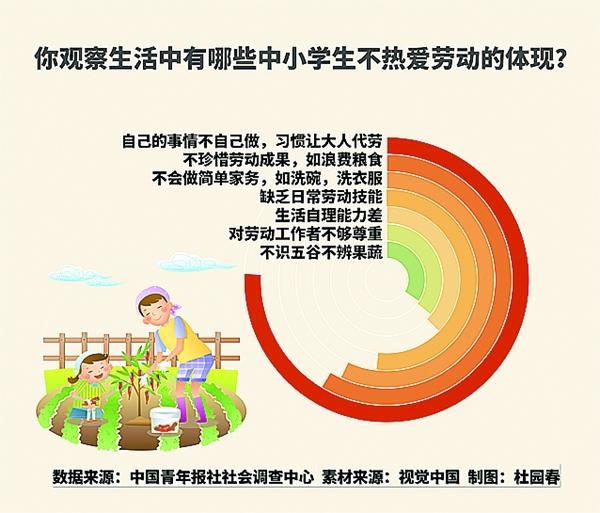
孩子不爱劳动?65.3%受访家长认为一些家长主抓课业不让劳动是主因
Zhong Guo Qing Nian Bao· 2025-05-01 02:06
Core Viewpoint - The article highlights the lack of labor appreciation among middle and primary school students in China, attributing it to parental over-involvement in their children's tasks and a focus on academic performance over labor education [2][5]. Group 1: Survey Findings - A survey conducted by China Youth Daily Social Survey Center involving 1,603 parents of middle and primary school students reveals that 75.7% of parents believe their children do not handle their own tasks and are accustomed to having adults do things for them [3]. - 65.3% of parents attribute the lack of labor appreciation to a focus on academic performance, which leads to neglect of labor education [5]. - Other manifestations of students' lack of labor appreciation include 58.7% of parents noting their children waste food, 57.0% indicating children cannot perform simple household chores, and 51.8% stating a lack of daily labor skills [3]. Group 2: Parental Influence - Many parents take over tasks that children could do themselves, leading to a lack of responsibility among students, as noted by a parent who emphasizes the importance of teaching children to do things independently [4]. - The trend of grandparents spoiling children and prioritizing academic success over labor education is prevalent, with 64.6% of parents indicating that societal emphasis on academic performance diminishes the importance of labor education [5]. Group 3: Educational Environment - The educational environment is also a contributing factor, with 47.5% of parents believing that school labor education is ineffective and 46.8% noting that grandparents' indulgence further exacerbates the issue [5]. - Despite a reduction in academic burden due to the "double reduction" policy, many children still spend most of their time in various learning classes, limiting their opportunities for labor [5].