
居民人均可支配收入

Search documents
2025年全国居民人均可支配收入43377元,增长5%
Guo Jia Tong Ji Ju· 2026-01-19 02:15
国家统计局:2025年,全国居民人均可支配收入43377元,比上年名义增长5.0%,扣除价格因素,实际 增长5.0%。分城乡看,城镇居民人均可支配收入56502元,增长(以下如无特别说明,均为同比名义增 长)4.3%,扣除价格因素,实际增长4.2%;农村居民人均可支配收入24456元,增长5.8%,扣除价格因 素,实际增长6.0%。 ...
去年全年全国居民人均可支配收入43377元
Xin Jing Bao· 2026-01-19 02:13
Core Viewpoint - The report highlights the economic performance of China in 2025, focusing on the growth of disposable income and consumption among residents, indicating a stable economic environment with positive growth rates across different income groups [1] Income Distribution - The national per capita disposable income reached 43,377 yuan, reflecting a nominal growth of 5.0% and a real growth of 5.0% after adjusting for price factors [1] - Urban residents had a per capita disposable income of 56,502 yuan, with a nominal growth of 4.3% and a real growth of 4.2% [1] - Rural residents reported a per capita disposable income of 24,456 yuan, showing a nominal growth of 5.8% and a real growth of 6.0% [1] - The median per capita disposable income for all residents was 36,231 yuan, with a nominal increase of 4.4% [1] - Income distribution among five groups showed low-income households with 10,150 yuan, lower-middle-income with 22,702 yuan, middle-income with 35,536 yuan, upper-middle-income with 55,586 yuan, and high-income households with 103,778 yuan [1] Consumption Patterns - The average per capita consumption expenditure for residents was 29,476 yuan, with a nominal growth of 4.4% and a real growth of 4.4% after adjusting for price factors [1] - The Engel coefficient, which measures the proportion of food, tobacco, and alcohol in total consumption, was 29.3%, a decrease of 0.5 percentage points from the previous year [1] - Per capita expenditure on services grew by 4.5%, maintaining a share of 46.1% in total consumption expenditure compared to the previous year [1]
国家统计局:2025年,全国居民人均可支配收入43377元,比上年名义增长5.0%,扣除价格因素,实际增长5.0%
Mei Ri Jing Ji Xin Wen· 2026-01-19 02:13
每经AI快讯,国家统计局:2025年,全国居民人均可支配收入43377元,比上年名义增长5.0%,扣除价 格因素,实际增长5.0%。分城乡看,城镇居民人均可支配收入56502元,增长(以下如无特别说明,均为 同比名义增长)4.3%,扣除价格因素,实际增长4.2%;农村居民人均可支配收入24456元,增长5.8%, 扣除价格因素,实际增长6.0%。 ...
国家统计局:2025年全国居民人均可支配收入43377元,比上年名义增长5.0%
Guo Jia Tong Ji Ju· 2026-01-19 02:10
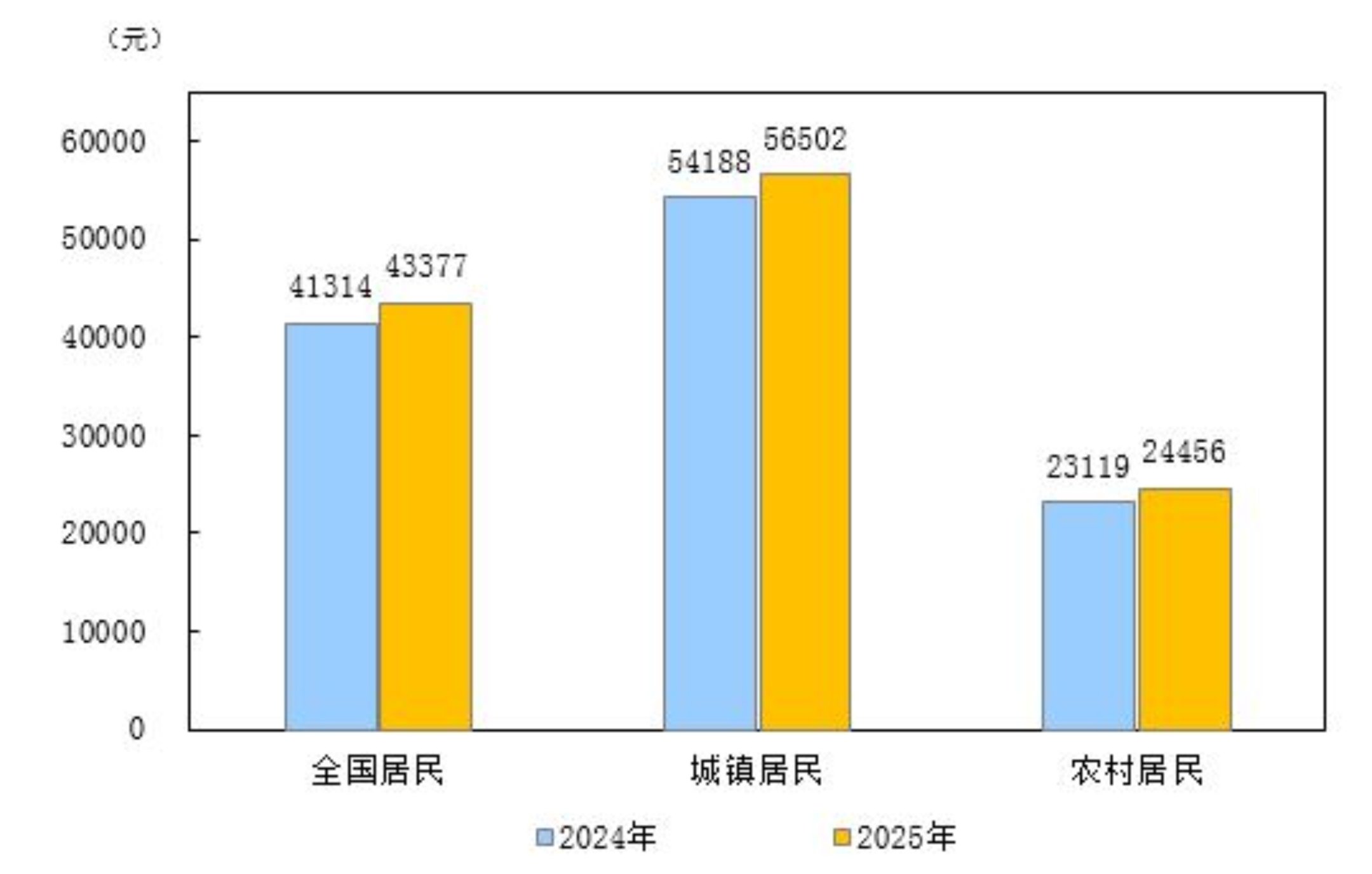
2025年,全国居民人均可支配收入中位数36231元,增长4.4%,中位数是平均数的83.5%。其中,城镇居民人均可支配收入中位数51115元,增长3.7%,中位 数是平均数的90.5%;农村居民人均可支配收入中位数20711元,增长5.6%,中位数是平均数的84.7%。 图1 2025年全国及分城乡居民人均可支配收入 一、居民收入情况 2025年,全国居民人均可支配收入43377元,比上年名义增长5.0%,扣除价格因素,实际增长5.0%。分城乡看,城镇居民人均可支配收入56502元,增长 (以下如无特别说明,均为同比名义增长)4.3%,扣除价格因素,实际增长4.2%;农村居民人均可支配收入24456元,增长5.8%,扣除价格因素,实际增长 6.0%。 按收入来源分,2025年,全国居民人均工资性收入24555元,增长5.3%,占人均可支配收入的比重为56.6%;人均经营净收入7252元,增长5.0%,占人均可 支配收入的比重为16.7%;人均财产净收入3490元,增长1.6%,占人均可支配收入的比重为8.0%;人均转移净收入8080元,增长5.7%,占人均可支配收入的 比重为18.6%。 二、居民消费支出情 ...

五年来石景山区地区生产总值连跨4个百亿台阶
Xin Jing Bao· 2026-01-13 07:01
Core Insights - The core viewpoint of the article highlights the economic growth and development achievements of Shijingshan District over the past five years, with a focus on GDP growth, fixed asset investment, and the modernization of its industrial system [1] Economic Performance - Shijingshan District's GDP has crossed four hundred billion thresholds in the past five years, with an expected annual growth rate of around 6% [1] - The average annual growth rate of general public budget revenue is 6.7%, with tax revenue accounting for over 90% [1] - Fixed asset investment totaled 230.96 billion, with an average annual growth rate of 9.3% [1] Industrial Development - The industrial system has evolved from "1+3+1" high-tech to a modernized system characterized by "leading +特色 + future" [1] - The added value of the digital economy accounts for 57.4% of the GDP, exceeding the city average by 12.4 percentage points [1] Future Goals - The main economic and social development targets for this year include a GDP growth of 5%, general public budget revenue growth of 2%, and a market total consumption growth of around 5% [1] - The fixed asset investment targets are set to meet city-level requirements, with an unemployment rate controlled within 5% [1] - The per capita disposable income of residents is expected to grow in line with economic growth [1]
2025年第三季度青海省城镇、农村居民累计人均可支配收入之比为2.65:1,累计人均消费支出之比为1.82:1
Chan Ye Xin Xi Wang· 2025-10-30 02:58
Core Insights - The per capita disposable income for urban residents in Qinghai Province reached 31,712 yuan in Q3 2025, marking a year-on-year increase of 4.04%, while rural residents' per capita disposable income was 11,963 yuan, with a year-on-year growth of 5.83% [1] - Urban residents' per capita consumption expenditure was 20,900 yuan in Q3 2025, reflecting a year-on-year increase of 2.72%, whereas rural residents' per capita consumption expenditure was 11,500 yuan, showing a year-on-year growth of 4.59% [1] Income Growth - Urban residents' per capita disposable income has shown consistent growth over the past six years in Q3 [1] - Rural residents' per capita disposable income has also demonstrated a steady increase during the same period [1] Consumption Expenditure - The consumption expenditure for urban residents has increased year-on-year, indicating a positive trend in consumer spending [1] - Rural residents' consumption expenditure has outpaced urban residents in terms of year-on-year growth percentage [1]

2025年第三季度西藏自治区城镇、农村居民累计人均可支配收入之比为3.12:1,累计人均消费支出之比为2.86:1
Chan Ye Xin Xi Wang· 2025-10-30 02:58
Group 1 - The core viewpoint of the article highlights the growth in disposable income and consumption expenditure for both urban and rural residents in Tibet Autonomous Region for the third quarter of 2025, indicating a positive economic trend [1] Group 2 - In the third quarter of 2025, the per capita disposable income for urban residents in Tibet reached 45,434 yuan, reflecting a year-on-year increase of 6.24%, while rural residents' per capita disposable income was 14,540 yuan, with a year-on-year increase of 7.33% [1] - The per capita consumption expenditure for urban residents in Tibet was 26,100 yuan, showing a year-on-year growth of 5.99%, whereas rural residents had a per capita consumption expenditure of 9,100 yuan, with a year-on-year increase of 9.52% [1]

2025年第三季度四川省城镇、农村居民累计人均可支配收入之比为2.23:1,累计人均消费支出之比为1.7:1
Chan Ye Xin Xi Wang· 2025-10-30 02:51
Core Insights - The disposable income for urban residents in Sichuan Province reached 37,338 yuan in Q3 2025, marking a year-on-year increase of 4.53%, while rural residents' disposable income was 16,741 yuan, with a year-on-year growth of 5.51% [1] - Urban residents' per capita consumption expenditure was 23,700 yuan in Q3 2025, reflecting a year-on-year increase of 4.71%, and rural residents' consumption expenditure was 13,900 yuan, with a year-on-year growth of 5.61% [1] Income Growth - Urban residents' disposable income has shown consistent growth over the past six years, with a cumulative increase noted from 2020 to Q3 2025 [1] - Rural residents' disposable income has also demonstrated a steady upward trend during the same period [1] Consumption Expenditure - The per capita consumption expenditure for urban residents has increased annually, indicating a positive trend in consumer spending [1] - Similarly, rural residents have experienced growth in their consumption expenditure, suggesting an overall improvement in living standards [1]

2025年第三季度湖南省城镇、农村居民累计人均可支配收入之比为2.33:1,累计人均消费支出之比为1.67:1
Chan Ye Xin Xi Wang· 2025-10-29 03:10
Core Insights - The disposable income of urban residents in Hunan Province reached 38,564 yuan in Q3 2025, marking a year-on-year increase of 4.44%, while rural residents' disposable income was 16,571 yuan, with a year-on-year growth of 5.82% [1] - Urban residents' per capita consumption expenditure was 24,300 yuan in Q3 2025, reflecting a year-on-year increase of 4.11%, and rural residents' consumption expenditure was 14,500 yuan, with a year-on-year growth of 5.69% [1] Income Growth - The disposable income for urban residents in Hunan has shown consistent growth over the past six years, indicating a positive trend in economic conditions [1] - Rural residents have also experienced a steady increase in disposable income, suggesting improvements in rural economic development [1] Consumption Expenditure - The consumption expenditure for urban residents has increased, which may indicate a rise in consumer confidence and spending power [1] - The growth in rural residents' consumption expenditure also points to enhanced purchasing power and economic activity in rural areas [1]

2025年第三季度安徽省城镇、农村居民累计人均可支配收入之比为2.18:1,累计人均消费支出之比为1.5:1
Chan Ye Xin Xi Wang· 2025-10-29 03:10
Core Insights - The disposable income for urban residents in Anhui Province reached 39,508 yuan in Q3 2025, marking a year-on-year increase of 4.54%, while rural residents' disposable income was 18,115 yuan, with a growth of 5.69% [1] - The per capita consumption expenditure for urban residents was 23,400 yuan, reflecting a year-on-year increase of 4.48%, and for rural residents, it was 15,700 yuan, with a growth of 4.67% [1] Income Growth - Urban residents' disposable income has shown consistent growth over the past six years, indicating a positive trend in economic conditions [1] - Rural residents also experienced a steady increase in disposable income, suggesting improvements in rural economic development [1] Consumption Expenditure - The consumption expenditure for both urban and rural residents has increased, indicating a rise in consumer spending and economic activity in the region [1] - The growth rates in consumption expenditure are slightly lower than those in disposable income, which may suggest a cautious approach to spending among residents [1]
