
AI regulation

Search documents
X @The Economist
The Economist· 2025-09-05 00:00
AI Regulation Approach - China's AI regulation is pragmatic and industry-friendly [1] - A "Beijing effect" is unlikely to trigger a race to the top in AI regulation [1]
A top EU policy manager gave Meta a 'Met Most' performance rating in an internal post announcing her departure
Business Insider· 2025-09-03 16:03
Core Insights - A senior EU policy manager at Meta, Christelle Dernon, announced her departure from the company after four years, giving it a "Met Most Expectations" rating in a performance review [1][2] - Dernon played a significant role in campaigns related to the EU's Digital Services Act and Digital Markets Act, and coordinated an open letter on AI regulation signed by over 40 CEOs [2][4] Departure Context - Dernon's exit follows the recent departure of another key figure, Monica Allen, who was the director of public policy campaigns in Europe [3][4] - Both departures occur amid increasing regulatory scrutiny faced by Meta in Europe [4] Regulatory Environment - Meta's chief global affairs officer, Joel Kaplan, criticized the EU's approach to AI regulation, labeling it as an "over-reach" that could hinder AI development in Europe [5][6] - In response to new regulations, Meta announced it would cease accepting paid political, electoral, and social-issue advertising across the EU starting in October [7]



Meta to spend tens of millions on pro-AI super PAC
TechCrunch· 2025-08-26 17:59
Group 1 - Meta plans to launch a super PAC named "Mobilizing Economic Transformation Across California" to support candidates favoring a light-touch approach to AI regulation [1][2] - The company intends to invest tens of millions into this new PAC, with the aim of influencing California's regulatory environment to avoid stifling innovation in AI [2] - Meta's lobbying efforts have previously targeted legislation that could impose stricter regulations on AI firms, such as requiring safety protocol disclosures [2] Group 2 - The new PAC indicates Meta's strategy to influence statewide elections, including the upcoming governor's race in 2026 [3] - Meta has already contributed to various down-ballot candidates from both political parties, showcasing its bipartisan approach to political contributions [3]


X @TechCrunch
TechCrunch· 2025-08-25 15:13
Industry Focus - The AI industry is actively seeking favorable regulation through political action committees [1] - The AI industry aims to oppose candidates perceived as hindering its growth [1] Political Strategy - A new pro-AI super-PAC network, Leading the Future, is using campaign donations [1] - Leading the Future is utilizing digital ads to advocate for its agenda [1]
Trump Releases the US AI Action Plan
Bloomberg Television· 2025-07-23 19:12
Infrastructure & Technology Focus - The document centers on infrastructure, the American technology stack, and the energy required to support it [2] - A key aspect involves removing onerous regulations to facilitate data center development and the energy needed to power them [3] - Building AI globally on the American technology stack is another significant component of the document [4] AI Regulation & Export Strategy - The US aims to set a lighter regulatory tone for AI [6] - Focus is on deploying technology and infrastructure abroad, influencing the relaxation of export curbs on H20 chips from Nvidia to China [6] - Relaxing export curbs on H20 chips from Nvidia to China is seen as a step to enable American companies, especially Nvidia, to compete in China and prevent China from dominating technology exports [6] Implementation & Policy - The success of the policy directives depends on gaining traction with industry, Congress, federal bureaucracy, agencies, and state/local levels [2] - The administration intends to enhance the deployment and export of American technology, including chips, software, and related components [7]

Unpacking Geopolitics Behind the AI Race
Bloomberg Technology· 2025-07-22 19:59
AI Regulation & Geopolitics - Boston Consulting Group's Nikolaus Lang discusses the geopolitics of AI [1] - AI regulation requires a global approach [1] Source & Media - The discussion is featured on "Bloomberg Tech" with Caroline Hyde and Ed Ludlow [1] - Bloomberg Technology can be found on YouTube, X, Facebook, and Instagram [1] - Bloomberg Business is present on X, Facebook, Instagram, LinkedIn, and TikTok [1]

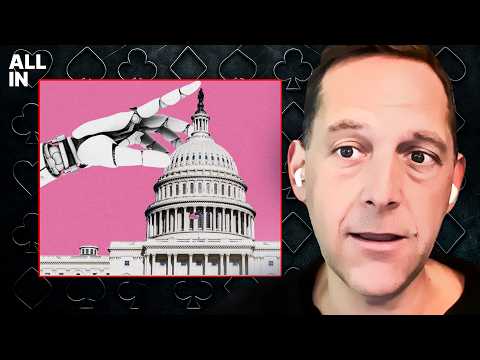
Who Should Control AI? State vs. Federal Law - David Friedberg
All-In Podcast· 2025-07-09 15:00
AI Regulation & Governance - The industry believes AI regulation should occur at the federal level due to interstate and international commerce, and the open internet [2][3] - The industry notes that a patchwork of state regulations on AI model development and deployment would hinder internet service providers and negatively impact consumers and the job market [4] - The industry points out that early state legislation on AI, such as in California, demonstrated a naive understanding of AI technology and its diverse applications [5] - The industry emphasizes that federal AI regulation is critical for job creation, economic improvement, GDP growth, and productivity [6] - The industry expresses disappointment that federal preemption of AI regulation was not included in a particular bill, considering it vital for the US economy [7] - The industry argues that AI is of national security importance and crucial for maintaining technological and economic supremacy, thus requiring federal governance [10][11] - The industry fears that 50 different sets of state regulations on AI would slow down startups and smaller companies, while benefiting a few large incumbents [13] Comparison with Other Issues - The industry differentiates AI regulation from issues like abortion, which are considered individual matters best left to state governance [9] - The industry draws parallels between the current AI regulatory landscape and the historical development of internet regulation, suggesting a need for federal standards [18][19] - The industry contrasts AI regulation with issues like gambling and cannabis, which are currently regulated at the state level, arguing that AI's impact is broader and requires a unified federal approach [14][15]
X @Bloomberg
Bloomberg· 2025-07-01 17:40
AI Regulation - States are actively regulating AI due to federal inaction [1] - States play a crucial role in AI regulation [1]
GOP bill would protect AI companies from lawsuits if they offer transparency
MSNBC· 2025-06-12 10:37
Politics & Policy - Senator Ran Paul was allegedly uninvited to a White House picnic due to his opposition to the budget bill, tariffs, and other Trump policies [1][2] - The uninvitation was described as "petty" and immature [2][3] Broadband & AI Regulation - A budget package includes a moratorium on AI regulation by states for 10 years, potentially impacting broadband funding [6] - States that regulate AI may not receive Broadband Equity, Access, and Deployment (BEAD) funding, which is crucial for closing the digital divide [6] - Broadband is considered essential for the economy, online learning, and emergency services like next-generation 911 [7][8] - The policy is seen as coercively pushing AI legislation by weaponizing infrastructure funding [9] - Concerns exist about the rapid advancement of AI and the potential impact of limiting regulation for several years, especially on children's online safety, consumer fraud, and surveillance [11][12][13] - There is a missed opportunity for Congress to establish regulations for AI [14]

Meta allegedly used pirated books to train AI—US courts may decide if this is 'fair use'
TechXplore· 2025-04-01 16:11
Core Perspective - The article discusses the legal and ethical implications of AI companies, particularly Meta, using copyrighted materials for training their AI models, raising concerns among authors and publishers about intellectual property rights and fair compensation [2][3][5][24]. Group 1: Legal Challenges - Meta is facing a lawsuit in the United States for copyright infringement, with allegations that it used the LibGen dataset, which contains pirated materials, to train its AI models [4][10]. - The legal debate centers on whether mass data scraping for AI training qualifies as "fair use," a legal doctrine that allows limited use of copyrighted works under certain conditions [5][6][24]. - A significant case is The New York Times vs. OpenAI and Microsoft, where the newspaper claims its articles were used without permission for AI training [9][10]. Group 2: Industry Reactions - The Australian Society of Authors has called for regulations requiring AI companies to obtain permission and provide fair compensation to authors for using their works [13][14]. - Various licensing agreements are being established globally between academic publishers and AI companies to ensure creators are compensated while allowing data usage [21][22]. - The Authors Guild argues for a more favorable compensation model for authors, suggesting a 75% share of earnings should go to the author [15]. Group 3: Implications for Creators - The average median full-time income for authors in the U.S. was just over USD 20,000 in 2023, highlighting the financial vulnerability of creators in the face of AI advancements [12]. - The proliferation of AI-generated content poses a threat to original works, making it challenging to distinguish and protect intellectual property [16][17]. - As AI systems often do not cite sources, the value of attribution diminishes, further complicating the landscape for content creators [16]. Group 4: Regulatory Landscape - The European Union's Artificial Intelligence Act of 2024 aims to balance the interests of copyright holders with the need for innovation in AI, though its provisions are considered relatively weak [18]. - In contrast, the U.S. government has not enacted specific regulations for AI, with some officials arguing against excessive regulation [19][20]. - The Australian government has released a voluntary framework emphasizing transparency and fairness in AI systems, but no specific statutes have been enacted yet [23].
