Consumer spending

Search documents
Consumer spending bounced back in October, CNBC/NRF Retail Monitor finds
Youtube· 2025-11-10 13:04
Core Insights - Consumer spending rebounded in October after a decline in September, indicating a strong start for the retail sector in Q4 [2][6] - The retail monitor, based on credit card spending data, showed a 0.6% increase in retail sales excluding auto and gas, compared to a 0.7% decline in September [2][3] - Year-over-year growth rates for core retail sales decreased slightly, with a drop from 5.4% to 5% [3] Sector Performance - Most retail sectors experienced growth, with digital products leading at a 2% increase, followed by clothing and accessories at 1.4% [4] - Restaurants, beverages, and health and personal care sectors also performed well, while building and garden supplies saw a decline of 0.8% [5] Economic Context - Consumer spending remains robust, supported by wage growth exceeding inflation, low unemployment rates, and positive wealth effects from strong stock market performance [6] - Despite mixed economic data, October's performance is seen as a positive indicator for the upcoming holiday season, although historical correlations between October gains and holiday sales are weak [6] Challenges Ahead - Key concerns for the retail sector include the impact of goods inflation, tariffs, and early signs of a cooling job market on holiday shopping [7] - The ongoing government shutdown has affected the release of critical economic data, creating uncertainty about the accuracy and timeliness of upcoming reports [9][10]


Elf Beauty slumps as tariff costs, muted consumer spending hit annual forecasts
Yahoo Finance· 2025-11-05 22:44
Core Insights - Elf Beauty forecasted annual sales and profit below Wall Street estimates due to higher tariff costs and cautious consumer spending, resulting in a 26% drop in shares during extended trading [1] - The company missed expectations for second quarter sales and provided a fiscal 2026 forecast after previously pulling it in May [1] Financial Performance - Elf Beauty expects over $50 million in annual costs from higher U.S. tariffs on imports in fiscal 2026, with China accounting for about 75% of its global production [2] - Gross margin fell approximately 165 basis points to 69% for the quarter ended September 30 [2] - Quarterly adjusted earnings per share were 68 cents, exceeding estimates of 57 cents, following a $1 price increase in August, with no additional price increases planned [3] - Quarterly sales totaled $343.9 million, missing expectations of $366.4 million [4] Market Position and Strategy - The company is streamlining its supply chain and diversifying operations to mitigate tariff impacts, as lower-income shoppers are seeking cheaper alternatives and reducing non-essential purchases [3] - CEO Tarang Amin noted a lack of major product launches compared to the previous year, which had significant success with lip oils [5] Future Outlook - Full-year net sales are expected to be between $1.55 billion and $1.57 billion, below analysts' estimates of $1.65 billion [6] - Adjusted profit is estimated to be in the range of $2.80 to $2.85 per share, also below estimates of $3.58 per share [6]
McDonald's boosts third quarter sales by emphasizing value but warns customers remain pressured
Yahoo Finance· 2025-11-05 12:12
Core Insights - McDonald's experienced a 3.6% increase in same-store sales for Q3, slightly surpassing Wall Street's forecast of 3.5% [1] - The return of Snack Wraps in July significantly boosted U.S. store traffic by 15% on their release day [2] - Q3 revenue rose 3% to $7.08 billion, aligning with Wall Street expectations [3] Financial Performance - Net income increased by 1% to $2.28 billion, with adjusted earnings per share at $3.22, falling short of the $3.33 forecast by analysts [4] - Increased spending on marketing and promotions contributed to the earnings miss, as consumer perception of value becomes critical [5] Competitive Landscape - While McDonald's faced challenges, Taco Bell reported a 7% increase in same-store sales, indicating a strong performance driven by value items [6] - The overall trend shows younger consumers are becoming more cautious with spending, impacting higher-priced fast casual chains [5][6]

Mortgage rates have reached an inflection point, says Frost Bank CEO Phil Green
CNBC Television· 2025-11-03 19:26
Mortgage Lending - Mortgage lending activity saw an inflection point as rates decreased, leading to increased refinancing and home purchases [3][4] - Approximately half of the mortgage lending activity is driven by refinancing, as people seek to adjust rates on adjustable-rate mortgages (ARMs) reaching maturity [3] - A conventional mortgage rate of 5.75% is attracting borrowers [3] Consumer Behavior - Consumer spending is bifurcated, with middle to low-income consumers being cautious and high-income consumers maintaining good spending activity, including automobile purchases [5][6] Interest Rate Expectations - The company expects the Federal Reserve to respond to the economy, particularly potential softness in the labor market, by lowering rates [8][9] Expansion Strategy - The company is not interested in mergers and acquisitions, focusing instead on organic growth, having increased physical locations by 50% in the last five years in Texas markets [10] - The company aims to capitalize on dislocations resulting from mergers by attracting disenfranchised customers and bankers [11]

Americans’ credit scores are falling. Here’s how to fix it
Yahoo Finance· 2025-11-01 09:00
Core Insights - American consumers are experiencing a slight decline in credit scores, with the average score dropping to 715, down two points year over year [1][2] Group 1: Credit Score Trends - The decline in credit scores is attributed to increased delinquencies in auto loans, which have risen by 24% since 2021, and credit cards, which have increased by 48% over the same period [2] - Credit utilization rates have also increased, currently at 35.5% compared to 29.6% in 2021, indicating consumers are using a larger portion of their available credit [2] Group 2: Factors Influencing Credit Scores - The restart of federal student loan collection activities in February has contributed to the decline, with 3.1% of federal student loan borrowers experiencing delinquencies added to their credit reports [3][4] - Outstanding credit card balances reached $1.21 trillion in Q2 2025, a 5.87% increase from the previous year, further driving up credit utilization rates [5] Group 3: Economic Implications - The decline in credit scores may indicate underlying issues in Americans' financial health, potentially leading to a slowdown in consumer spending, which constitutes about two-thirds of U.S. economic activity [7] - Consumers may resort to high-interest financial products, such as credit cards with average interest rates above 21%, to manage expenses, which could exacerbate financial difficulties [8]
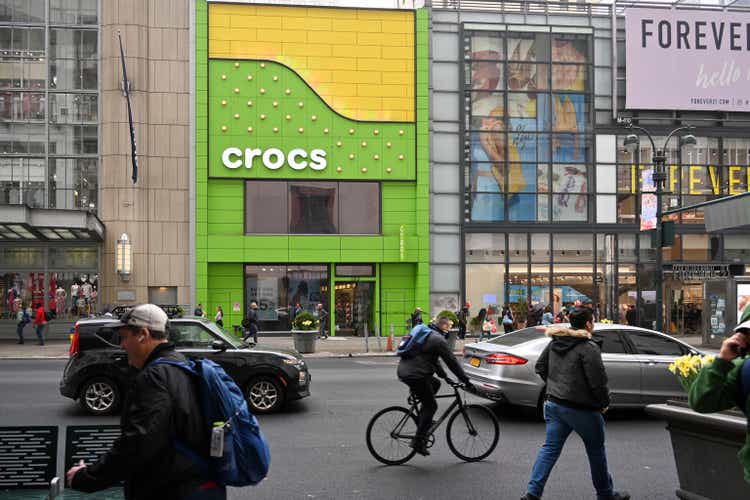
Crocs Stock: Waning Sales, Eroding Margins (Downgrade) (NASDAQ:CROX)
Seeking Alpha· 2025-11-01 03:59
Core Insights - The S&P 500 has remained stable during the early part of the Q3 earnings season, but there is significant underlying volatility, particularly among small- and mid-cap stocks that are more sensitive to declining consumer spending [1] Group 1: Market Performance - The S&P 500 has managed to stay afloat despite high volatility [1] - Small- and mid-cap stocks are experiencing direct exposure to weaker consumer spending, indicating potential challenges ahead [1] Group 2: Analyst Background - Gary Alexander has extensive experience in covering technology companies and has worked in Silicon Valley, providing insights into current industry trends [1] - He has been a contributor to Seeking Alpha since 2017 and has been featured in various web publications [1]

Chipotle Struggles as Customers Skip the Guac
Yahoo Finance· 2025-10-31 10:30
Company Overview - Chipotle's shares dropped over 15% following a quarter with flat same-store sales and declining traffic, marking the third consecutive reduction in annual sales guidance [1] - CEO Scott Boatwright attributed the decline to reduced consumer spending on dining out, particularly among the core demographic of 25- to 35-year-olds, influenced by factors such as unemployment, student loans, and slow wage growth [2][3] Industry Context - The challenges faced by Chipotle are reflective of broader issues within the fast-casual dining sector, with competitors like Sweetgreen and Cava also reporting disappointing earnings and declining same-store sales [5] - Sweetgreen's same-store sales fell by 8%, and Cava's growth has significantly slowed from double-digit increases to nearly zero in Q2 [5] - A KPMG survey indicated that nearly 70% of consumers are dining at home more frequently, with 85% citing cost-saving as the primary reason, and about 40% reporting a decrease in income, which has doubled from the previous year [5]

Bank of America CEO cautions over middle class feeling the 'pinch' as economy faces new threats
Fox Business· 2025-10-28 13:31
Bank of America Chairman and CEO Brian Moynihan cautioned that while the American consumer remains a powerful force keeping the economy afloat, the middle class is beginning to feel the strain. Joining "Mornings with Maria" on Tuesday, Moynihan shared his outlook on the average U.S. consumer and warned the economy could slow down amid the ongoing government shutdown."You're still seeing growth among median income households, at up to … 75,000, 100,000. They're still growing, but they're growing at a slower ...


Deckers Stock Slumps as Hoka Maker Warns of Consumer Pullback Because of Tariffs, Higher Prices
Yahoo Finance· 2025-10-24 15:00
Core Insights - Deckers Outdoor (DECK) shares have dropped significantly, losing more than half of their value in 2025 due to a weaker-than-expected outlook and anticipated consumer pullback [1][6] - The company expects full-year sales to be around $5.35 billion, which is below analyst consensus [2] - The CEO indicated that the full impact of tariffs and price increases will lead to a more cautious consumer environment in the U.S. [3] Financial Performance - Deckers reported earnings per share of $1.82 for the fiscal second quarter, with revenue increasing by 9.1% year-over-year to $1.43 billion, surpassing analysts' expectations [5] - Ugg brand sales rose by 10.1% to $759.6 million, while Hoka brand sales grew by 11.1% to $634.1 million; however, sales from other brands fell by 26.5% to $57.2 million [5] Market Implications - The increase in tariffs may lead to higher prices for Deckers' products, creating margin pressure and potentially affecting consumer spending more broadly [4] - The company's current-quarter outlook has missed analysts' estimates, raising concerns about future performance [6]

Best Buy Stock: Where's The Growth?
Forbes· 2025-10-21 13:30
Core Insights - Best Buy has experienced a significant decline in stock value, losing about 20% over the past year, while the S&P 500 has increased by 13% [2] - The disparity in performance is attributed to margin pressures, decreasing consumer demand, and broader retail challenges [2][4] Financial Performance - Comparable store sales dropped by 0.7% in Q1 FY26, with a slight recovery of 1.6% growth in Q2, but gross profit margins decreased due to a higher proportion of lower-margin products [3] - Revenues have decreased by 2.2% over the last twelve months, with a three-year average growth rate of -5.4%, compared to the S&P 500's growth rate of 5.3% [7] - Operating margin stands at 4.1% and net margin at 1.9%, both significantly below market averages [7] Market Environment - Best Buy is facing a challenging environment characterized by curtailed discretionary spending and slim margins, where even minor price increases can drive customers to seek alternatives online [4] - Historical data shows that during economic downturns, Best Buy's stock tends to decline more severely than the broader market, as seen during the 2022 inflation crisis and the 2008 financial crisis [9][10] Risk Factors - Ongoing tariff challenges from imports are leading to margin compression, which may necessitate price increases that could further decrease sales in discretionary categories [11] - The company is experiencing weak growth, with a projected 5% revenue contraction over three years and slow quarterly growth [11] - Competitive threats from online and big-box retailers like Amazon, Walmart, and Target are exerting pricing pressure on Best Buy [12] Potential Downside - If macroeconomic or company-specific challenges escalate, Best Buy could face an additional 30-40% decline in stock value, reflecting its historical volatility during downturns [13] - The current stock price may appear undervalued, but weak growth, diminishing margins, and sensitivity to consumer spending expose the company to significant risks [13] Conclusion - Best Buy remains a well-known brand with solid cash reserves and moderate debt, but it is not positioned as a resilient growth stock [14] - The company's performance is likely to suffer disproportionately during market downturns, raising concerns about the potential impact on investor portfolios [14]