
Decarbonization

Search documents
Safe Bulkers(SB) - 2025 Q1 - Earnings Call Transcript
2025-05-20 15:02
Financial Data and Key Metrics Changes - The adjusted EBITDA for Q1 2025 was $29.4 million, down from $64.3 million in Q1 2024, indicating a significant decline in profitability [18] - Adjusted earnings per share for Q1 2025 were $0.05, compared to $0.20 in the same period last year [18] - Average daily time charter equivalent decreased to $14,655 in Q1 2025 from $18,158 in Q1 2024 [19] - Daily vessel operating expenses increased by 6% to $5,765 in Q1 2025, up from $5,442 in Q1 2024 [19] Business Line Data and Key Metrics Changes - The company operated an average of 46 vessels in Q1 2025, compared to 47 vessels in Q1 2024 [19] - The charter market for Capesize vessels is currently weaker, with average rates around $23,000, compared to $16,000 on the spot market [13] Market Data and Key Metrics Changes - The global drybulk demand is forecasted to decline by 1% to 0% in 2025, with a potential recovery of 1.5% to 2.5% in 2026 [11] - China's GDP growth is projected at 4% for 2025 and 2026, while India is expected to grow at 6.2% during the same period, impacting drybulk demand [12] Company Strategy and Development Direction - The company is focused on maintaining a strong balance sheet, operational excellence, and environmental performance in line with IMO regulations [5] - The fleet renewal strategy includes taking delivery of six newbuilds by Q1 2027, which are positioned to meet stringent greenhouse gas targets [9] - The company aims to leverage its majority Japanese-built fleet for energy efficiency and lower CO2 taxation [17] Management's Comments on Operating Environment and Future Outlook - The management noted a softer charter market due to seasonality, geopolitical uncertainties, and tariff concerns affecting global trade [4] - There is an expectation of continued supply growth outpacing demand, which may pressure freight rates [12] - The management remains cautious about further share repurchases, indicating that market conditions will dictate future actions [24][28] Other Important Information - The company declared a $0.05 dividend per share, marking the fourteenth consecutive quarterly dividend [13] - The company completed a share repurchase program of 3 million shares, maintaining a healthy cash position of around $122 million [20] Q&A Session Summary Question: Thoughts on future share buybacks given market conditions - Management indicated that buybacks depend on market conditions and stock price, suggesting they may initiate buybacks if the stock price remains depressed [24][25] Question: Current state of the sale and purchase market for ships - Management noted that S&P values for older ships have dropped around 25% and 10-15% for modern ships, making it unattractive to buy ships at this time [27] Question: Status of Capesize vessels and future chartering strategy - Management stated that they prefer to trade in the spot market unless period employment rates exceed $20,000, indicating a cautious approach to chartering [34][35]

Safe Bulkers(SB) - 2025 Q1 - Earnings Call Presentation
2025-05-20 12:38
Market Overview - The IMF projects global GDP growth of +2.8% for 2025 and +3% for 2026[32] - Global inflation is estimated at 4.3% for 2025 and 3.6% for 2026[32] - Dry bulk demand is expected to be 0% in 2025 and +1.5% in 2026[32] - The orderbook represents 11% of the existing dry bulk fleet[18] Company Performance - The company declared a $0.05 per share quarterly dividend[46] - The company repurchased 3 million common shares[46] - Net revenues were $64.3 million for the quarter[46] - The company's consolidated leverage is 37%[46, 57] Financial Strength - The company has $128 million in cash[55] - Contracted revenues stand at $203 million[55] - The estimated fleet scrap value is $317 million[55, 56]
Plug Power’s GenEco Electrolyzers Power Live Customer Demos at The Green Box Innovation Hub
Globenewswire· 2025-05-20 11:00
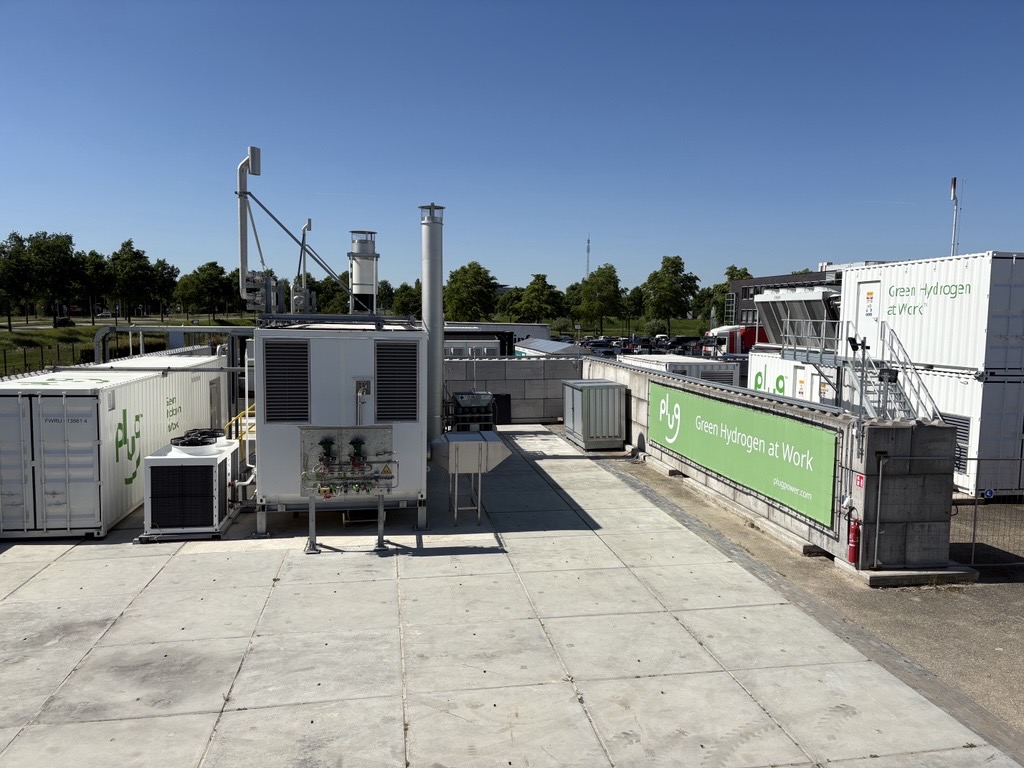
Core Insights - Plug Power Inc. has successfully operationalized its GenEco electrolyzer systems at The Green Box in the Netherlands, showcasing its capabilities to European customers [1][3] - The GenEco platform is designed for flexible deployment in various industrial applications, including refining, sustainable aviation fuel, and green ammonia production [2] - The establishment of a live demonstration site is a strategic move to bolster confidence in Plug's technology and facilitate ongoing commercial discussions in Europe [3] Company Developments - The Green Box serves as a hub for innovation and customer showcase, enhancing Plug's presence in the European market [5] - Plug Power's electrolyzer opportunity pipeline exceeds $21 billion for 2025 and 2026, supported by initiatives like the EU Green Deal and RePowerEU [5] - The site features advanced energy infrastructure, including a 6 MW public grid connection and a 10 kV network, with over 18,000 solar panels meeting most of its electricity needs [4] Technology and Operations - The 5 MW GenEco system has demonstrated successful hydrogen production, primarily powered by on-site solar energy, highlighting economic advantages [3] - Plug Power has deployed over 72,000 fuel cell systems and 275 fueling stations globally, leading in hydrogen production [7] - The company operates hydrogen plants in Georgia, Tennessee, and Louisiana, producing 40 tons of hydrogen per day [7]


Global Ship Lease(GSL) - 2025 Q1 - Earnings Call Presentation
2025-05-19 14:22
Financial Performance - Revenue increased to $191 million in 1Q 2025, up from $179.6 million in 1Q 2024[16, 27] - Net income increased to $121 million in 1Q 2025, up from $89.5 million in 1Q 2024[16, 27] - Adjusted EBITDA increased to $132.3 million in 1Q 2025, up from $125.4 million in 1Q 2024[16, 27] - Normalized net income increased to $94.3 million in 1Q 2025, up from $89.1 million in 1Q 2024[16, 27] Contract Coverage and Revenue - $352 million in contracted revenues were added in 1Q 2025[16, 20, 66] - Contract cover is 93% for 2025 and 75% for 2026[16] - Contracted revenues as of March 31, 2025, were $1.87 billion with an average remaining contract cover of 2.3 years[20] Capital Allocation and Debt Management - The annualized dividend increased to $2.10 per share[16, 21, 22, 66] - $85 million re-fi pushes weighted average debt maturity to 5.1 years & cost to 3.99%[27, 66] - Average break-even cash flows reduced to $9,314 per vessel per day[66] Fleet and Market Dynamics - Sub-10,000 TEU vessels are the focus, serving non-mainlane trades which constitute approximately 74% of global containerized trade volume[43] - Red Sea disruption has absorbed approximately 10% of effective global capacity[45] - The orderbook to fleet ratio for the company's focus segments (2,000 – 9,999 TEU) is 11.5%[63]

ZIM Integrated Shipping Services .(ZIM) - 2025 Q1 - Earnings Call Transcript
2025-05-19 13:02
Financial Data and Key Metrics Changes - The company generated revenue of $2 billion in Q1 2025, representing a year-over-year increase of 28% [7][17] - Net income for the first quarter was $296 million, compared to $92 million in Q1 2024 [22] - Adjusted EBITDA was $779 million with a margin of 39%, and adjusted EBIT was $463 million with a margin of 23% [8][22] - The average freight rate per TEU was $1,776, a 22% increase year-over-year [18] - Free cash flow in Q1 totaled $787 million, significantly up from $3 million in the previous year [18] Business Line Data and Key Metrics Changes - The company carried 944,000 TEUs in Q1 2025, a 12% increase from 846,000 TEUs in the same period last year [23] - Total revenues from non-containerized cargo were $114 million, slightly up from $111 million in Q1 2024 [18] Market Data and Key Metrics Changes - Transpacific volume grew by 11% in Q1 2025, while Latin America saw a notable 22% year-over-year volume growth [23] - The company anticipates low single-digit volume growth year-over-year for 2025, adjusting from previous expectations [26][50] Company Strategy and Development Direction - The company is focusing on maintaining flexibility in fleet deployment and enhancing business resilience in response to changing market conditions [10][12] - A recent charter agreement for ten LNG dual fuel container ships is part of the strategy to modernize the fleet and meet growing demand for eco-friendly shipping solutions [14] - The company is committed to ESG initiatives, having reduced carbon intensity by 35% in 2024 compared to the 2021 baseline [15] Management's Comments on Operating Environment and Future Outlook - Management expressed cautious optimism regarding the recent suspension of tariffs between the U.S. and China, viewing it as a positive development for cargo movement [4][5] - The company remains vigilant about geopolitical and macroeconomic uncertainties impacting trade, particularly in the Transpacific market [5][9] - Full-year guidance for adjusted EBITDA is maintained between $1.6 billion and $2.2 billion, reflecting high uncertainty in global trade [9][25] Other Important Information - The company declared a dividend of $0.74 per share for a total of $89 million based on Q1 results, consistent with its dividend policy [8][78] - The fleet transformation program has significantly improved operational efficiency, with approximately 40% of the fleet now LNG-powered [15][22] Q&A Session Summary Question: What are you hearing from customers regarding inventory levels and expectations for peak season? - Management noted that recent tariff changes have revitalized demand, with customers eager to move cargo quickly to avoid inventory shortages [35][36] Question: What is the current status of the Red Sea transit situation? - Management indicated that safety concerns remain high, and they will not return to the Red Sea until it is deemed safe [40][41] Question: Can you provide insight into the Transpacific contract negotiations? - The company confirmed that contract negotiations were affected by market uncertainties, resulting in a 30% contract volume for the upcoming year, similar to last year [44][46] Question: What is the outlook for Q2 profitability? - Management suggested that while Q2 may see increased profitability due to rising demand, uncertainties regarding tariff levels could impact future performance [61][63] Question: How is the company managing its exposure to U.S. port fees for Chinese-built vessels? - The company is actively exploring options to mitigate potential fees by shifting tonnage between trades [59][60] Question: How is the company planning to optimize its cost structure? - Management highlighted ongoing efforts to reduce repositioning costs and invest in digital tools to enhance operational efficiency [75]

ArcelorMittal to Invest 1.2B Euros to Decarbonize Operations in Dunkirk
ZACKS· 2025-05-19 13:00
Group 1: Company Commitment and Investments - ArcelorMittal is dedicated to reducing carbon emissions in France, collaborating closely with the government for support [1] - The company plans to build its first electric arc furnace (EAF) in Dunkirk, with a significant investment of approximately €1.2 billion [4] - A broader investment strategy of €2 billion aims to strengthen ArcelorMittal's presence in France, including recent investments of €254 million for Dunkirk and €53 million for Fos [5] Group 2: Industry Context and Challenges - The European steel sector is facing its most severe downturn since the 2009 financial crisis, leading ArcelorMittal to postpone some decarbonization initiatives [2] - Updated steel safeguard measures effective from April 1, 2025, are seen as a positive step, but a more robust framework is needed to ensure fair competition [3] Group 3: Financial Performance - ArcelorMittal's shares have increased by 17.6% over the past year, contrasting with a 36.7% decline in the industry [6] - For 2025, capital expenditures are projected to be between $4.5 billion and $5 billion, with $1.4 billion to $1.5 billion allocated for strategic growth and $0.3 billion to $0.4 billion for decarbonization projects [7]

ZIM Integrated Shipping Services .(ZIM) - 2025 Q1 - Earnings Call Transcript
2025-05-19 13:00
Financial Data and Key Metrics Changes - The company generated revenue of $2 billion in Q1 2025, representing a year-over-year increase of 28% [6][18] - Net income for the first quarter was $296 million, compared to $92 million in Q1 2024, marking a significant increase [23] - Adjusted EBITDA was $779 million with a margin of 39%, and adjusted EBIT was $463 million with a margin of 23% [7][23] - The average freight rate per TEU was $1,776, a 22% increase year-over-year, although it was 6% lower than the Q4 average [19] Business Line Data and Key Metrics Changes - The company carried 944,000 TEUs in Q1 2025, a 12% increase from 846,000 TEUs in the same period last year, outperforming the market growth of 4.5% [24] - Total revenues from non-containerized cargo, primarily from car carrier services, totaled $114 million, slightly up from $111 million in Q1 2024 [19] Market Data and Key Metrics Changes - Transpacific volume grew by 11% in Q1 2025, indicating a recovery in trade between the U.S. and China [24] - The company experienced a 22% year-over-year volume growth in Latin America during the first quarter, with expectations to further increase market share in this region [24] Company Strategy and Development Direction - The company is focusing on maintaining flexibility in fleet deployment and adjusting service rotations in response to changing market conditions, particularly in the Transpacific trade [10][12] - A recent charter agreement for ten new LNG dual fuel container ships is part of the company's strategy to enhance commercial agility and support long-term decarbonization objectives [14][15] - The company aims to strengthen its presence in Latin America and Southeast Asia to diversify operations and increase resilience against market fluctuations [11][12] Management's Comments on Operating Environment and Future Outlook - Management expressed cautious optimism regarding the recent suspension of tariffs between the U.S. and China, viewing it as a positive development but remaining wary of long-term trade agreements [4][5] - The company maintained its full-year guidance for adjusted EBITDA between $1.6 billion and $2.2 billion, despite uncertainties in global trade and geopolitical issues [8][26] - Management highlighted the importance of agility in responding to market changes and emphasized the need for ongoing investment in fleet modernization and operational efficiency [12][16] Other Important Information - The company declared a dividend of $0.74 per share for a total of $89 million based on Q1 results, consistent with its dividend policy [7][81] - The company reported total liquidity of $3.4 billion as of March 31, 2025 [7] Q&A Session Summary Question: What are you hearing from customers regarding inventory levels and expectations for peak season? - Management noted that recent tariff changes have revitalized demand, with customers eager to move cargo quickly to avoid inventory shortages, suggesting a potential early peak season [36][39] Question: How do you view the situation with the Red Sea and Suez Canal? - Management indicated that safety concerns prevent a return to the Red Sea, despite incentives from canal authorities, and emphasized the importance of a stable network [40][41] Question: Can you provide insight into the Transpacific contract negotiations? - Management explained that uncertainties in the market led to a 70% split between contract and spot volumes, down from an expected 50-50 split [47][49] Question: What are the expectations for volume growth in 2025? - Management adjusted volume growth expectations to low single digits due to slower recovery post-Chinese New Year and changes in partnerships affecting fleet utilization [50][53] Question: How much of your fleet is Chinese-built and what mitigation strategies are in place? - Management stated that nearly half of the fleet is Chinese-built and is exploring options to minimize the impact of potential fees on operations [62] Question: What is the outlook for Q2 profitability? - Management acknowledged the recent increase in demand and rates but cautioned about the uncertainty of how long this momentum will last [64][66]
Infineon gains approval of Science Based Targets initiative for ambitious CO2 emission reduction targets
Prnewswire· 2025-05-15 15:26
Scope 1 and 2 targets meet highest SBTi standard for near-term reduction goals Infineon sets ambitious scope 3 target to further reduce emissions along the supply chain Active work with over one hundred suppliers to further reduce emissionsMUNICH, May 15, 2025 /PRNewswire/ -- Infineon Technologies AG (FSE: IFX) (OTCQX: IFNNY) has reached another milestone in its decarbonization efforts: The Science Based Targets initiative (SBTi) has approved the company's ambitious greenhouse gas emission reduction target ...


C3is (CISS) - 2025 Q1 - Earnings Call Transcript
2025-05-15 15:02
Financial Data and Key Metrics Changes - The company achieved a net income of $8,000,000 for Q1 2025, an increase of 109% from Q1 2024 [3][30] - Net revenues were reported at $5,800,000, a decrease of 41% compared to Q1 2024, primarily due to a decrease in charter rates [3][21] - Cash balance increased by 25% to $15,700,000 from the end of 2024 [4][24] - Adjusted net income decreased by 74% to $1,200,000 compared to Q1 2024 [24] Business Line Data and Key Metrics Changes - The Aframax tanker, Afra Pearl II, contributed approximately 72% to total revenues, with TCE rates 55% lower than Q1 2024 [4][21] - The TCE rates for the entire fleet were 56% lower than the rates for Q1 2024 [4][21] - Voyage costs remained stable at $2,800,000, while vessel operating expenses increased to $2,100,000 from $1,800,000 in Q1 2024 [22] Market Data and Key Metrics Changes - The dry bulk trade is experiencing shifting dynamics influenced by economic trends and environmental pressures, with a forecasted long-term downtrend in the iron ore market [5][6] - Global dry bulk trading ton miles are expected to grow by 1.5% in 2025, lagging behind fleet growth of 3.1% [8] - China's grain imports are expected to slow due to high inventories and policy adjustments [7] Company Strategy and Development Direction - The company aims for disciplined growth through technical assessments and selective acquisitions of non-Chinese built vessels [27][28] - The strategy includes maintaining high-quality fleet standards to reduce operating costs and secure favorable charters [27][28] - The company has no bank debts and has met all CapEx obligations without resorting to bank loans [29][30] Management's Comments on Operating Environment and Future Outlook - The global economic environment in 2025 is characterized by mixed signals, presenting both risks and opportunities for the shipping sector [11][30] - Economic shocks and evolving policy measures are expected to shape the outlook, contributing to a cautious yet dynamic landscape [11][30] - The company is positioned to leverage regional growth drivers and adapt to evolving economic dynamics [31] Other Important Information - The company has increased its fleet by 234% since inception and maintains a focus on high-quality charterers [28][29] - The global Handysize fleet has seen a slight increase, with 3,151 vessels currently in operation [15] - The Aframax LR2 fleet stands at 1,174 vessels, with a significant portion over 20 years of age [17] Q&A Session Summary - No specific questions or answers were documented in the provided content.

C3is (CISS) - 2025 Q1 - Earnings Call Transcript
2025-05-15 15:00
Financial Data and Key Metrics Changes - The company reported a net income of $8,000,000 for Q1 2025, an increase of 109% from Q1 2024 [3][24] - Net revenues were $5,800,000, a decrease of 41% compared to Q1 2024, primarily due to a decrease in charter rates [3][21] - Cash balance increased by 25% to $15,700,000 from the end of 2024 [4][24] - Adjusted net income decreased by 74% to $1,200,000 compared to Q1 2024 [24] Business Line Data and Key Metrics Changes - The Aframax tanker, Afra Pearl II, contributed 72% to total revenues, with TCE rates 55% lower than Q1 2024 [4][21] - The TCE rates for the entire fleet were 56% lower than the rates for Q1 2024 [4][21] - Voyage costs remained stable at $2,800,000, while vessel operating expenses increased to $2,100,000 from $1,800,000 in Q1 2024 [22] Market Data and Key Metrics Changes - The dry bulk trade is experiencing shifting dynamics influenced by economic trends and environmental pressures, with a forecasted long-term downtrend in the iron ore market [5][6] - Global dry bulk trading ton miles are expected to grow by 1.5% in 2025, lagging behind fleet growth of 3.1% [8] - China's grain imports are expected to slow due to high inventories and policy adjustments [7] Company Strategy and Development Direction - The company aims for disciplined growth through technical assessments and selective acquisitions of non-Chinese built vessels [27] - The strategy includes maintaining high-quality fleet standards to reduce operating costs and secure favorable charters [26] - The company has no bank debts and has met all CapEx obligations without resorting to bank loans [28][29] Management's Comments on Operating Environment and Future Outlook - The global economic environment in 2025 is characterized by mixed signals, presenting both risks and opportunities for the shipping sector [10][29] - Economic shocks and evolving policy measures are expected to shape the outlook, contributing to a cautious yet dynamic landscape [10][29] - The company is positioned to leverage regional growth drivers and adapt to evolving economic dynamics [30] Other Important Information - The company has increased its fleet by 234% since inception and maintains a focus on short to medium-term charters and spot voyages [27][28] - The global Handysize fleet has seen a slight increase, with 3,151 vessels currently in operation [14] Q&A Session Summary Question: What are the expectations for the dry bulk market in 2025? - The dry bulk market is expected to face lower demand growth due to various uncertainties, but a relatively balanced supply-demand dynamic is anticipated [9] Question: How is the company managing its fleet and operational costs? - The company maintains high standards of safety and reliability, conducting regular inspections and adopting comprehensive maintenance programs [26] Question: What impact do environmental regulations have on the shipping sector? - Environmental regulations are expected to play a significant role in market dynamics, influencing supply-side conditions and operational practices [8][10]