税收法定原则

Search documents
增值税法实施条例公开征求意见 进一步增强税制确定性和可操作性
Zheng Quan Ri Bao· 2025-08-12 16:12
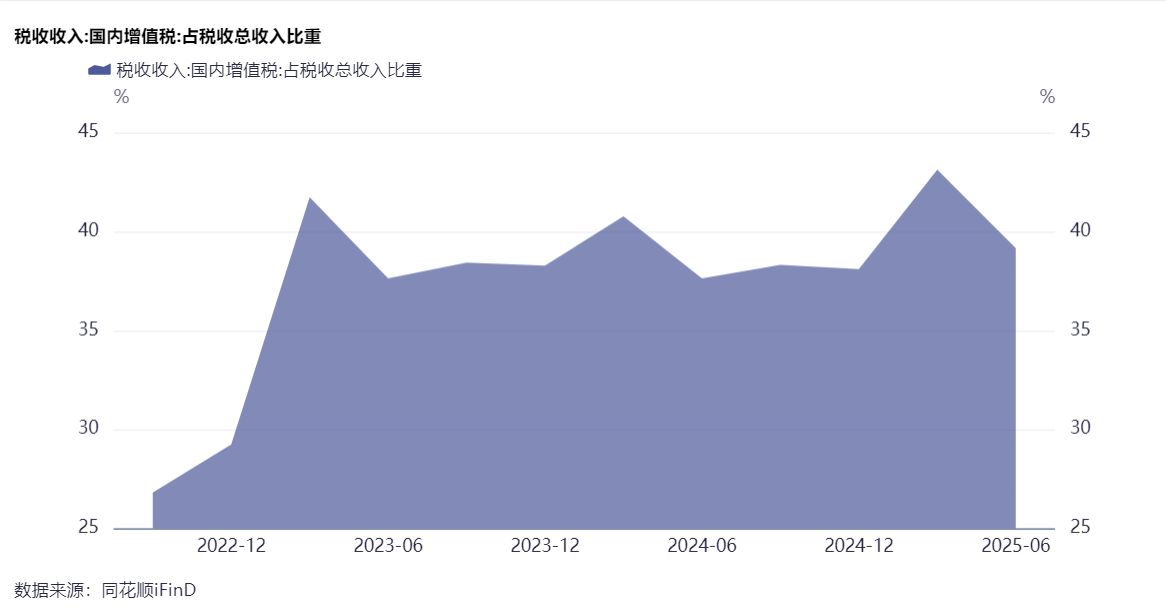
Core Viewpoint - The implementation of the Value-Added Tax (VAT) Law in China, effective from January 1, 2026, represents a significant legal advancement, elevating VAT regulations from administrative to legal status, which is crucial for the enforcement of tax law principles in the country [1][2]. Group 1: VAT Law Implementation - The VAT Law is expected to account for nearly 40% of national tax revenue, with projected VAT income of approximately 6.57 trillion yuan in 2024, representing 38% of total tax revenue [1]. - The Ministry of Finance and the State Taxation Administration released the draft implementation regulations to solicit public opinions, ensuring a smooth transition to the new VAT Law [1]. Group 2: Impact on Taxpayers and Administration - The implementation regulations provide a legal framework for taxpayers, enhancing their rights and offering tax authorities a basis for precise enforcement, thereby improving tax collection efficiency [2]. - The regulations consist of six chapters and fifty-seven articles, detailing tax rates, taxable amounts, tax incentives, and collection management, ensuring alignment with existing VAT policies [2]. Group 3: Tax Incentives and Economic Environment - The regulations clarify the specific standards for VAT exemption projects and outline the scope, standards, conditions, and management measures for tax incentives, ensuring transparency and compliance [3]. - The timely introduction of the implementation regulations is expected to foster a better business environment, enhance market confidence, and contribute to high-quality economic development in China [3].
事关第一大税种! 增值税法实施条例征言
Mei Ri Jing Ji Xin Wen· 2025-08-12 14:19
Core Viewpoint - The implementation of the Value-Added Tax (VAT) Law and its accompanying regulations is expected to significantly impact taxpayers and enhance tax administration efficiency in China [1][2]. Group 1: Implementation and Structure of the VAT Law - The VAT Law will take effect on January 1, 2026, with an estimated revenue of approximately 6.57 trillion yuan in 2024, accounting for 38% of total tax revenue [1]. - The implementation regulations consist of six chapters and 57 articles, detailing aspects such as tax rates, taxable amounts, tax incentives, and collection management [2]. - The regulations aim to provide a stable tax framework, enhancing investor confidence and stabilizing investment expectations [2][3]. Group 2: Clarification of Taxpayer and Tax Scope - The regulations clarify definitions related to taxable transactions, including goods, services, intangible assets, and real estate, which helps avoid disputes between taxpayers and tax authorities [4]. - The classification of taxpayers, including individual businesses and natural persons, is explicitly defined to ensure fair tax burdens across similar transactions [4][5]. Group 3: Efficiency and Adaptability of Tax Administration - Maintaining a mature tax framework reduces compliance costs and operational difficulties for both tax authorities and taxpayers, thereby improving tax administration efficiency [3][5]. - The regulations allow for flexibility in adapting to economic developments and new business models, ensuring that tax administration remains relevant and effective [5][6]. Group 4: Addressing New Business Models and Cross-Border Transactions - The regulations provide clarity on the scope of export goods, cross-border services, and intangible assets, addressing challenges in tax administration related to new business models [6]. - Specific rules for transactions involving multiple tax rates are established, which helps reduce uncertainty for tax authorities and taxpayers alike [6][7]. Group 5: Digital Transformation and Modern Tax Governance - The regulations reinforce the VAT's position as a primary tax source, ensuring stable funding for the government while enhancing tax fairness and governance [7]. - The recognition of electronic invoices as having equal legal status to paper invoices promotes a digital approach to tax management, addressing issues of fraud and traceability [7].
增值税法实施条例公开征求意见,专家解析将如何影响纳税人
Mei Ri Jing Ji Xin Wen· 2025-08-12 04:13
Core Viewpoint - The implementation of the VAT Law and its accompanying regulations is expected to significantly impact taxpayers and enhance the efficiency of tax administration in China [1][2][8]. Group 1: Overview of the VAT Law Implementation Regulations - The Ministry of Finance and the State Taxation Administration have released a draft of the VAT Law Implementation Regulations for public consultation, which will take effect on January 1, 2026 [1]. - The VAT is the largest tax category in China, with an estimated revenue of approximately 6.57 trillion yuan in 2024, accounting for 38% of total tax revenue [1]. Group 2: Impact on Taxpayers - The new regulations aim to provide clear legal frameworks for taxpayers, enhancing their rights and ensuring that tax authorities have a basis for enforcement, thereby improving tax collection efficiency [1][2]. - The regulations will clarify definitions related to taxable transactions, including goods, services, intangible assets, and real estate, which will help reduce disputes between taxpayers and tax authorities [4][5]. Group 3: Stability and Investor Confidence - A stable tax system is crucial for boosting investor confidence and stabilizing investment expectations, which is essential for attracting investment and achieving sustainable business operations [2]. - The regulations maintain the existing VAT framework while enhancing its clarity and operability, which is expected to stabilize social expectations and improve the business environment [2][3]. Group 4: Efficiency and Compliance - The continuity of the tax framework will reduce the costs associated with transitioning to new systems, allowing tax authorities to avoid redesigning tax collection processes and minimizing compliance burdens for taxpayers [3][5]. - The regulations will allow for flexible adaptation to economic developments and new business models, ensuring that tax administration remains relevant and efficient [5][8]. Group 5: Addressing New Business Models - The draft regulations specifically address the taxation of export goods, cross-border services, and intangible assets, providing clarity on applicable tax rates and rules [7]. - There is a call for further refinement of definitions related to new business models, particularly in the digital economy, to prevent disputes arising from ambiguous concepts [6][8].
两部门就增值税法实施条例公开征求意见 明确税制要素助力税收征管
Huan Qiu Wang· 2025-08-12 02:22
Core Viewpoint - The implementation of the "Regulations on the Implementation of the Value-Added Tax Law of the People's Republic of China" aims to enhance tax system certainty and standardize tax collection behaviors, providing a solid foundation for the smooth implementation of the Value-Added Tax Law starting January 1, 2026 [1][3]. Group 1: Tax System Framework - The Value-Added Tax (VAT) is China's largest tax category, with an estimated revenue of approximately 6.57 trillion yuan in 2024, accounting for 38% of the national tax revenue [3]. - The new regulations are designed to clarify and detail the provisions of the VAT Law, enhancing the certainty and operability of the tax system, which is expected to positively impact the business environment and promote high-quality economic development [3][4]. Group 2: Key Provisions of the Regulations - The regulations consist of six chapters and fifty-seven articles, covering general principles, tax rates, taxable amounts, tax incentives, collection management, and supplementary provisions [1][4]. - In terms of general principles, the regulations specify definitions for taxable transactions involving goods, services, intangible assets, and real estate, as well as clarifying the categories of taxpayers [1][4]. - The tax rates section details the scope of zero-rated exports and cross-border sales of services and intangible assets, along with applicable rules for transactions involving multiple tax rates [4]. - The taxable amounts section elaborates on the methods for deducting input VAT, including rules for non-deductible input VAT and adjustments for sales discounts or returns [4]. - The tax incentives section outlines specific standards for VAT exemption projects and the conditions for applying tax incentive policies, ensuring transparency in tax administration [4].

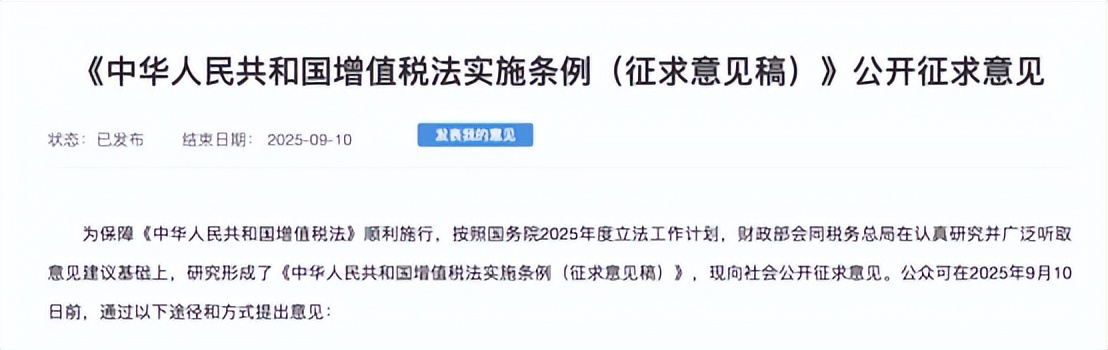
增值税法实施条例公开征求意见 对纳税人、征税范围等税制要素进行细化和明确
Zhong Guo Zheng Quan Bao· 2025-08-11 21:10
Core Viewpoint - The Ministry of Finance has released a draft of the Implementation Regulations for the Value-Added Tax Law to ensure its smooth implementation, highlighting the importance of VAT as the largest tax type in China, projected to generate approximately 6.57 trillion yuan in 2024, accounting for 38% of total tax revenue [1] Group 1: Necessity of the Regulations - The VAT is the largest tax type in China, with significant implications for taxpayers and the economy [1] - The regulations aim to clarify and detail the provisions of the VAT Law, enhancing the certainty and operability of the tax system [1] Group 2: Main Contents of the Regulations - The regulations include six chapters and fifty-seven articles, covering general principles, tax rates, taxable amounts, tax incentives, tax collection management, and supplementary provisions [1] - Definitions of taxable transactions involving goods, services, intangible assets, and real estate are specified [2] - Clarifications on the definitions of taxpayers, including units, individuals, general taxpayers, and small-scale taxpayers, are provided [2] Group 3: Tax Rates and Taxable Amounts - The regulations specify the scope of zero tax rates for exported goods and cross-border sales of services and intangible assets [2] - Detailed rules for deducting input tax amounts, including the scope of non-deductible input tax, are outlined [2] Group 4: Tax Incentives - The regulations clarify the specific standards for VAT exemption projects and the applicable scope, standards, conditions, and tax collection measures for tax incentives [3] - Provisions are made against illegal enjoyment of VAT incentives through false documentation or failure to account for VAT separately [3]
增值税制度再完善 税收优惠标准拟进一步细化
Zheng Quan Shi Bao· 2025-08-11 17:42
Core Points - The Ministry of Finance and the State Taxation Administration released the draft implementation regulations for the Value-Added Tax (VAT) Law on August 11, aiming to enhance the operability of the largest tax category in China [1][2] - The VAT accounts for approximately 38% of total tax revenue, with an income of about 6.57 trillion yuan in the past year, reflecting its significant impact on the economy [1] - The implementation regulations provide detailed provisions on tax rates, taxable amounts, tax incentives, and collection management, thereby ensuring a smoother implementation of the VAT Law set to take effect on January 1, 2026 [2] Summary by Sections VAT Law Implementation - The draft implementation regulations further clarify the VAT Law's provisions on tax rates, taxable amounts, tax incentives, and collection management [1][2] - The regulations specify that certain services, such as international transportation and intangible assets, will be taxed at a zero rate [1] Tax Incentives - The implementation regulations refine the standards for tax incentives supporting agriculture, education, healthcare, and elderly care, including the exemption of VAT for certain educational services provided by registered institutions [2] - The regulations aim to enhance the certainty and operability of the tax system, contributing to a cohesive VAT regulatory framework [2] Legislative Process - The State Taxation Administration is expediting the legislative process for the implementation regulations while also revising the tax collection management law, which is the highest-level procedural law in China's tax legal system [2]
事关第一大税种!增值税法实施条例公开征求意见 专家解析将如何影响纳税人
Mei Ri Jing Ji Xin Wen· 2025-08-11 16:31
Core Viewpoint - The implementation of the "Regulations on the Implementation of the Value-Added Tax Law of the People's Republic of China" is expected to enhance tax certainty and improve the business environment, thereby boosting investor confidence and promoting high-quality economic development [4][11]. Group 1: Overview of the New Regulations - The "Implementation Regulations" will be open for public consultation and are set to take effect on January 1, 2026, following the Value-Added Tax Law [1][3]. - The value-added tax (VAT) is the largest tax category in China, with an estimated revenue of approximately 6.57 trillion yuan in 2024, accounting for 38% of total tax revenue [1][3]. Group 2: Impact on Taxpayers and Tax Authorities - The new regulations will clarify key tax elements such as taxpayers and taxable scope, which will help both taxpayers and tax authorities in their operations [3][5]. - The regulations aim to provide legal clarity for taxpayers, ensuring they have a clear understanding of their rights and obligations, while also enabling tax authorities to enforce laws more effectively [3][4]. Group 3: Stability and Investor Confidence - A stable tax framework is crucial for enhancing investor confidence and stabilizing investment expectations, which is essential for attracting investment and ensuring sustainable business operations [4][11]. - The regulations are designed to maintain the stability of the VAT system and improve its operability, which is expected to foster a better business environment and restore economic vitality [4][11]. Group 4: Clarification of Tax Elements - The regulations will provide detailed definitions for taxable transactions involving goods, services, intangible assets, and real estate, which will help clarify the tax obligations for different types of taxpayers [7][8]. - By clearly defining taxable objects and ensuring similar transactions bear the same tax burden, the regulations aim to promote tax fairness and reduce disputes between taxpayers and tax authorities [7][8]. Group 5: Efficiency and Adaptability - The regulations will allow for flexibility in adapting to economic developments and new business models, which is essential for maintaining effective tax administration [8][10]. - The shift to a registration system for general taxpayers, rather than an approval system, is expected to reduce compliance costs and improve administrative efficiency [8][10]. Group 6: Addressing New Business Models - The regulations will address challenges related to new business models and cross-border transactions, providing clearer guidelines for tax rates and applicable rules [10][11]. - There is a call for further optimization of the regulations to better address the complexities of the digital economy and emerging business models [9][11].
增值税实施条例公开征求意见 为增值税法落地实施提供保障
Zhong Guo Jing Ying Bao· 2025-08-11 15:44
Group 1 - The implementation of the "Value-Added Tax Law" (VAT Law) is a significant milestone in China's tax legal system, set to take effect on January 1, 2026, after extensive public consultation and revisions [1][2] - The VAT Law is expected to provide clearer legal foundations for tax collection, promote tax fairness and legal governance, and support high-quality economic development [2][3] - The "Value-Added Tax Law Implementation Regulations" are being developed to detail and clarify the provisions of the VAT Law, ensuring effective execution of tax policies [2][3] Group 2 - In 2024, VAT revenue is projected to be approximately 6.57 trillion yuan, accounting for 38% of total tax revenue, highlighting the importance of VAT in China's tax system [2] - The VAT Law and its implementation regulations will enhance the certainty and operability of the tax system, forming a cohesive VAT regulatory framework [3] - As of now, 14 out of 18 tax types in China have completed the legislative process, indicating significant progress in tax legal construction [3]
增值税法实施条例公开征求意见!为增值税法落地实施提供保障
Zhong Guo Jing Ji Wang· 2025-08-11 15:01
Core Points - The implementation of the new Value-Added Tax (VAT) Law in China will begin on January 1, 2026, with the Ministry of Finance and the State Taxation Administration releasing a draft for public consultation to ensure smooth implementation and adherence to the principle of tax law [1][2] - The draft includes six chapters and fifty-seven articles, detailing the VAT law's provisions, tax rates, taxable amounts, tax incentives, collection management, and other relevant regulations [1][2] - The draft aims to enhance the certainty and operability of the tax system, maintaining the stability of existing tax policies, particularly regarding the financial sector's treatment under VAT [2][3] Tax Policy Details - The draft clarifies definitions of taxable transactions, including goods, services, intangible assets, and real estate, and specifies the VAT taxable objects [2] - It provides detailed rules for the application of different tax rates and the deduction of input VAT, particularly for financial services, ensuring continuity with previous practices [2][3] - The draft optimizes tax policies to reflect the basic principles of VAT, including the non-deductibility of input VAT for non-taxable activities, aligning with international practices [3] Future Expectations - The successful implementation of the VAT Law is expected to contribute to the construction of a modern VAT system that supports high-quality economic development and the establishment of a unified national market [4]
增值税法实施条例公开征求意见,去年征收超6万亿
第一财经· 2025-08-11 13:31
Core Viewpoint - The article discusses the release of the draft implementation regulations for the Value-Added Tax (VAT) Law in China, which aims to clarify and detail various aspects of the VAT system to enhance its certainty and operability [3][4]. Group 1: Implementation Regulations - The draft implementation regulations consist of six chapters and fifty-seven articles, focusing on general principles, tax rates, taxable amounts, tax incentives, collection management, and supplementary provisions [3][4]. - The regulations aim to provide a stable framework for the VAT system, ensuring better alignment with existing VAT policies and enhancing social expectations [4][5]. Group 2: Taxpayer and Taxable Transactions - The draft clarifies the definitions of taxable transactions, including the sale of goods, services, intangible assets, real estate, and the import of goods, identifying both units and individuals as VAT taxpayers [4][5]. - Specific rules regarding tax rates for exported goods and cross-border sales of services and intangible assets are detailed, including zero tax rates under certain conditions [4][5]. Group 3: Tax Deduction and Exemptions - The draft specifies the rules for input tax deductions, including the conditions under which certain expenses, such as financing-related fees, cannot be deducted from output tax [4][6]. - It also outlines the specific standards for VAT exemptions, such as those applicable to medical services provided by qualified medical institutions, excluding cosmetic medical services [6]. Group 4: Impact on Economic Activities - The implementation of these regulations is expected to standardize the relationship between taxpayers and tax authorities, facilitating compliance and enhancing the efficiency of resource allocation [5][6]. - VAT is highlighted as the largest tax category in China, covering all sectors of the national economy, with projected revenues of approximately 6.57 trillion yuan in 2024, accounting for 38% of total tax revenue [6].