
以数治税

Search documents
两会|全国人大代表,立信会计师事务所首席合伙人、董事长朱建弟:严打资本市场协同造假 完善金融监管与税收治理
证券时报· 2026-03-03 23:56
Core Viewpoint - The article emphasizes the importance of combating third-party collusion in financial fraud within the capital market, advocating for a more robust regulatory framework to enhance financial security and support the high-quality development of the real economy [1][3]. Group 1: Combating Financial Fraud - Financial fraud is described as a significant issue in the capital market, exacerbated by the involvement of third parties such as suppliers and financial institutions, which increases the concealment and harm of such fraud [3]. - Continuous calls have been made for stricter regulations against third-party collusion in financial fraud, with past suggestions leading to improvements in the legal framework, such as the Supreme People's Court's regulations issued in January 2022 [3]. - There is a need for comprehensive accountability for third parties involved in financial fraud, with proposals to enhance legal provisions to ensure that both primary and colluding fraudsters are held liable for investor losses [3]. Group 2: Responsibilities of Accountants - The article discusses the increasing legal risks faced by registered accountants due to intensified regulatory scrutiny on financial fraud, highlighting cases where accountants have faced criminal charges without prior administrative penalties [5]. - It is suggested that regulatory bodies should differentiate between various levels of responsibility for accountants, establishing clear standards for accountability to ensure fair treatment in legal proceedings [5]. Group 3: Modernizing Financial Regulation - The rapid development of the digital economy and financial innovation presents new challenges for traditional financial regulation, necessitating a balanced approach to development and security [7]. - The use of AI tools in regulatory practices is recommended to enhance risk identification and management capabilities, transforming technological tools into effective regulatory measures [7]. - Establishing a global regulatory collaboration mechanism for cross-border financial activities is proposed to mitigate risks arising from regulatory discrepancies among countries [8]. Group 4: Tax Governance Modernization - In the tax domain, there are calls for the acceleration of legal frameworks governing tax information sharing and data governance to improve policy effectiveness and enhance the experience of market participants [11]. - The establishment of a cross-departmental data coordination mechanism is suggested to institutionalize data-driven tax governance, ensuring both efficiency and data security [11]. - The article also highlights the need to revise the Property Management Regulations to address conflicts with the Civil Code and resolve ongoing disputes between property service providers and owners [12].


税收改革蹄疾步稳开新局
Jing Ji Ri Bao· 2026-02-23 23:17
Core Insights - The recent tax work meetings across various regions emphasize the importance of tax collection reforms to support high-quality economic development and improve the business environment [1][2][3] Group 1: Tax Revenue and Economic Support - Tax revenue is crucial for national financial security, providing support for public services and strategic initiatives. In 2025, Hebei is projected to collect 10,250.5 billion yuan in taxes, with a tax revenue of 5,061 billion yuan, marking a 4.2% year-on-year increase, the highest in history [2] - Sichuan's total tax revenue is expected to exceed 16,000 billion yuan, with tax income surpassing 7,200 billion yuan, reflecting a 3.2% growth [2] - Anhui anticipates a total tax revenue of 10,456.9 billion yuan, with tax income reaching 5,404 billion yuan, a 3.5% increase [2] Group 2: Support for Innovation and Manufacturing - Structural tax reductions and incentives are being implemented to support technological innovation and manufacturing, with over 400 billion yuan in tax incentives in Shaanxi and 140 billion yuan in Hainan [2] - Tax authorities are focusing on precise policy implementation and outreach to ensure that tax benefits reach the intended businesses [2][3] Group 3: Tax Governance and Efficiency - Various regions are enhancing tax governance through comprehensive management and data analysis. Beijing aims to strengthen key tax source management and policy implementation [3] - Jilin is promoting effective measures for tax governance, while Jiangxi is focusing on controlling the entire revenue organization process [3] Group 4: Digital Taxation and Innovation - The initiative "Data-Driven Taxation" is being advanced, with regions like Sichuan and Anhui developing data analysis tools to enhance tax governance and compliance [4] - The "Silver-Tax Interaction" program is helping small and micro enterprises access financing through tax credit systems, with significant loan amounts facilitated in various provinces [5][6] Group 5: International Tax Environment - Regions are accelerating reforms to create an international tax business environment, with initiatives in Inner Mongolia and Hainan aimed at enhancing cross-border tax services [7] Group 6: Legal and Fair Taxation - Efforts to combat tax-related crimes and improve regulatory frameworks have been intensified, with various regions implementing new mechanisms to ensure fair tax practices [8][9] - The focus on platform economy regulation is increasing, addressing challenges posed by the gig economy and ensuring compliance [10]
数电发票加速落地 多地发布通知明确2026年推进安排
Zhong Guo Jing Ying Bao· 2026-02-11 13:49
Core Viewpoint - The implementation of fully digital electronic invoices (referred to as "digital invoices") by the State Taxation Administration starting December 1, 2024, aims to enhance administrative efficiency and reduce institutional transaction costs through comprehensive digitalization across all sectors and stages [1]. Group 1: Digital Invoice Implementation - Digital invoices are a new type of invoice that fully digitizes invoice elements, assigns a unified national number, and allows for automatic information flow between tax subjects via digital accounts, holding the same legal validity as paper invoices [1]. - The pilot program for digital invoices began on December 1, 2021, in Guangdong, Shanghai, and Inner Mongolia, gradually expanding to nationwide implementation [1]. Group 2: Tax Administration Reform - The 2026 National Tax Work Conference emphasized the need to deepen tax collection and management reforms, accelerate the revision of tax collection laws, and advance smart tax construction, with digital invoice promotion being a key focus [1]. - Various local tax authorities, including those in Beijing, Shanghai, and Guangdong, have issued announcements detailing the timeline for promoting digital invoices and reducing paper invoices [2]. Group 3: User Experience and Benefits - The transition to digital invoices is expected to significantly improve the experience for users, such as freight drivers, by reducing the time spent on obtaining invoices and eliminating the need for paper [2][3]. - Digital invoices support a wide range of invoice types and industries, allowing for differentiated formats and meeting specific business needs, thus streamlining the invoicing process [3]. Group 4: Cost Reduction and Efficiency - The promotion of digital invoices is projected to lower costs associated with paper printing, mailing, and storage, while also enabling comprehensive tracking and regulatory oversight [3]. - The shift from paper to digital invoices represents a significant upgrade in tax service digitalization and a practical example of modern governance [3].
电商税务合规服务机构选择指南:政策脉络与专业能力解析
Sou Hu Cai Jing· 2026-02-07 04:46
Core Insights - The article discusses the profound changes in tax regulation that e-commerce companies are facing due to the deepening of the "data-driven tax" regulatory system starting in 2025, emphasizing the need for proactive compliance management [1] Group 1: Key Policy Points on E-commerce Tax Compliance - Step 1: Clarify applicable tax types and declaration logic [2] - Step 2: Embrace the new normal of "data-driven" regulation [3] - Step 3: Strengthen compliance in specific scenarios [4] - Step 4: Build an internal control closed-loop system [5] Group 2: Practical Considerations for E-commerce Tax Compliance - Tax obligations include Value Added Tax (VAT) at 13%, Corporate Income Tax at 25%, specific consumption taxes, and customs duties for cross-border transactions [6] - Live streaming revenue should be taxed separately as modern services and sales; cross-border e-commerce follows a "list release, summary declaration" model requiring customs and tax registration [6] - Establish an electronic ledger system to ensure traceability of orders, payments, and logistics data; prioritize electronic invoices to avoid manual entry errors [6] Group 3: Industry Characteristics and Responsibilities - High-frequency, fragmented transactions necessitate real-time data aggregation capabilities rather than end-of-month consolidation [6] - Platforms must establish merchant tax qualification review mechanisms to mitigate joint liability risks [6] - Companies should conduct quarterly tax health self-checks, focusing on compliance in promotional activities [6] Group 4: Choosing Professional Support Institutions - Evaluate the institution's experience in servicing specific e-commerce segments like live streaming and cross-border [7] - Assess the ability to integrate with mainstream e-commerce platforms for automated data processing [7] - Ensure the team continuously tracks local tax execution differences, such as facilitation measures for cross-border e-commerce in Guangdong [7] Conclusion - Tax compliance is not merely a cost burden but an "invisible moat" for sustainable development, with compliance capabilities becoming a core competitive advantage for e-commerce companies [7]

全市税务工作会议在长沙召开
Chang Sha Wan Bao· 2026-02-06 03:21
Core Insights - The tax authority in Changsha has successfully collected over 1 trillion yuan in tax revenue during the "14th Five-Year Plan" period, showcasing the "Changsha speed" in high-quality tax development [1] - The tax system will focus on implementing reforms and enhancing efficiency through various collaborative governance models, including "tax + finance," "tax + judiciary," and "tax + market supervision" [1] - The upcoming "15th Five-Year Plan" will emphasize six key areas for improvement, aiming for excellence in political quality, revenue quality, governance efficiency, service level, grassroots foundation, and team image [1] Group 1 - The tax authority has implemented a risk management system and achieved over 99% coverage of electronic invoices [1] - In the first eleven months, tax incentives for technology innovation and manufacturing amounted to 20.1 billion yuan in tax reductions and refunds [1] - The tax authority has established a comprehensive consultation network and trained over 100,000 individuals annually to improve the tax environment [1] Group 2 - In 2026, the tax authority will focus on strengthening the "Strong Foundation Project" and enhancing the work mechanism for tax management [2] - The authority will implement a new management approach combining household and business tax source management, expanding the coverage of electronic invoices [2] - Continuous efforts will be made to address tax violations and improve the quality of tax revenue through data-driven strategies [2]
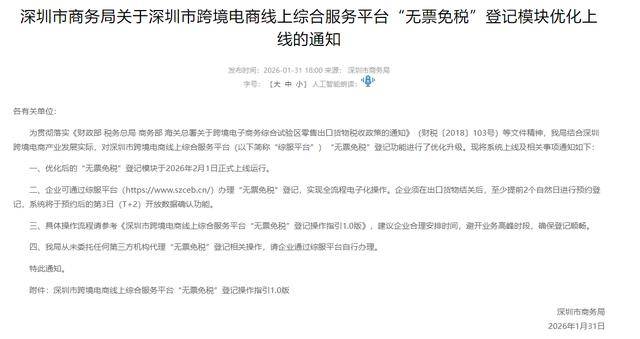
护航企业合规出海!深圳跨境电商“无票免税”登记模块优化上线
Sou Hu Cai Jing· 2026-02-01 13:54
Core Viewpoint - Shenzhen's cross-border e-commerce sector is set to benefit from a newly optimized "no-invoice tax exemption" registration module, enhancing operational efficiency and supporting high-quality industry development [1][2]. Group 1: Policy Implementation - The optimization of the "no-invoice tax exemption" registration module is a concrete measure to implement national tax policies and reflects the commitment to improving the business environment for compliant overseas operations [2]. - This initiative is part of the broader strategy to simplify registration processes and enhance efficiency, allowing companies to more easily access tax benefits [2][5]. Group 2: Operational Efficiency - Companies can now complete the "no-invoice tax exemption" registration through the Shenzhen cross-border e-commerce online service platform, which allows for full electronic processing from appointment to data confirmation, significantly reducing time costs [4]. - Businesses must make an appointment at least two natural days before the export goods are cleared, with data confirmation available on the third day after the appointment [4]. Group 3: Compliance and Industry Development - The "no-invoice tax exemption" policy provides a legal pathway for eligible cross-border e-commerce companies to enjoy VAT and consumption tax exemptions, even without upstream purchase invoices, thus addressing the challenges of export tax refunds [5][6]. - The optimization of the registration module aims to facilitate compliance and transparency in the industry, particularly benefiting small and medium-sized sellers who utilize no-invoice procurement [6]. - With the full implementation of the "no-invoice tax exemption" registration module and ongoing supportive policies, Shenzhen's cross-border e-commerce industry is expected to achieve further compliance, transparency, and efficiency, leading the national transformation wave in the sector [6].
【2025年市直部门核心职能履行创新做法巡礼】滨州财政管理向“数据智能”转型
Xin Lang Cai Jing· 2026-01-27 16:55
Core Insights - The article highlights the innovative practices of the Binzhou Municipal Finance Bureau in transforming fiscal management towards "data intelligence" since 2025, focusing on enhancing efficiency and transparency in budget management, tax source control, and public service delivery [1][5]. Group 1: Budget Management Innovations - The Binzhou Finance Bureau upgraded its budget management to a comprehensive business platform, achieving a closed-loop system for budget execution and accounting, covering 1,388 budget units and processing an average of 3,989 transactions daily [2]. - A fiscal data standard system was established to eliminate data silos between business modules, enhancing data accuracy and improving the scientific allocation of funds [2]. - The Bureau's transparency ranked 14th nationally and 3rd in Shandong Province among 296 cities in the 2025 fiscal transparency report [2]. Group 2: Tax Management Innovations - The Bureau implemented a data-driven approach to tax management, significantly improving fiscal revenue and tax collection efficiency, with both general public budget revenue and tax growth rates ranking among the top in Shandong Province in 2025 [3]. - A digital tax control pilot was launched for gas stations, creating a collaborative governance structure involving tax authorities and big data departments [3]. - A data collection platform was developed to monitor key transaction data in real-time, achieving a 100% software connection rate and a 93.41% hardware connection rate, transitioning tax supervision from manual to data-driven [3]. Group 3: Invoice Management Innovations - The Bureau initiated electronic invoice reforms to streamline the cross-province reimbursement process, recognized as the "Binzhou Experience" and promoted across the province [4]. - The focus was on addressing challenges in medical reimbursements, positioning Binzhou as one of the first pilot cities nationwide to eliminate the need for patients to advance costs [4]. - A collaborative "digital bridge" system was established, completing upgrades for 25 medical institutions and achieving the first national electronic invoice cross-province reimbursement transaction [4].
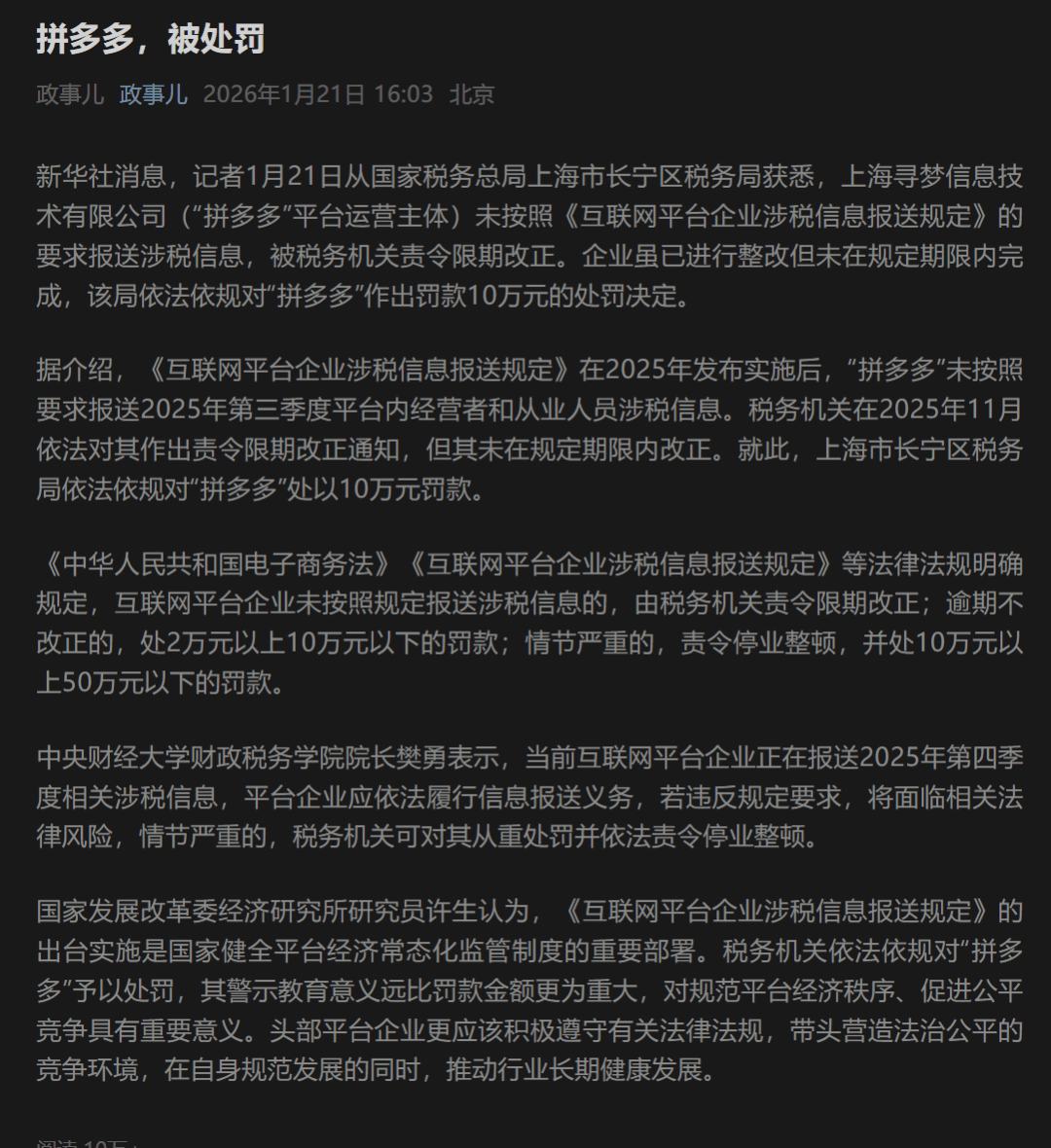
拼多多被罚!下一个可能是即时零售平台!
Sou Hu Cai Jing· 2026-01-27 07:33
Core Viewpoint - The recent fine imposed on Pinduoduo, although seemingly minor compared to its annual revenue exceeding 100 billion, serves as a significant regulatory warning for the entire instant retail industry, highlighting the importance of tax compliance for internet platforms [2][6]. Regulatory Changes - The fine is a direct consequence of Pinduoduo's failure to comply with the newly implemented "Internet Platform Enterprises Tax Information Reporting Regulations," which came into effect in June 2025, marking a shift from traditional tax control to a data-driven approach [4][5]. - This regulation requires all internet platforms to report 12 key tax-related data points quarterly, fundamentally changing the tax responsibilities of platforms and merchants [5][6]. Industry Impact - The instant retail sector has seen explosive growth, with over 50,000 warehouses established by August 2025, but many face survival challenges due to rising operational costs and new tax compliance requirements [8][9]. - The regulatory upgrade aims to eliminate inefficient businesses that rely on tax loopholes, promoting a healthier competitive environment for those that adhere to compliance [9][10]. Compliance Challenges - Despite the new regulations, some merchants continue to seek ways to evade tax obligations, often focusing on the "500 million threshold" to maintain lower tax rates [10][11]. - The platform's control over transaction data makes it difficult for merchants to hide non-compliance, as tax authorities can easily track discrepancies [11][12]. Industry Dynamics - The intense competition among instant retail platforms has led to a cycle of price wars, pushing many merchants to operate unsustainably [12][13]. - Regulatory interventions have been made to curb this internal competition, but the effectiveness of these measures remains in question as platforms continue to prioritize profit over compliance [13][15]. Future Outlook - The recent fine against Pinduoduo is seen as a precursor to stricter enforcement of tax compliance across the industry, signaling that non-compliance will lead to more severe penalties in the future [16][17]. - The industry must adapt to these regulatory changes, as compliance is deemed essential for long-term sustainability and growth [17][18].

融资、审计前必看!重庆哪些代账公司能帮你把“内账”做成“漂亮账”?
Sou Hu Cai Jing· 2026-01-22 03:21
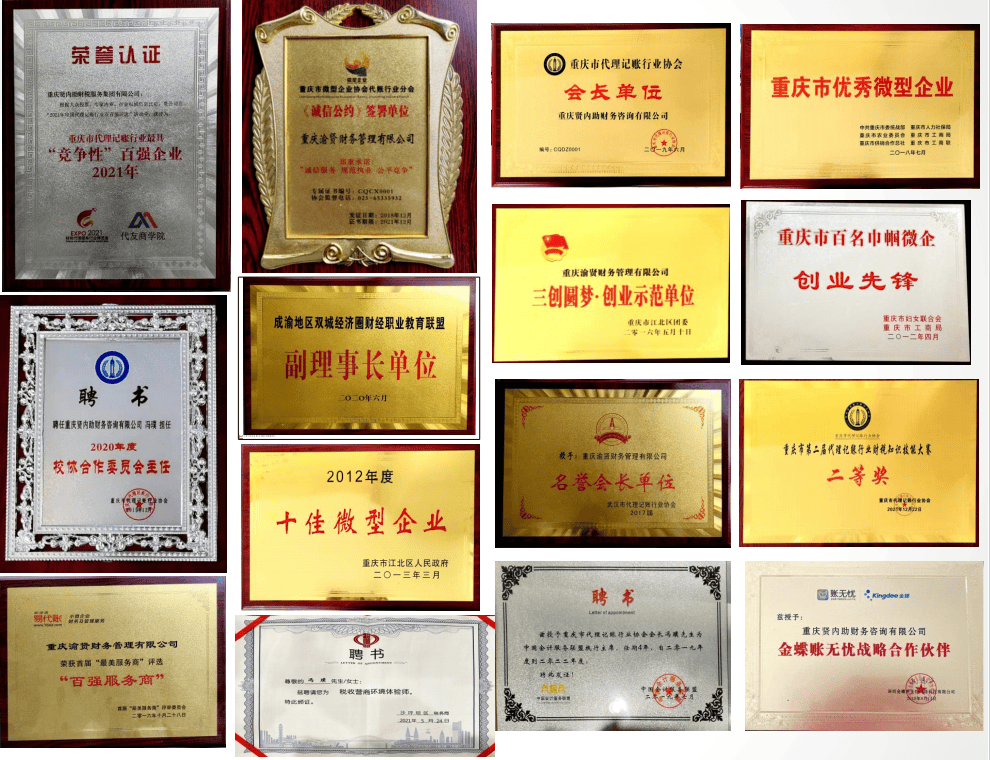
Group 1 - The core viewpoint of the article highlights the transition of tax regulation in Chongqing from "invoice-based tax management" to "data-driven tax management," which imposes significant compliance pressure on over 4 million market entities, particularly small and medium-sized enterprises [1] - Many enterprises still maintain a dual accounting system, with external accounts for tax compliance and internal accounts for actual business operations, which poses risks under digital tax supervision [1][2] - The inability to provide real, complete, and compliant financial data can lead to disadvantages in financing negotiations and missed development opportunities [2] Group 2 - The transformation from non-compliant internal accounts to a professional and compliant financial system, referred to as "beautiful accounts," is essential for many enterprises [2] - A professional "beautiful account" system can accurately reflect a company's profitability, cash flow health, and asset structure, serving as a reliable basis for management decisions and passing third-party inspections [2] - The Xian Neizhu Group has successfully assisted numerous enterprises in Chongqing in transitioning to compliant accounting practices, demonstrating the capabilities of professional institutions in creating "beautiful accounts" [2][3] Group 3 - Xian Neizhu Group helps enterprises eliminate the dual accounting model by thoroughly organizing old accounts and addressing historical issues to establish a fully compliant accounting foundation [3] - The group provides financial restructuring services that meet capital requirements, optimizing cost structures and ensuring accurate financial reporting to enhance financing success rates [3] - Xian Neizhu Group's service model includes a multi-layered support structure with experienced tax professionals and accountants, ensuring that all accounts undergo multiple reviews to meet "audit-friendly" standards [3] Group 4 - The group offers strategic support throughout the enterprise lifecycle, including equity structure design in the startup phase and cost control and tax planning during growth [5] - During the expansion phase, Xian Neizhu provides professional financial support for mergers, acquisitions, and asset divestitures, helping enterprises achieve rapid and safe growth [6] - The collaboration with local universities ensures a continuous supply of skilled financial professionals, enhancing the service quality provided to enterprises [6]
百望股份助力企业构建“以数治税”合规中枢
Zheng Quan Ri Bao Wang· 2026-01-20 12:12
Core Insights - Baidang Co., Ltd. has launched an innovative Group Tax Compliance Insight Platform aimed at transforming tax compliance management from a passive response to a proactive, systematic approach [1] - The platform focuses on "data unification, risk preemption, and closed-loop governance," enabling enterprises to establish a compliance hub suitable for the era of "data-driven tax management" [1] Group-Level Insights - The platform provides a comprehensive "compliance panorama" for management, allowing them to visualize overall tax risk distribution, credit rating changes, risk concentration, and declaration progress [1] - This visualization helps management quickly identify key risk areas and allocate resources proactively rather than reactively [1] Member Unit-Level Insights - At the member unit level, the platform functions as a dynamic "tax health report," enabling self-checks based on tax numbers and monitoring abnormal indicators, pending declarations, and historical rectifications [2] - Compliance becomes a sustainable action integrated into daily operations rather than a one-time task [2] Risk Management Features - The platform includes a risk model and indicator system covering multiple dimensions such as invoices, declarations, finance, and business operations, continuously scanning and scoring tax-related data [2] - It automatically triggers alerts based on risk levels and generates corresponding action tasks, providing a detailed risk anomaly display panel for both groups and member units [2] Intelligent Assistance - The platform incorporates Baidang's intelligent assistant product matrix, which aids tax personnel by providing targeted verification suggestions and response directions based on historical data and regulatory changes [2] - Feedback indicates that the platform has significantly reduced risk identification time from 7 days to real-time and decreased query response time from 36 hours to under 4 hours, while also reducing average workload by 60% and annual tax loss by over 800,000 yuan [2] Comprehensive Solution - The Group Tax Compliance Insight Platform serves as an intelligent BI display for compliance management and integrates tax data services, risk governance capabilities, and AI decision-making into a comprehensive solution [3] - It enables enterprises to see earlier, think deeper, and act more steadily in tax compliance management, transforming it into a long-term operational capability [3]