
Consumption

Search documents
Fed's too restrictive and rates have to come down, says Hayman Capital's Kyle Bass
CNBC Television· 2025-07-30 19:08
Economic Outlook & Monetary Policy - Consumption growth has slowed significantly, from 3% last year to only 1% this year, marking the first two descents since 1993 focused on consumer behavior and the labor market [1] - With inflation around 2-4% and short rates at 43%, the Fed's monetary policy is considered too restrictive, suggesting potential for more rate cuts than the dot plot indicates [1] Geopolitical Risks & US-China Relations - Despite potential diplomatic efforts, both the US and China are reportedly preparing for potential conflict over Taiwan [1] - The exchange of Nvidia H20 chips for rare earth magnets is viewed as a questionable transaction, potentially enabling China's military advancements [1] - Concessions to China are seen as enabling the modernization of their combat forces, particularly in AI capabilities [1] US-Russia Relations & Sanctions - President Trump is setting a deadline for a peace deal between Russia and Ukraine, threatening stricter sanctions if no progress is made [1] - The US has the ability to impose more impactful sanctions on Russia by targeting remaining foreign correspondent banks that facilitate dollar transactions [2][3]

X @The Economist
The Economist· 2025-07-24 19:20
Studies suggest moderate consumption is harmless. It may even be beneficial https://t.co/vNpJcYvBI9 ...
The U.S. Latino cohort is our nation's differentiation as a competitive entity, says Sol Trujillo
CNBC Television· 2025-07-22 12:14
New report showing US Latino GDP reaching $4 trillion dollars. It's about the same size as India if ranked as a world economy. It would come in at number five.The results are based on 2023 data from the Latino Donor Collaborative. Salt Trillo is here. He's the chairman of the Latino Donor Collaborative and founder of the Trillo Group.Uh he joins us with part one of the report. More data is going to be released this fall. Let's talk about the data we know about, but I'm also curious maybe you'll tease us abo ...

Busting the myths about sustainable fashion | Maja Nellström & Matilda Lidfeldt | TEDxGöteborg
TEDx Talks· 2025-07-14 16:20
Environmental Impact of Fashion Industry - The fashion industry is resource-intensive and contributes to climate change and water scarcity [1] - The industry has been focusing on the wrong solutions regarding environmental impact [2] - Textile recycling alone won't solve the fashion industry's environmental problem [4] - Fiber production accounts for only about 10% of the total climate impact of a cotton t-shirt, while yarn to garment production accounts for more than 70% [7] - Scaling up textile recycling in Europe from less than 1% to 10% by 2035 would only decrease the climate impact by less than 1% [9][10] - Decreasing clothing consumption by 10% would directly reduce the climate impact by 10% [10] Consumer Behavior and Transportation - Transports account for about 15% of the total climate impact of a cotton t-shirt [12] - User transport (transport to and from the store) accounts for about 13% of the total climate impact, which is more than the t-shirt's trip across the ocean [14] - Buying secondhand clothes can lower the carbon footprint only if it leads to less consumption of new clothes [19] Recommendations for Consumers - Focus on using what is already in the wardrobe [21] - When shopping for clothes, choose walking, cycling, or public transportation whenever possible [21] - Buy only the clothes that will be used, whether new or secondhand [21] - Buying less is more effective than buying smarter when it comes to fashion and the climate [21]

X @The Economist
The Economist· 2025-07-10 01:20
Studies suggest moderate consumption is harmless. It may even be beneficial https://t.co/3ThskihLE9 ...
China Growth Is on a 'Moderating Trend,' JPMorgan's Ng Says
Bloomberg Television· 2025-06-30 20:05
Economic Outlook - Despite the trade truce, economic numbers appear soft, necessitating a broader perspective [1] - Macro policy improvements in September of last year, along with front-loaded activity in Q1, led to solid data in Q4 of last year and Q1 of this year [2] - The underlying economic momentum is moderating due to trade tariff issues with the US and increasing external uncertainty [2][3] - The baseline expectation is for sequential growth of the Chinese economy to slow from approximately 66% quarter-on-quarter in Q1 to around 35% in Q2, and further to 3% in Q3 [3] - PMI numbers align with expectations of moderating economic momentum [4] Sector Performance - Diverging trends exist across different sectors, with China's exports to the US down 40% in April and May [5] - Sectors receiving policy support, such as training subsidies and equipment upgrades, are performing well [6] - The housing sector continues to be a drag on the economy and has not yet bottomed out [6] - Consumer sentiment outside of policy support areas remains at a historical low [7] Policy Implications - Domestic and consumption support are crucial for policy focus this year [7] - Subsidies for consumer durables and autos have shown some impact, but their effect will fade by year-end [7] - Further policy support, particularly for services consumption, is needed [8]
Jobless claims fall, GDP revised lower, durables orders soar
CNBC Television· 2025-06-26 13:14
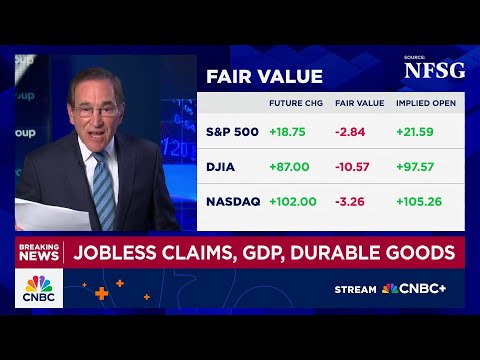
Economic Indicators - Preliminary durable goods orders surged by 164% [2] - Trade balance deficit reached minus 966 billion [1] - Capital good orders non-defense xir increased by 17% [3] - Shipments rose by 05% [4] - Initial jobless claims decreased to 236000, the lowest since mid-year [7] - Continuing claims remained over 1974 million for five consecutive weeks [7][8] GDP and Consumption - First quarter GDP revised to minus 05%, the weakest since Q1 2022 [4][5] - Consumption dropped to 05% from 12% [6] Inflation - Price index increased to 38%, one-tenth higher than 37% [6] - PCE core moved to 35%, one-tenth higher than 34% [6]
美国经济-第一季度 GDP 显示最终私人国内需求疲软
2025-06-02 15:44
Summary of Key Points from the Conference Call Industry Overview - The conference call discusses the U.S. economic outlook, particularly focusing on the first quarter GDP and private domestic demand trends. Core Insights and Arguments 1. **GDP Revision**: The second release of Q1 GDP shows a modest contraction in growth at -0.2%, revised from -0.3%, primarily due to a surge in imports before tariffs [1][3] 2. **Private Domestic Demand**: Final private domestic demand rose by 2.5%, indicating stronger underlying demand than the overall GDP figure, although revisions suggest a softer demand than previously thought [1][6] 3. **Consumption Trends**: Consumption, especially in services, was revised down significantly from 2.4% to 1.7%, with overall consumption growth at 1.2%, the weakest since Q2 2023 [3][7] 4. **Business Investment**: Business investment in equipment was revised modestly higher, reflecting potential front-loading of investments before tariffs, particularly in information processing equipment [4][8] 5. **Residential Investment**: Residential investment contracted by 0.6% in Q1, indicating potential ongoing weakness in the housing market, which could signal broader economic concerns [4][9] 6. **Inflation and Corporate Profits**: Core PCE inflation was revised slightly lower to 3.41%, while corporate profits fell by 11.3% QoQ annualized, marking the largest decline since Q4 2020 [5] 7. **Trade Dynamics**: Trade remains a volatile factor in GDP growth, with expectations that a decline in imports could boost growth, but this may be offset by weaker consumption and investment [10] Additional Important Insights 1. **Front-loading of Purchases**: The increase in goods spending in March was attributed to front-loading purchases before tariffs, particularly in autos, which may not sustain in the following quarters [7] 2. **Future Economic Outlook**: The expectation is for continued weakening in final private domestic demand throughout the year, influenced by higher prices from tariffs and financial concerns [6] 3. **Upcoming Data**: Advance data on goods trade for April is anticipated to provide insights into trade patterns for Q2 [10]