
Employment

Search documents
How AI Is Influencing The Fed's Calculus
Youtube· 2025-12-22 17:00
Economic Outlook - The Federal Reserve anticipates a rapid growth in gross domestic product (GDP) by 2026, faster than previous estimates, potentially driven by advancements in AI and sustained productivity growth [1][2] - Economists suggest that while AI may initially lead to job losses, it is expected to significantly enhance productivity in the long run, with labor productivity potentially increasing by 3 to 4 times [3][4] Labor Market Dynamics - The current labor market is experiencing slow job growth, with a notable decline in both federal and private sector employment, attributed in part to recent economic policies such as reciprocal tariffs [6][7] - The unemployment rate rose to 4.6% in November, with uncertainty surrounding the number of jobs needed to stabilize this rate, indicating a unique situation of low hiring and high layoffs [8][9] Technological Impact - The introduction of AI technologies is expected to follow a J-curve pattern, where initial declines in job growth and efficiency are followed by improvements as businesses adapt and incorporate these technologies [4][5] - Generative AI tools are anticipated to enhance productivity over time, but may also lead to reduced leverage for workers in wage negotiations, particularly affecting middle-tier employees [10][11] Historical Context and Monetary Policy - The current investment trends in AI infrastructure are reminiscent of the late 1990s tech boom, raising concerns about potential irrational exuberance in asset valuations [12] - Historical precedents, such as Alan Greenspan's decisions during the mid-90s, highlight the complexities of managing monetary policy in the face of technological advancements and their implications for the economy [13][14] - The Federal Reserve's approach suggests a focus on addressing the broader economic impacts of AI, rather than attempting to prevent potential market bubbles [15][16]


How AI Is Influencing The Fed’s Calculus
CNBC· 2025-12-22 17:00
Economic Outlook & AI Impact - The Federal Reserve anticipates rapid GDP growth in 2026, exceeding prior forecasts, potentially influenced by AI and increased productivity [1] - Economists project AI could significantly reshape American work, with concerns about job displacement offset by substantial productivity gains [2] - New technologies, including AI, typically cause initial job losses but ultimately drive productivity increases, potentially leading to a 3-4x rise in labor productivity in the long term [3] - AI adoption follows a J-curve pattern, initially causing efficiency and job growth decline, followed by improvement as AI is effectively utilized [4][5] Labor Market Dynamics - The labor market is experiencing slower growth, with job growth declining throughout the year, partly due to federal worker layoffs and private sector reductions [6][7] - The unemployment rate rose to 4.6% in November, and economists are uncertain about the number of jobs needed to prevent further increases [8] - Current low hiring and low firing rates suggest uncertainty in the market rather than a slowdown [9] Monetary Policy & AI - The Federal Reserve's tools are not designed to directly address technological advancements like AI, focusing instead on cyclical versus secular trends [9][10] - AI may lead to lower wages or employment, and lower interest rates may not easily resolve these issues [15] - There's a risk that workers may become more productive but lose leverage in wage negotiations as businesses adapt to AI [11] Historical Parallels & Investor Behavior - The current AI investment boom resembles the late 1990s, with rising price-to-earnings ratios for tech stocks [12] - The Federal Reserve should be prepared to address the implications of asset bubbles for the broader economy and banking system after they burst [15]

What to Watch With Lowe's Stock in 2026
The Motley Fool· 2025-12-20 05:00
Core Viewpoint - Lowe's shares have underperformed compared to the S&P 500 in 2025, raising questions about potential recovery in 2026 [3][4]. Group 1: 2025 Performance - Lowe's share price decreased by 0.1% through December 15, 2025, while the S&P 500 appreciated by 15.6% [3]. - Including dividends, Lowe's total return was 2.8%, significantly lower than the S&P 500's total return of 17.3% [3]. - The company's market capitalization stands at $135 billion, with a current share price of $240.44 [4]. Group 2: Sales and Financial Metrics - Lowe's reported positive same-store sales over recent quarters, but fiscal third-quarter comps only increased by 0.4% [5]. - The increase in comps was driven by higher spending, with the average ticket contributing 3.4 percentage points, while traffic decline accounted for a 3 percentage point drop in comps [5]. - The gross margin for Lowe's is 31.42%, and the dividend yield is 1.95% [4][5]. Group 3: Economic Factors Influencing 2026 - Lowe's sales are closely tied to the overall economy, as consumers are more likely to undertake home improvement projects when they feel economically secure [6]. - Key economic indicators to monitor include new and existing home sales, as these typically lead to increased remodeling projects [7]. - Interest rates, particularly long-term Treasury yields and short-term rates set by the Federal Reserve, will impact mortgage rates and home equity loans, affecting homebuying and renovation financing [8]. Group 4: Employment and Consumer Confidence - Employment trends show signs of weakness, which could deter consumer spending at Lowe's for significant projects [9]. - Consumer confidence is crucial; higher confidence levels typically lead to increased spending, which can boost economic growth [9]. Group 5: Strategic Initiatives - Lowe's is focusing on the professional contractor market, having made significant acquisitions, including Foundation Building Materials for $8.8 billion and Artisan Design Group for $1.3 billion [10]. - Management's commentary on progress in the professional contractor segment and sales growth in this market will be important to monitor [10].


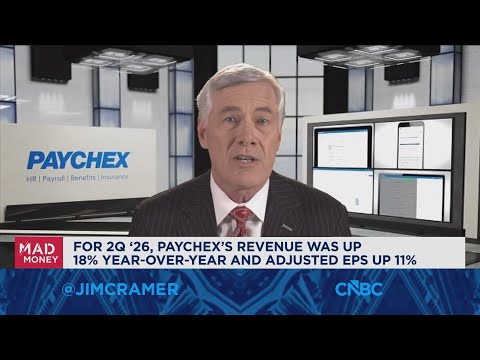
Watch Jim Cramer's full interview with Paychex CEO John Gibson
CNBC Television· 2025-12-20 01:00
Financial Performance - Paychex reported a modest top and bottom line beat, raising the midpoint of the full-year earnings forecast for the second consecutive quarter [1] - The company had 18% revenue growth and earnings per share up 11% [3][4] - Free cash flow increased by 38% year-to-date [4] - Paychex raised earnings per share guidance for the second time this year [5] Strategic Initiatives and Acquisitions - Paychex acquired Pay Corps and fully integrated Paychex Enterprise business into the Pay Corps brand [7][8] - The company expects $100 million in cost synergies for the fiscal year from the Pay Corps integration, raised from an initial commitment of $80 million [9] - The acquisition of Pay Corps has expanded Paychex's market opportunity by $10 billion [10] Market and Industry Outlook - Paychex's full-service HR outsourcing business continues to perform exceptionally well [6] - The company believes it is well-positioned to capitalize on market opportunities, drive growth, expand margins, and strengthen its leadership position in the AI era for human capital management [6][7] - Small business job index has remained relatively stable in 2025, with continued moderation in wage inflation [16] - The company sees continued challenges in the small end of the market in finding qualified employees [17] - Paychex clients are not buying as many ancillary attachment products as expected, which led to some guidance discussions [18] - The company does not see any signs of recession and anticipates positive developments in 2026 with tax clarity and easing interest rates [18][19] - 70% of Paychex's clients are blue and gray-collar workers, and 95% are companies with less than 100 employees, making them less exposed to AI risks [13]

Why 'avocado and garlic' could be key AI market catalysts to watch
CNBC Television· 2025-12-19 22:36
Market Trends & Key Themes - AI remains the most important theme in the market, with upcoming "Garlic" (OpenAI) and "Avocado" (Meta) LLM models expected around Q1, representing a major event for the industry [1][2] - Monetary policy globally will be less dovish in the coming year compared to the current year, although a monetary tailwind for the market and economy is still expected [5][6] - The Santa Claus rally is expected to kick off, with the final trading days of the year typically being seasonally strong [6] Economic Factors & Potential Risks - Large tax refunds are anticipated, potentially providing a tailwind for consumer activity [3] - Incremental Fed stimulus is expected in Q1, including a potential rate cut and ongoing asset purchases of T-bills [4] - Employment is identified as a major wild card, with companies potentially maintaining margins by limiting headcount additions, and AI possibly contributing marginally [11] - Affordability challenges are expected to ease, with housing likely to exert disinflationary pressure [10] - The narrative is expected to shift towards employment concerns, with a potential rise in the unemployment rate and increased job stress in more vulnerable sectors of the economy [12] Sector-Specific Observations - Micron's performance significantly boosted the tech sector, reversing earlier negative trends from Broadcom and Oracle earnings reports [7] - The positive momentum in the tech sector, driven by Micron, is likely to continue in the near term, especially with a relatively light calendar of major events and a seasonally favorable period [8]

X @Bloomberg
Bloomberg· 2025-12-19 11:11
Economic Outlook - Economists predict limited improvement in job prospects for Americans in 2026 [1]
X @Investopedia
Investopedia· 2025-12-16 19:00
Madison, Wisconsin, is the best U.S. city for Gen Z workers, based on affordability, employment, and social life. Find other top destinations for young workers willing to move. https://t.co/MZ11PInUgB ...
X @Bloomberg
Bloomberg· 2025-12-16 14:34
Here are the key takeaways from the monthly US jobs report https://t.co/uJRerShrur ...
Gold prices holding its ground above $4,300 after U.S. economy created 64K jobs in November, unemployment rate rises
KITCO· 2025-12-16 13:44
Neils ChristensenNeils Christensen has a diploma in journalism from Lethbridge College and has more than a decade of reporting experience working for news organizations throughout Canada. His experiences include covering territorial and federal politics in Nunavut, Canada. He has worked exclusively within the financial sector since 2007, when he started with the Canadian Economic Press. Neils can be contacted at: 1 866 925 4826 ext. 1526 nchristensen at kitco.com @Neils_cShareDisclaimer: The views expressed ...

X @Bloomberg
Bloomberg· 2025-12-16 12:56
US Jobs Report November 2025: Live News on Employment, Payrolls https://t.co/aHk5JtmhUY ...