
Global Economy

Search documents
X @Bloomberg
Bloomberg· 2025-09-04 14:02
Global Economy - The podcast discusses the events of the week in UK and Japan bond auctions [1] - The discussion focuses on the implications of these events for the global economy [1] Financial Markets - The podcast features discussion from @RushEconomics and FX reporter @MiaTGlass in Japan [1]
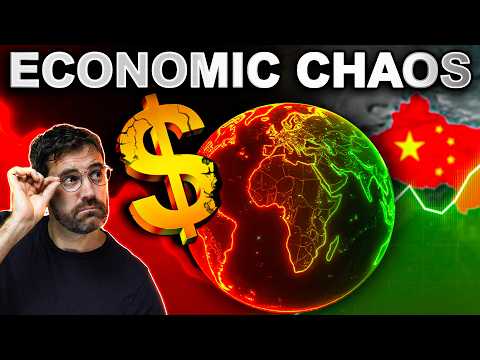
The Global Economy Is Breaking: Crypto Could Be the Escape
Coin Bureau· 2025-09-03 15:00
Global Economic Outlook - 全球经济分裂为通胀和通缩两个极端,给经济带来前所未有的挑战 [2] - G20 国家的通货膨胀率仍然维持在 3.8%,预计至少在 2026 年才能达到中央银行的目标 [4] - 中国面临需求驱动型通缩,房地产市场崩溃导致消费者信心下降 [22][23][24] Inflation Drivers - 疫情后的通货膨胀是由前所未有的财政刺激、供应链混乱和宽松的货币政策同时冲击造成的 [5][6] - 欧洲央行的分析表明,2022 年企业利润占欧元区通货膨胀的三分之二,而历史平均水平为三分之一 [10] - 乌克兰和俄罗斯合计供应全球 30% 的小麦、20% 的玉米和 80% 的葵花籽油,战争扰乱了这些资源流动,导致商品价格上涨 [10][11] - 美联储研究估计,乌克兰战争直接导致 2022 年全球通货膨胀增加 1.3 个百分点,相当于全球经济额外增加 1.3 万亿美元的成本 [12] Deflationary Pressures in China - 中国房地产市场占经济的 30%,占家庭财富的 70%,房地产价格下跌 15% 到 30% 不等 [23] - 中国现在生产了全球 70% 的太阳能电池板、60% 的电动汽车和 75% 的电池,国内需求疲软导致产能过剩,只能以极低的价格出口 [25][26] - 摩根大通估计,中国的通货紧缩可能会使全球核心商品通货膨胀率降低 70 个基点 [31] Central Bank Policies and Divergence - 美联储在 18 个月内将利率从 0% 提高到 5.5%,这是 40 年来最快的紧缩周期 [20] - 中国人民银行正在放松货币政策,但由于信心不足和债务负担沉重,效果不佳 [41] - 各国央行政策分化,美国和欧洲的债券可能因降息而上涨,而中国的债券收益率受到抑制,日本的收益率则在几十年后首次上升 [43] Structural Inflationary Forces - 气候变化导致干旱摧毁农作物,洪水破坏供应链,热浪屠杀牲畜,所有这些都导致食品价格上涨 [35][36] - 能源转型需要大量的铜、锂、钴和稀土,对这些材料的需求正在爆炸式增长,而供应仍然受限 [37] - 由于对石油和天然气的投资减少,传统能源供应变得更加紧张,任何地缘政治冲击都会导致价格飙升 [37] Crypto Market Implications - 持续的通货膨胀,但又不足以触发 20% 的利率,对加密货币来说是一个有利的环境 [45] - 中国经济面临通缩,促使富裕的中国人寻求在中国大陆以外的价值储存手段,加密货币提供了一个后门 [46] - 各国央行政策分化造成波动和不确定性,这正是加密货币作为一种非相关资产发光发热的时候 [46][47]

Nordea Bank (NBNK.F) Update / Briefing Transcript
2025-09-03 10:02
Summary of Nordea Economic Outlook Webinar Industry Overview - The webinar discusses the **Nordea Economic Outlook**, focusing on global economic trends, particularly in the U.S. and Europe, and their implications for the Nordic countries [2][32]. Key Points and Arguments Global Economic Trends - **U.S. Trade Agreements**: The uncertainty regarding the global economy has decreased as the U.S. has reached trade agreements with major countries, with the effective U.S. tariff rate expected to stabilize between **15% and 20%** [2][3]. - **Economic Slowdown**: The U.S. economy is anticipated to slow down, while Europe may experience better economic conditions, especially if a peace agreement in Ukraine is reached [3][10]. - **Inflation Control**: Inflation is under control in most countries, but it is expected to rise in the U.S. due to tariff policies, potentially impacting monetary policy [4][11]. Nordic Economic Outlook - **Diverging Growth**: The Nordic countries are experiencing diverging economic paths, with strong growth in Norway and Denmark, while Sweden and Finland are lagging [3][14]. - **Domestic Demand Recovery**: There are good opportunities for a strong recovery in domestic demand across the Nordic countries, despite uncertainties in global trade [4][19]. - **Consumer Confidence**: Consumer confidence in the U.S. is declining, which poses risks to economic growth, while Europe shows signs of stabilization [13][14]. Trade and Exports - **Impact of Tariffs**: The new U.S. tariff regime is expected to have a limited impact on Nordic growth, as these countries are not heavily reliant on the U.S. as an export market [17][18]. - **Export Performance**: Nordic exports to the U.S. have not significantly declined, with Denmark's trade surplus with the U.S. increasing recently [18][19]. Monetary Policy and Financial Markets - **Interest Rate Expectations**: The Federal Reserve is expected to cut rates once, while the European Central Bank is anticipated to halt cuts and may consider hikes in the future [27][28]. - **Bond Yields**: Long-term bond yields are expected to rise, reflecting increasing pressure on financial markets [29][33]. Economic Forecasts - **Global Growth Projections**: The global economy is projected to grow by **3.1%** this year, with the U.S. economy slowing to around **2%** [22][23]. - **Nordic Growth Rates**: Denmark is forecasted to grow by **2.3%** next year, while Sweden is expected to see growth of **2.5%** in 2024 [24][25]. Additional Important Insights - **Fiscal Expansion in Europe**: Fiscal expansion in Europe, particularly in defense and infrastructure, is expected to stimulate growth [10][24]. - **Housing Market Trends**: Rising house prices in Denmark and Norway may boost consumer confidence, while Finland's housing market remains weak [21][22]. - **Volatility in Financial Markets**: Financial markets have shown a significant decrease in volatility since earlier in the year, indicating a more stable outlook [5][32]. This summary encapsulates the key insights from the Nordea Economic Outlook webinar, highlighting the current economic landscape and future expectations for both global and Nordic economies.
X @Bloomberg
Bloomberg· 2025-09-02 13:39
Overview - Bloomberg New Economy tracks and unpacks the global economy for global leaders [1] - Bloomberg New Economy aims to influence global change [1] Event Information - Bloomberg New Economy summit will be held from November 19-21 [1]
X @Bloomberg
Bloomberg· 2025-08-30 09:18
What happened to the global economy this week — in charts https://t.co/3EEatxHEEA ...
X @Bloomberg
Bloomberg· 2025-08-23 09:48
Global Economy Overview - The report provides a summary of global economic events presented in charts [1] - The report focuses on key economic indicators and trends [1]
Why Remitly's Digital Model Could Deliver Big Upside
Seeking Alpha· 2025-08-22 17:53
Economic Overview - The global economy is currently facing challenges, including weak manufacturing activity and escalating government debt [1] - Consumer stress is becoming evident in various economic indicators [1] Analyst Insights - Saba Sadiq, a psychologist with a keen interest in finance, emphasizes the importance of a data-driven approach to guide investors through market uncertainties [1]


Will Widening Metal Tariffs Lead to Inflation?
Bloomberg Television· 2025-08-19 23:52
Economic Impact of Tariffs - Tariffs contribute to inflation, increasing costs for businesses and consumers [1] - Tariffs may reduce company profits and margins if costs are not fully passed on to consumers [2] - The U S government's tariff policies create governance problems domestically and internationally due to the use of emergency powers [2][3] Global Trade and U S Role - The U S government's approach shifts from being a global business insurer to an extractor, increasing premiums and reducing coverage [8][9][10] - Countries may seek alternative insurance or self-insure, leading to a weaker dollar and higher interest rates on U S treasuries [11][12] - U S allies may be more negatively affected by the U S government's policies than China [14] Policy Recommendations - The U S government should adopt an assumption, not sanction approach with China, attracting ideas, people, and investment away from China [15] - The U S government should avoid day-to-day pronouncements on specific stocks [4]
X @Bloomberg
Bloomberg· 2025-08-16 09:18
Global Economy Overview - The report provides insights into the global economy this week [1] Data Source - The information is presented in charts [1]
X @Sei
Sei· 2025-08-14 23:49
Stablecoin Potential - Stablecoins are poised to revolutionize the dollar's role, similar to the internet's impact on information dissemination [1] - Stablecoins offer programmability, borderless transactions, and accessibility, creating a link to the global economy [1] Infrastructure and Adoption - Scalable infrastructure is crucial as stablecoin adoption increases globally [1] - Sei network facilitates faster stablecoin transactions ($/acc) [1]