
气温变化

Search documents
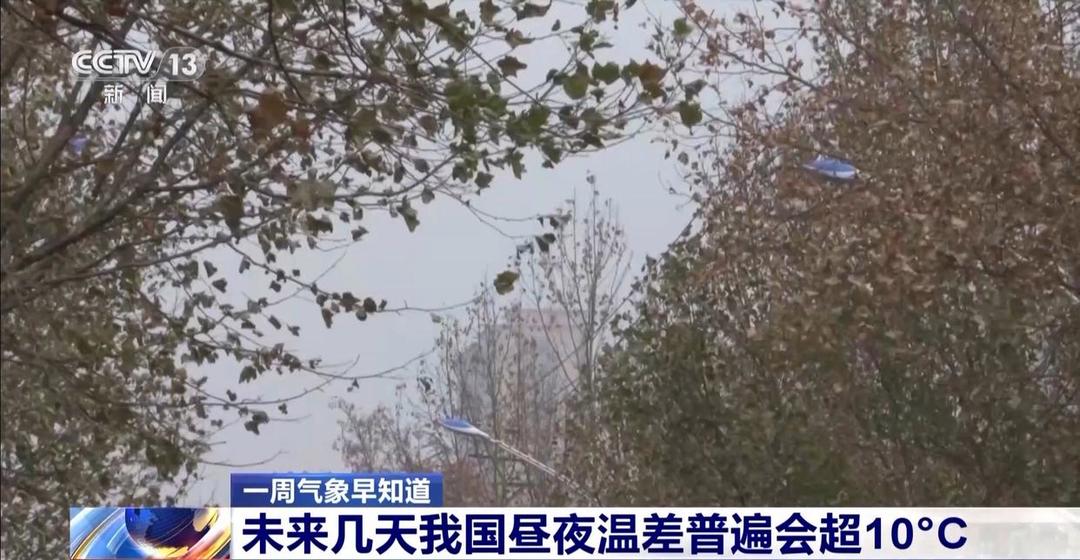
本周我国多地升温明显,昼夜温差普遍超10℃,华北到东北地区南部基本无降水
Yang Shi Xin Wen· 2025-12-15 05:09
Group 1 - This week, significant warming is expected across many regions in China, with temperature increases of 6-10°C in the central and eastern parts, and some areas in Northeast and eastern Jiangnan exceeding 12°C [1][2] - By Friday, temperatures will peak, with most of Northeast China rising above 0°C during the day, and the 10°C line reaching southern North China, while the 20°C line will extend to the Yangtze River region, with temperatures about 10°C higher than the same period in previous years [2][4] - The temperature difference between day and night will exceed 10°C in most areas, with some regions north of the Yangtze River experiencing differences of 15°C to 20°C, necessitating attention to warmth during early and late hours [4][5] Group 2 - Precipitation will initially be sparse but will increase later in the week, with overall intensity remaining low; from Monday to Wednesday, scattered rain and snow will occur in regions such as Xinjiang, Heilongjiang, Yunnan, Guizhou, Guangxi, and Hainan, with significant snowfall expected in northern Xinjiang [5][7] - By the weekend, a larger area from Huanghuai to South China will experience considerable rainfall due to the interaction of cold and warm air masses, with potential for widespread moderate rain in Jianghuai to Jiangnan [7][9] - The northern regions, including North China and southern Northeast China, will see little to no precipitation this week, with afternoon humidity levels dropping below 30%, highlighting the need for hydration and safety precautions regarding fire and electricity [9][11]

中东部大部地区气温略有反弹 未来三天全国大部地区降水较少
Yang Shi Wang· 2025-12-14 01:17
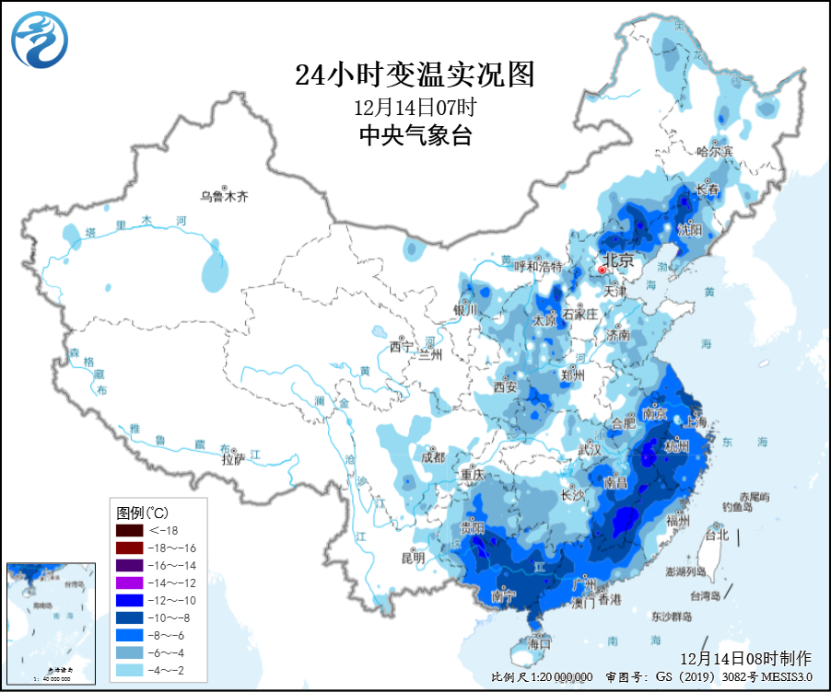
Group 1 - The central meteorological observatory reports a significant drop in temperatures across central and eastern regions of China, with decreases of 6 to 10 degrees Celsius, and in some areas, over 10 degrees Celsius [1] - A rebound in temperatures is expected in the coming days, but the public is advised to continue taking precautions against cold weather and winter illnesses due to the previous significant temperature drop [1] - A weak cold air mass is anticipated to affect eastern Inner Mongolia and northeastern regions around December 16, leading to a temperature decrease of 4 to 6 degrees Celsius [1] Group 2 - Recent weather conditions have resulted in light snow or sleet in northern Xinjiang, central Inner Mongolia, northeastern regions, and parts of Shandong and Jiangsu, with moderate to heavy snow reported in Dalian, Yantai, and Weihai [2] - The forecast for the next three days indicates sparse precipitation across most of the country, with some areas in northeastern Inner Mongolia and northern Xinjiang experiencing light to moderate snow, and localized heavy snow [2]
今明寒潮影响申城 最低温48小时内降8℃到10℃ 本周末将明显回暖下周或有雨
Jie Fang Ri Bao· 2025-12-03 01:33
Group 1 - A strong cold air mass is affecting Shanghai, with a temperature drop of 8℃ to 10℃ expected within 48 hours [1] - The lowest temperatures in the city are forecasted to be around 4℃ in urban areas and between -2℃ to 1℃ in suburban areas, with the possibility of thin ice [2] - The temperature is expected to slightly rebound on Friday, with a maximum temperature of 13℃, followed by a significant warming trend over the weekend, reaching up to 19℃ [2] Group 2 - Shanghai has not experienced any rainfall for nearly a month, with only 8.5 millimeters of precipitation recorded in November, which is less than 20% of the average for the same period [2] - Rain is anticipated to return next week due to the influence of warm and moist air moving northward [2]
周二起气温骤降 周四早晨仅1℃—4℃
Mei Ri Shang Bao· 2025-12-02 02:59
Group 1 - The first cold air mass of December is expected to bring significant temperature drops and light precipitation to Hangzhou, with average daily temperature decreasing by 5℃ to 7℃ [2] - The lowest temperatures are forecasted to occur on Thursday and Friday mornings, with plains expected to see temperatures between 1℃ and 4℃, and mountainous areas between 0℃ and 3℃, potentially leading to frost or ice [2] - November was notably dry, with Hangzhou's average temperature at 13.9℃, 0.6℃ above the historical average, and total precipitation at only 28.5mm, about 62% less than normal [1] Group 2 - The incoming cold air mass will also bring some moisture, resulting in light rain in parts of the city from Tuesday afternoon to Wednesday morning, which will help alleviate dryness [2] - The cold air mass is associated with the influx of external pollutants, leading to light pollution levels in Hangzhou and surrounding areas, with air quality expected to deteriorate as the cold front arrives [2] - Residents are advised to take precautions against potential health impacts from air pollution, including wearing masks and minimizing outdoor activities [2]
东北等地大范围降雪来袭 中东部气温先升后降
Yang Shi Wang· 2025-11-29 00:54
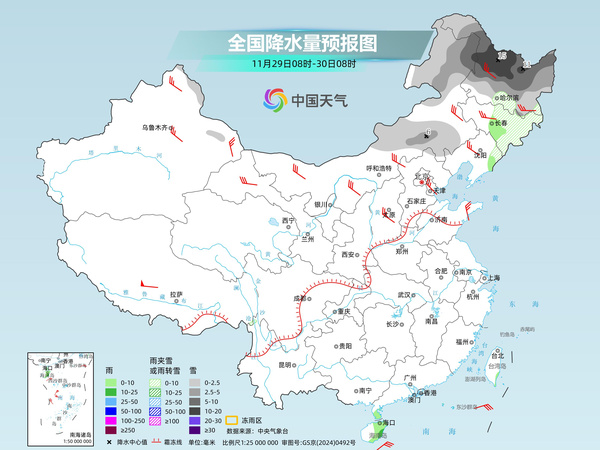
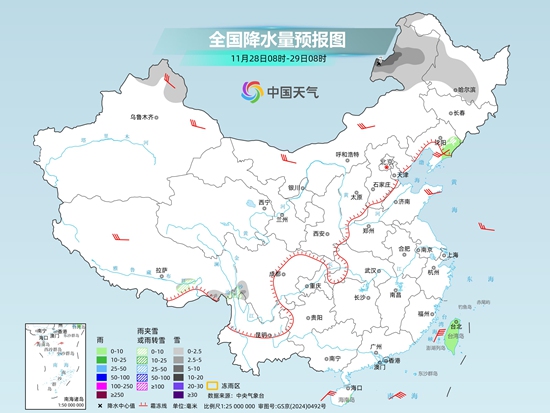
Summary of Key Points Core Viewpoint - A significant increase in snowfall is expected in eastern Inner Mongolia and northeastern regions, with local areas experiencing heavy to blizzard conditions, necessitating public caution regarding road conditions and travel safety [1][2][4]. Weather Conditions - Eastern Inner Mongolia and northeastern regions will see increased snowfall today, with local areas expecting heavy to blizzard conditions, leading to snow accumulation of 4 to 8 centimeters, and locally exceeding 10 centimeters [2][4]. - The central and eastern regions will continue to experience dry weather with minimal precipitation over the next few days, prompting public advisories for hydration and safety regarding electricity and fire usage [2][4]. Temperature Fluctuations - A warming trend is observed in the central and eastern regions, with temperatures expected to rise significantly before a cold front causes a drop in temperatures, with some areas experiencing a temperature fluctuation exceeding 15°C [5]. - By early December, temperatures are projected to reach new lows across a wide area, with some regions experiencing a cumulative drop of over 15°C, and local areas potentially exceeding 20°C [5]. Rainfall Predictions - As warm and moist air strengthens in early December, a significant rainfall event is anticipated in southern regions, which, while not heavy, will help alleviate dryness and reduce forest fire risks in southern China [6].
明起新一股冷空气来袭 东北等地降雪明显增强部分地区有暴雪
Yang Shi Xin Wen· 2025-11-28 00:54
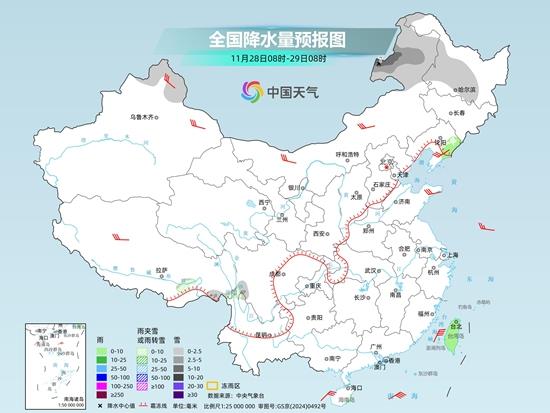
Group 1 - The central and eastern regions of China will experience a temporary rise in temperatures before a new cold air mass arrives, leading to a significant drop in temperatures by early December [2][4] - The cold air mass is expected to cause temperature drops of 8°C to 10°C in some areas, with cities like Shenyang experiencing a drop from a high of 11°C to a low of -7°C [2][4] - Southern regions are less affected by the cold air, maintaining higher daytime temperatures but experiencing lower nighttime temperatures, resulting in a notable temperature difference of around 15°C [2][3] Group 2 - The dry conditions in southern regions are unprecedented for this time of year, with relative humidity dropping below 20% in several areas, such as 9% in Hubei [4][5] - In contrast, northeastern regions are expected to see increased snowfall, with heavy snow warnings in places like central Heilongjiang, where snow accumulation could exceed 10 centimeters [5][6] - The upcoming days will see continued dry and sunny weather in the central and eastern regions, while the northeast will face frequent snow, necessitating caution for travel due to slippery roads and reduced visibility [8]
南方多地干燥程度同期少见 明天东北等地降雪明显增强
Yang Shi Wang· 2025-11-28 00:28
Core Points - A new cold air mass is expected to impact the central and eastern regions of China starting tomorrow, leading to a significant drop in temperatures, with some areas experiencing a decrease of 8°C to 10°C [2][4] - The northeastern region will see increased snowfall, with blizzard conditions expected in central Heilongjiang, where snow accumulation could reach 10 centimeters or more [4][5] - The southern regions are experiencing unusual dryness, with relative humidity dropping below 20% in several areas, marking a record low for November [4] Summary by Sections Weather Forecast - The central and eastern regions will experience a brief temperature rise today, but this will be interrupted by the arrival of cold air starting tomorrow [2] - The temperature in Shenyang is projected to drop from a high of 11°C tomorrow to -7°C by December 2, marking the coldest temperatures of the second half of the year [2] Precipitation and Dryness - The southern regions are facing unprecedented dryness, with relative humidity in places like Hubei and Anhui dropping to as low as 9% [4] - In contrast, the northeastern areas will see frequent rain and snow, with significant snowfall expected in Heilongjiang and other parts of the northeast [4][5] Public Advisory - The public is advised to dress in layers due to significant temperature fluctuations, with day-night temperature differences reaching around 15°C in many areas [3] - During windy and dusty conditions, it is recommended to minimize outdoor activities and use protective gear such as masks [3]
周四起开启升温模式 昼夜温差超10℃
Mei Ri Shang Bao· 2025-11-20 02:44
Group 1 - The recent cold wave in Hangzhou has led to a significant drop in temperatures, with the lowest recorded at 3°C, marking a new low for the second half of the year [1] - Following the cold wave, temperatures are expected to gradually rise, with the highest temperatures during the weekend projected to reach between 17°C and 19°C, accompanied by clear weather [1] - The temperature increase will be more pronounced during the day compared to the night, with some areas experiencing temperature differences exceeding 10°C to 15°C, such as Lishui with a range of 3°C to 20°C [1] Group 2 - The upcoming week is forecasted to maintain a dry and sunny weather pattern across the province, with relative humidity potentially dropping to around 35%, leading to increased static electricity [2] - Residents are advised to stay hydrated and take care of skin and lip moisture due to the dry conditions, while also being cautious about fire safety outdoors [2] - The fluctuating temperatures may pose health risks, prompting citizens to monitor weather changes and adjust clothing accordingly to mitigate the effects of temperature differences [2]
中东部大部降水稀少 冷空气活动较频繁
Zhong Guo Xin Wen Wang· 2025-11-19 03:06
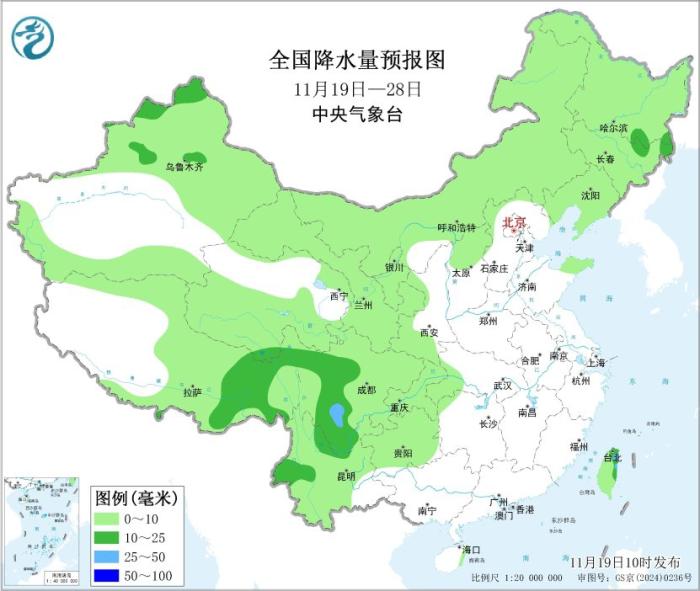
Core Points - The central meteorological station has issued a medium-term weather forecast indicating that most regions in China have experienced less precipitation over the past ten days, with significant temperature fluctuations due to cold air activity [1][3] - The forecast for the next ten days suggests frequent cold air activities, with little precipitation expected in the central and eastern regions of China [1][3] Summary by Sections Recent Weather Conditions - Over the past ten days (November 9-18), areas such as eastern Sichuan Basin, northern Hunan, southeastern Zhejiang, northern Fujian, and parts of Yunnan and Guizhou received 20-40 mm of rainfall, while southeastern Hainan and some areas in Zhejiang and Fujian saw 50-70 mm, which is 50% to 100% above the normal levels for this time of year [1] - Most other regions in China experienced below-normal precipitation during this period [1] Upcoming Weather Forecast - For the next ten days (November 19-28), regions including northern Xinjiang, the Tibetan Plateau, eastern Northwest China, northern North China, and Northeast China are expected to receive 1-5 mm of precipitation, with localized areas exceeding 10 mm. Southwestern regions may see 10-20 mm, while most of the central and eastern regions will have little to no precipitation [1][2] - Average temperatures in northern Xinjiang, most of North China, and Northeast China are projected to be 2-3°C higher than the same period in previous years, while other regions will experience temperatures 1-3°C lower than normal [2] Significant Weather Events - A strong cold air mass is expected to impact most of China from November 22-24, leading to a temperature drop of 6-8°C in most areas north of the Yangtze River, with localized drops of 10-12°C and winds of 4-6 levels [3] - Another strong cold air mass will affect the central and eastern regions around November 26, with similar temperature drops and potential for light to moderate snow in parts of Northwest China, northern North China, and Northeast China [3] Long-term Weather Outlook - For the 11-14 day forecast (November 29-December 2), areas in northeastern Inner Mongolia, Northeast China, and eastern Southwest China are expected to receive 1-5 mm of precipitation, while most other regions will see little to no precipitation [3] - Except for northern Xinjiang and Tibet, where temperatures are expected to be 1-2°C higher than normal, most other regions will experience temperatures 1-2°C lower than the historical average [3]
近期天气晴好为主周末冷暖形势逆转
Da Zhong Ri Bao· 2025-11-12 01:18
Core Viewpoint - The article discusses the recent temperature changes in the province, highlighting a warming trend followed by a significant cold front expected to impact the region from the 14th to the 17th of the month [1] Weather Forecast Summary - From the night of the 11th to the day of the 12th, the weather will be mostly clear with temperatures ranging from a low of around 4°C in the mountainous areas to 6°C in other regions, and a high of approximately 15°C in the mountainous areas and 18°C in others [1] - From the night of the 12th to the day of the 13th, the weather remains mostly clear with lows of about 5°C in most areas, 8°C in the southern regions, and 10°C along the coast, while highs will be around 14°C in most areas and 17°C in the southern regions [1] - From the night of the 13th to the day of the 14th, the weather continues to be mostly clear with lows of approximately 3°C in most areas and 6°C in specific regions, while highs will be around 14°C in the mountainous and peninsula areas and 17°C in others [1] Public Advisory - Meteorological authorities advise the public to pay attention to temperature changes and adjust clothing accordingly to prevent health issues related to significant temperature drops, particularly respiratory and cardiovascular diseases [1]