
Global Trade

Search documents
X @Bloomberg
Bloomberg· 2025-07-27 09:17
Investment Strategy - Experts suggest keeping investment strategies simple and focusing on long-term gains in India [1] Global Trade Impact - Trump's tariffs are reshaping the global trade landscape, influencing investment decisions in emerging markets like India [1]
X @The Wall Street Journal
The Wall Street Journal· 2025-07-24 01:55
President Trump’s push to introduce a new standard for global trade is coming into sharper focus as U.S. and EU officials converge on a possible 15% tariff deal https://t.co/FTkfhPTlT4 ...
Q3 Stock Market Outlook - 7/15/25 | Market Sense | Fidelity Investments
Fidelity Investments· 2025-07-17 14:44
Market Overview - Market experienced volatility due to policy uncertainty and geopolitical events, even a "bear market scare" in Q2, but stocks recovered to all-time highs by the end of the quarter [1] - Fidelity thought leaders provided insights on the past quarter and discussed potential risks and opportunities for the next quarter [1] Key Topics Covered - Discussion included a Q2 recap and Q3 market outlook [1] - Analysis of stocks & bonds, taxes & tariffs, and interest rates [1] - Examination of risks & opportunities, consumer debt, and national debt & Treasurys [1] - Commentary on Bitcoin & gold [1] Economic Factors - CPI data and the Federal Reserve's actions were discussed [1] - Impact of tariffs on corporate earnings was analyzed [1] Market Segments - Perspectives on international stocks and U S exceptionalism were shared [1]


摩根士丹利:中国经济-出口仍逆势坚挺
摩根· 2025-07-15 01:58
Investment Rating - The report does not explicitly provide an investment rating for the industry Core Insights - Exports to the US have shown a significant contribution to year-on-year growth, with a +2.6 percentage point increase, while exports to the rest of the world (RoW) decreased by -1.6 percentage points, indicating a mixed performance in export markets [2] - Imports have turned positive year-on-year for the first time this year, primarily due to higher commodity prices and a low base effect, although month-on-month growth remains soft at -0.6% seasonally adjusted [3] - A slowdown in global trade is anticipated in the second half of the year, with estimates suggesting that payback from front-loading could reduce year-on-year growth by 2 percentage points compared to the first half [4] Summary by Sections Trade Balance and Exports - The trade balance for June 2025 was reported at 115 billion USD, with exports totaling 325 billion USD, reflecting a year-on-year growth of 5.8% [6] - Exports to the US decreased by -16.1% year-on-year, while exports to Japan and the EU increased by 6.6% and 7.6% respectively [6] Imports - Total imports in June 2025 were 210 billion USD, with a year-on-year growth of 1.0% [6] - Mechanical and electrical products saw a year-on-year growth of 6.0%, while steel products and crude petroleum oil experienced declines of -13.1% and -14.3% respectively [6] Future Outlook - The report anticipates a slowdown in China's exports in the second half of the year, which may impact aggregate demand and inflation [10] - The stabilization of rare earth exports is noted, following a rapid deceleration earlier in the year [10]
X @Bloomberg
Bloomberg· 2025-07-14 23:14
Ireland’s finance ministry must better balance income and expenditure to protect public finances from global trade turmoil, the country’s biggest business lobbyist said https://t.co/zfIncnGxvb ...
X @Cointelegraph
Cointelegraph· 2025-07-14 19:00
🚨 INSIGHT: What if global trade didn’t need middlemen?@TradeOS_ai just joined the Cointelegraph Accelerator to build exactly that.No intermediaries. No platform lock-ins. Just programmable, verifiable settlement powered by stablecoins, ZK tech, and AI.Backed by Animoca, TON Ventures & HashKey.[Cointelegraph Accelerator] ...
X @The Economist
The Economist· 2025-07-08 17:50
To appease the world’s biggest market, countries must anger the world’s biggest trader https://t.co/eAsiur0DC3 ...
Trump Tariffs Shake Up Global Trade | Balance of Power: Early Edition 7/07/2025
Bloomberg Television· 2025-07-07 19:12
>> LIVE FROM WASHINGTON, D. C. , THIS IS "BALANCE OF POWER" WITH JOE MATHIEU AND KAILEY LEINZ.JOE: THE LETTERS ARE IN THE MAIL. WELCOME TO THE MONDAY EDITION OF "BALANCE OF POWER" AS THE PRESIDENT SENDS LETTERS TO JAPAN AND KOREA ANNOUNCING 25% TARIFFS ON THEIR GOODS. WITH MORE TO FOLLOW ACCORDING TO THE WHITE HOUSE.ON JOE MATHIEU ALONGSIDE KAILEY LEINZ IN WASHINGTON. WELCOME TO THE MONDAY EDITION. A LOT THAT WE DON'T KNOW ABOUT THIS AND THE PRESIDENT IS THREATENING ANOTHER LAYER, IF THESE COUNTRIES RETALIA ...

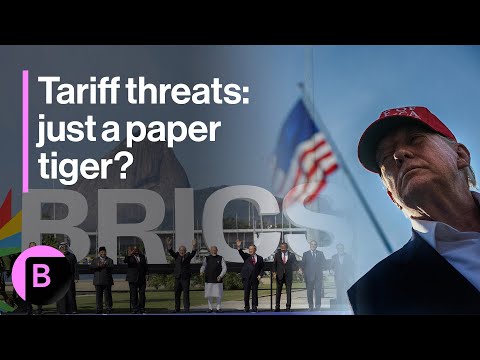
What to Know as Trump Threatens 10% Tariff on BRICS-Aligned Nations
Bloomberg Television· 2025-07-07 05:00
What are we hearing from the BRICS nations on the tariffs that Trump is suggesting. Well to begin with, I mean, there is a reference to tariffs and, you know, tariffs, unilateral tariffs that is upending global trade, that finds mention in the BRICS leader's declaration. It doesn't, of course, mention the United States, but it just says that tariffs are unilaterally imposed.Tariffs are creating problems, headwinds for developing nations in the global South. That is one mention that is. But having said that, ...
花旗:全球经济_关税正带来挑战
花旗· 2025-07-03 02:41
Investment Rating - The report indicates a cautious outlook on global trade due to the impact of tariffs, suggesting potential challenges for investment in related sectors [1]. Core Insights - The momentum in global trade driven by US frontloading has diminished, with a significant decline in US imports observed since March, particularly in pharmaceutical imports from Europe [1] - Approximately 70% of major economies have PMIs for new export orders below 50, indicating contraction in new export orders since April [1] - The restraining effects of tariffs on trade are becoming increasingly evident, with further impacts likely to materialize in the future [1] Summary by Sections Global Trade Dynamics - US imports through May have sharply retreated from their March highs, with pharmaceutical imports from Europe showing a marked decline [1] - New export orders for countries outside the US have contracted since April, reflecting a broader slowdown in global trade activity [1] Economic Indicators - The PMI for new export orders in June was reported at 48.9 for the global economy excluding the US, indicating a contraction [5] - The US PMI for new export orders was slightly better at 51.0, suggesting a marginal expansion compared to the global average [9] Trade Order Trends - The divergence between exports and imports is highlighted, with global imports rising significantly due to increased precious metal imports to the US, which are not reflected in export figures [54][55]