Export Controls

Search documents
X @The Economist
The Economist· 2025-08-04 05:40
Market Dynamics - The reversal of America's export controls allows Nvidia to sell its powerful H20 chips in China [1] - Making H20 chips available to tech firms in China will remove hurdles that are slowing their growth [1]

X @The Economist
The Economist· 2025-08-03 03:40
Market Dynamics - Nvidia can once again sell its powerful H20 chips in China due to the reversal of America's export controls [1] - Making H20 chips available to tech firms in China will remove hurdles that are slowing their growth [1]
The Chinese negotiating hand is quite firm right now, says China Beige Book CEO Leland Miller
CNBC Television· 2025-07-31 11:38
China's Economy & Trade Talks - China's economy is in relatively good shape, with July data showing improvement compared to June, although growth is not exceeding year-ago levels [1][2] - China has included export controls in trade negotiations, giving them significant leverage, particularly concerning rare earths and critical minerals [3][5] - The inclusion of export controls has created a situation of mutually assured destruction, giving China a choke point over the United States economy [6] Manufacturing Sector - Despite PMI data suggesting weakness, the manufacturing sector in China remains strong and continues to export [9][10] - While exports to the United States have contracted, there has been a surge in exports to Asia, indicating the manufacturing machine is still productive [10] - Manufacturing's strength is crucial as China currently lacks other significant growth drivers [11] Security Concerns & Chip Industry - China is raising potential security risks with chips, potentially as a response to concerns about Huawei [6] - There are concerns about the future ability to geographically track chips, leading to worries about transshipment and potential circumvention of regulations [7]

X @The Economist
The Economist· 2025-07-30 18:45
China has top-flight models. But export controls left it struggling to run them https://t.co/5Mexnry4dL ...
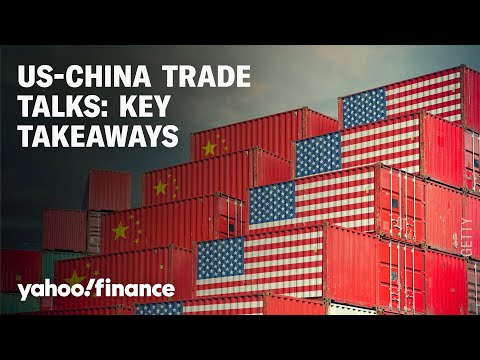
US-China trade talks: What to know from the latest meeting in Sweden
Yahoo Finance· 2025-07-29 22:36
Trade Talk Status - US-China trade talks in Stockholm concluded with mixed signals, Trump acknowledged Monday was not good, but today was better [1] - The talks ended without a confirmed 90-day pause on tariffs, a key market expectation [2] - Treasury Secretary and Trade Representative will brief President Trump, who will decide on the pause [2][3] - Another talk is expected in about 90 days, renewing focus on the August 12th deadline for tariff snapback [3] China's Economic Position - China's economy is "swimming in place" despite tariffs, indicating resilience [4] - China possesses negotiating leverage, exemplified by rare earth export controls [4] - China feels confident in its position [4] Tariff Impact and Future Scenarios - Companies relying on China imports, like toy companies, are experiencing pain, expecting it to last until at least 2026 [6] - The challenge lies in the uncertainty of future tariff levels, hindering production movement [7] - Toys and games are the most exposed sector from a consumer perspective due to reliance on China imports [8] - Tariff rates from China are converging with rates from elsewhere, potentially reducing the incentive to move production [9][10] - A realistic worst-case scenario involves tariffs staying at 30%, potentially leading to empty shelves and inflationary impacts [18] - Tariffs could reach close to 50% when combined with previous trade war tariffs and sectoral tariffs [19] US Strategy and Potential Concessions - The US may offer concessions on export controls and fentanyl tariffs to secure a meeting between President Trump and President Xi [12] China's Compliance and Economic Management - China has previously fallen short on commitments to buy US exports [15] - China is managing the situation by maintaining stable economic numbers and implementing stimulus measures [21][22] - China has kept interest rates at historic lows and increased fiscal activity [21]
Rare earths are China's bargaining chip in the trade war — the U.S. is trying to fix that
CNBC· 2025-07-29 12:00
Core Insights - Rare earths are critical elements in the U.S.-China trade war, with China controlling approximately 70% of mining and 90% of processing [2][3] - The U.S. is making efforts to establish a domestic supply chain for rare earths, highlighted by a $400 million investment in MP Materials and a $1 billion loan from Goldman Sachs and JPMorgan [4] Industry Overview - Rare earth magnets are essential for various applications, including electric vehicles, wind turbines, defense equipment, and high-tech consumer electronics [2] - China's monopoly in the rare earth market has increased, with low production costs making it difficult for other producers to compete [3] Company Developments - MP Materials is the only operational rare earth mine in the U.S., located in Mountain Pass, California, and is expanding its magnet-making operations [4] - Energy Fuels has been refining rare earths at its White Mesa facility and plans to increase production from 1,000 metric tons to 6,000 metric tons of NdPr, which could support up to 6 million electric vehicles [5][6] - Energy Fuels is also advancing its capabilities to produce other heavy rare earths, such as dysprosium, terbium, and samarium, contingent on government incentives [6] Market Dynamics - China's export controls on rare earths have disrupted various industries, particularly the automotive sector, as part of its response to perceived unfair actions by the U.S. and other countries [3][4] - Despite advancements in U.S. production capabilities, experts indicate that the country remains heavily reliant on China for rare earth materials [6]


China is clear, it will not be bullied, says Longview's Dewardric McNeal on trade talks with U.S.
CNBC Television· 2025-07-28 21:12
US-China Trade Negotiations - Negotiations with China are expected to differ significantly from those with the UK, Japan, and the EU [2] - China is prepared to respond to tariffs on a reciprocal basis and has other leverage mechanisms, such as export controls on critical minerals [2][3] - The negotiation is expected to be lengthy due to each side's strengths and weaknesses [3] Tariff Outlook - The initial approach of securing deals with allies before focusing on China has not been successful [6] - The market anticipates the removal of approximately 20% of EPA fentanyl tariffs over the next 90 days [9][10] - A 25% tariff from 2018 is expected to remain in place [10] Critical Minerals - China has leveraged export controls for critical minerals [3][6] - There is uncertainty regarding the expiration of the six-month sunset on the critical minerals export licensing process agreed to by China [8] Timelines and Potential Meetings - An additional 90 days are expected to provide benefits for Chinese factories, businesses, and consumers, extending beyond the holiday shopping period [7] - The administration aims to arrange a meeting between President Trump and President Xi Jinping [8]
X @Bloomberg
Bloomberg· 2025-07-28 21:02
Cadence Design pleaded guilty to charges accusing the company of violating US export controls by selling hardware and software to China’s National University of Defense Technology https://t.co/OchDJK7ANL ...
The US & EU have reached a trade deal, but don't expect it to be a framework for China
Yahoo Finance· 2025-07-28 20:33
US-China Trade Negotiations - US-China trade talks in Stockholm focus on market access, with the US seeking greater openness from China [2][3] - A key concern is the potential reinstatement of tariffs, currently at 30%, with an August 12th deadline [3] - An extension of the tariff deadline by potentially 90 days is anticipated to allow for continued negotiations [4] - A meeting between President Trump and President Xi Jinping later in the year is expected if progress is made [5] - Currency manipulation is one of many complicated issues to be addressed in the coming weeks [6] EU-US Trade Agreement & Geopolitical Implications - The EU-US trade agreement is seen as a positive geopolitical moment, uniting the US and its allies to counter China's rise [17] - The agreement signals that increasing trade is in the mutual interest of the US and the EU, even with some tariffs and trade restrictions [18] China's Trade Strategy - China has retaliated against US tariffs more resolutely than the EU [7] - China is aware of US dependence on Chinese inputs and can strategically retaliate through export controls [8] - China aims for self-sufficiency and self-reliance, diversifying trade away from the US and developing non-dollar-based financial infrastructure [20] - China seeks a tactical agreement for relaxation of export controls in the short term [20] - China's long-term goal is market domination with cheaper, better, and higher indigenous tech content [20] Investment & National Security Concerns - The US has concerns about Chinese investment in certain areas, particularly those related to national security [10] - The US aims to normalize trade with China in "below the line" areas (normal goods), while restricting trade in "above the line" areas (national security, armaments, chips) [11][12] Other Factors - The status of export licenses for rare earths and chips needs to be resolved to normalize trade relationships [14] - Potential secondary sanctions or tariffs related to Russia and oil are being closely watched by China, a major consumer [23][24]
U.S.-China trade talks are showing signs of détente, says MCC Global's Michelle Caruso-Cabrera
CNBC Television· 2025-07-28 18:46
US-China Trade Relations - The US faces a significant trade deficit with China, a problem that has persisted for decades [1] - National security concerns create tension regarding the extent of trade with China, specifically regarding the potential transfer of tools that could threaten US security [1] - Export controls, initially imposed by Biden and later strengthened by Trump, are a key point of contention between the US and China [1] - The US seeks to raise tariffs on Chinese products, potentially by 10-20% or more [1] - China's perspective on what constitutes a "win" in trade talks remains unclear, with the future of TikTok potentially being a factor [1] Chinese Economic Policies and Global Impact - China's economic structure is heavily geared towards production, leading to overcapacity in various industries [1] - Chinese government subsidies enable the production of very cheap EVs (under $25,000) for the EU market [1] - The EU is concerned about potential de-industrialization due to the influx of subsidized Chinese goods [1] - China's domestic consumption is relatively low, contributing to trade imbalances [1] Technology and National Security - The Committee on Foreign Investment in the United States (CFIUS) assesses whether foreign companies can invest in the US, with Nvidia chips being a recent example of scrutiny [1] - China passed a law preventing the export of TikTok's algorithm, posing hurdles to any potential sale of the platform [1] - China controls information flow within its borders, restricting access to platforms like Twitter and Google [1]