
Mortgage rates

Search documents
Mortgage and refinance interest rates today, December 31: Down to a new 2025 low
Yahoo Finance· 2025-12-31 11:00
Core Insights - Mortgage rates are currently stable, with the average 30-year fixed rate at 5.97% and the 15-year fixed rate at 5.42% [1][15] - Economists do not anticipate significant drops in mortgage rates before the end of 2026, despite recent cuts to the federal funds rate [17] - Mortgage rates have generally decreased over the past couple of months, remaining about half a point lower than a year ago [18] Current Mortgage Rates - The national average rates for various mortgage types are as follows: - 30-year fixed: 5.97% - 20-year fixed: 5.95% - 15-year fixed: 5.42% - 5/1 ARM: 5.83% - 7/1 ARM: 5.97% - 30-year VA: 5.42% - 15-year VA: 4.99% - 5/1 VA: 5.12% [4] Mortgage Refinance Rates - Current mortgage refinance rates are typically higher than purchase rates, although this is not always the case [3] - The national averages for refinance rates are also rounded to the nearest hundredth, similar to purchase rates [3] Mortgage Types and Their Characteristics - A 30-year fixed mortgage offers lower and predictable monthly payments, but comes with higher interest costs over the loan's life [7][9] - A 15-year fixed mortgage has higher monthly payments but lower interest rates, allowing homeowners to pay off their mortgage sooner and save on interest [10][11] - Adjustable-rate mortgages (ARMs) offer lower initial rates but can lead to unpredictable payments after the introductory period [12][13] FAQs on Mortgage Rates - The current national average for a 30-year mortgage is 5.97%, but rates can vary based on location [15] - To secure the lowest refinance rate, improving credit scores and lowering debt-to-income ratios are recommended strategies [19]
Mortgage and refinance interest rates today, December 29, 2025: Mostly unchanged for 2 months
Yahoo Finance· 2025-12-29 11:00
Core Viewpoint - Mortgage rates are stabilizing around current levels, with the 30-year fixed mortgage rate at 6.01% and the 15-year fixed rate at 5.47% [1][18]. Current Mortgage Rates - The national average for the 30-year fixed mortgage rate is 6.01%, while the 15-year fixed rate is 5.47% [18]. - Other mortgage rates include: - 20-year fixed: 5.93% - 5/1 ARM: 6.11% - 7/1 ARM: 6.34% - 30-year VA: 5.59% - 15-year VA: 5.19% - 5/1 VA: 5.24% [5]. Mortgage Payment Insights - For a $300,000 mortgage at a 30-year term with a 6.01% rate, the monthly payment would be approximately $1,800, resulting in $348,209 paid in interest over the loan's life [8]. - A 15-year mortgage at a 5.47% rate would increase the monthly payment to $2,446, with total interest paid being $140,366 [10]. Adjustable Mortgage Rates - Adjustable-rate mortgages (ARMs) typically start with lower rates than fixed rates but can increase after the initial period [11]. - The 5/1 ARM has a fixed rate for the first five years, after which it adjusts annually [11]. - Recent trends show that ARM rates can be similar to or even higher than fixed rates, necessitating careful comparison among lenders [13]. Factors Influencing Mortgage Rates - Lenders offer lower rates to borrowers with higher down payments, excellent credit scores, and low debt-to-income ratios [14]. - Options for reducing interest rates include paying for discount points at closing or utilizing temporary interest rate buydowns [15]. Future Rate Predictions - The Mortgage Bankers Association (MBA) forecasts the 30-year mortgage rate to remain near 6.4% through 2026, while Fannie Mae predicts rates above 6% next year, potentially dropping to 5.9% in Q4 2026 [20].
Mortgage Rates Dip To 3-Year-Lows As Home-Sellers Outnumber Buyers
ZeroHedge· 2025-12-26 19:15
Core Insights - The weekly mortgage rate for a 30-year fixed-rate mortgage has decreased to 6.18 percent, the lowest since 2022, down from 6.21 percent the previous week [2][3] - The current mortgage rate is 0.86 percentage points lower than the yearly peak of 7.04 percent reached in mid-January [3] Housing Market Dynamics - The U.S. housing market saw 37.2 percent more sellers than buyers in November, marking the largest gap since 2013, with 529,770 more sellers [5][6] - Redfin defines a market with over 10 percent more sellers than buyers as a buyer's market, which has been the case since May 2024 [6] - Among the 50 most populous U.S. metropolitan areas, Austin, Texas, had the highest disparity with 114 percent more sellers than buyers [6][7] - In November, the number of home buyers reached the second-lowest level on record due to economic uncertainty and high housing costs [7] Builder Confidence and Market Outlook - Builder confidence for newly built single-family homes has slightly improved, despite challenges like rising construction costs and buyer hesitation [8] - Builders have reported future sales expectations above the breakeven level of 50 for the past three months, aided by recent easing of monetary policy [9] - The Federal Reserve has cut its benchmark interest rates three times this year, now ranging from 3.5 to 3.75 percent [9] Future Projections - Mortgage rates are expected to ease somewhat in 2026, although they are forecasted to remain above 6 percent through the end of next year [10][11] - Slightly lower rates and slower price growth could improve affordability, potentially bringing more buyers into the market [11] - President Trump has indicated plans for aggressive housing reform and a new Federal Reserve chairman to support lower interest rates, which may further reduce mortgage rates [13]

Mortgage and refinance interest rates today, December 25, 2025: Mortgage rates drifting
Yahoo Finance· 2025-12-25 11:00
Mortgage Rates Overview - The average 30-year fixed mortgage rate has decreased by three basis points to 6.18%, while the 15-year fixed rate has increased by three basis points to 5.50% [1] - Freddie Mac's chief economist, Sam Khater, noted that declining rates are beneficial for potential homebuyers [1] Current Mortgage Rates - Current mortgage rates include: - 30-year fixed: 6.10% - 20-year fixed: 6.00% - 15-year fixed: 5.52% - 5/1 ARM: 6.26% - 7/1 ARM: 6.26% - 30-year VA: 5.62% - 15-year VA: 5.31% - 5/1 VA: 5.25% [5] - Another set of current rates shows: - 30-year fixed: 6.25% - 20-year fixed: 5.92% - 15-year fixed: 5.69% - 5/1 ARM: 6.44% - 7/1 ARM: 6.43% - 30-year VA: 5.55% - 15-year VA: 5.37% - 5/1 VA: 5.50% [6] Mortgage Rate Types - Mortgage rates can be categorized into fixed and adjustable rates. Fixed-rate mortgages maintain the same interest rate throughout the loan term, while adjustable-rate mortgages change after an initial fixed period [8] - The structure of payments changes over time, with initial payments primarily covering interest and gradually shifting towards the principal [9] Factors Influencing Mortgage Rates - Mortgage rates are influenced by controllable factors such as credit scores, debt-to-income ratios, and down payments, as well as uncontrollable economic factors like employment rates [10][11] - Generally, refinance rates are slightly higher than purchase rates, reflecting market conditions [12] Popular Mortgage Terms - The 30-year fixed mortgage is favored for its lower monthly payments but results in higher total interest paid over time [13] - The 15-year fixed mortgage offers lower rates and less interest paid overall, but comes with higher monthly payments [14] Market Insights - Banks like Chase and Citibank are noted for offering some of the lowest median mortgage rates, emphasizing the importance of comparing options across various lenders [15] - Historical context shows that the lowest-ever 30-year fixed mortgage rate was 2.65% in January 2021, with current rates unlikely to drop below 3% soon [17]
Mortgage rates fall ahead of Christmas holiday
Fox Business· 2025-12-24 18:03
Mortgage Rates - The average rate on the benchmark 30-year fixed mortgage decreased to 6.18% from 6.21% last week, down from 6.85% a year ago [1] - The average rate on a 15-year fixed mortgage rose to 5.5% from 5.47% last week [7] Economic Indicators - The Bureau of Economic Analysis reported a third-quarter GDP growth of 4.3%, surpassing economists' expectations of 3.3% [5] - The consumer price index rose 0.2% in November from the prior month and increased 2.7% year-over-year, both figures lower than economists' projections [6] Labor Market - Employers added 64,000 jobs in November, with the unemployment rate rising to 4.6%, the highest since September 2021 [7] Market Outlook - Higher inventory levels compared to last year may provide buyers with a better rate environment entering the new year [9] - If mortgage rates stabilize or decrease slightly, buyers could experience increased purchasing power in 2026, following two slow housing years [10]
Merry Christmas: 30-year mortgage rates dip lower
Yahoo Finance· 2025-12-24 17:16
Mortgage Rates and Economic Indicators - Mortgage rates have slightly decreased, with the average 30-year mortgage rate at 6.18%, down from 6.21% the previous week, while the 15-year mortgage rate increased to 5.5% from 5.47% [1] - The 10-year Treasury yield, which influences mortgage rates, has shown volatility due to mixed economic data, including a surprising easing of inflation and a strong GDP growth of 4.3% in the third quarter [2] - Mortgage rates have remained stable around 6.2% since mid-September, with expectations of minimal changes in the final week of the year due to a lighter holiday trading schedule [3] Housing Market Activity - The housing market is experiencing a slow period, with expectations of limited fluctuations in mortgage rates during traditionally slow homebuying months [4] - Mortgage applications for home purchases and refinancing have decreased, with purchase applications down 4% and refinancing applications down 6% as the year concludes [4]
Average US long-term mortgage rate ticks down to 6.18% this week
Yahoo Finance· 2025-12-24 17:03
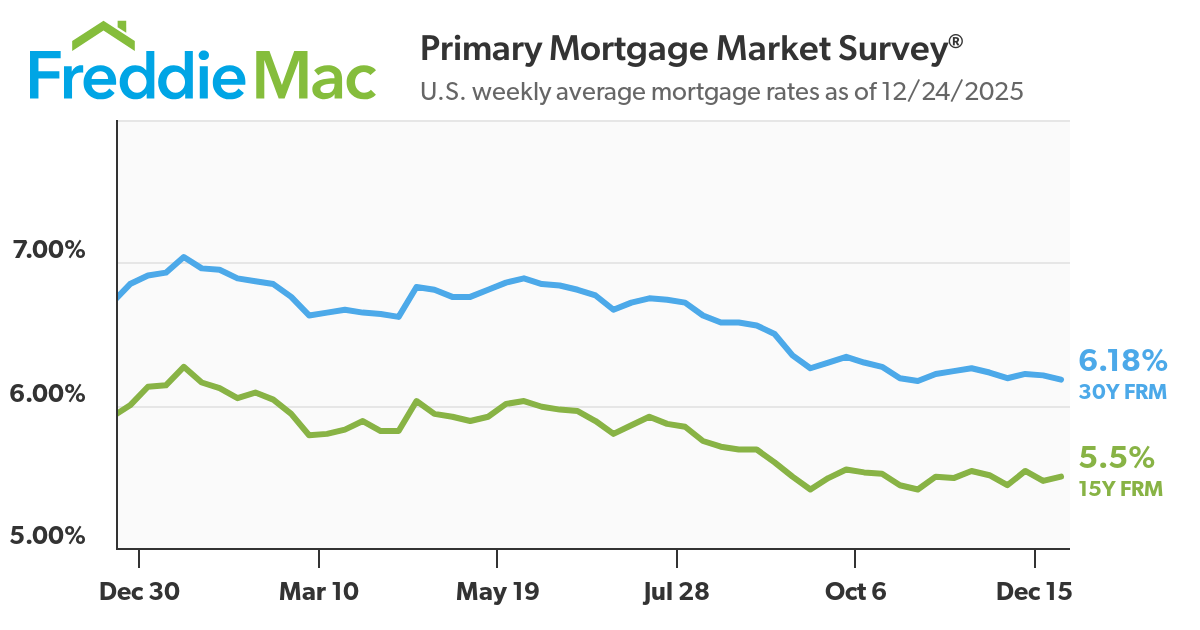
Mortgage Rates Overview - The average rate on a 30-year U.S. mortgage decreased to 6.18% from 6.21% last week, down from 6.85% a year ago [1][2] - The average rate on 15-year fixed-rate mortgages increased to 5.50% from 5.47% last week, compared to 6% a year ago [2] Influencing Factors - Mortgage rates are influenced by the Federal Reserve's interest rate policy, bond market expectations for the economy and inflation, and generally follow the 10-year Treasury yield [2][4] - The 10-year Treasury yield rose to 4.15% from 4.12% last week [3] Market Trends - The average 30-year mortgage rate has remained steady since dropping to 6.17% on October 30, its lowest level in over a year [3] - Home listings have significantly increased from last year, with many sellers lowering their asking prices due to longer selling times [5] Buyer Challenges - Affordability remains a significant challenge for many potential homeowners, particularly first-time buyers without existing home equity [6] - Economic uncertainty and job market conditions are causing many potential buyers to hesitate [6] Sales Performance - Sales of previously occupied U.S. homes rose in November compared to the previous month but slowed year-over-year for the first time since May, with home sales down 0.5% for the first 11 months of the year compared to last year [7] - Economists predict that the average rate on a 30-year mortgage will remain slightly above 6% next year [7]
Heading into the Christmas Holiday, Rates Dip Lower
Globenewswire· 2025-12-24 17:00
Core Insights - The average 30-year fixed-rate mortgage (FRM) decreased to 6.18% as of December 24, 2025, down from 6.21% the previous week and significantly lower than 6.85% a year ago, indicating a positive trend for homebuyers [1][4] - The 15-year FRM increased slightly to 5.50% from 5.47% last week, but is lower than the 6.00% average from a year ago, suggesting mixed trends in shorter-term mortgage rates [4] Company Overview - Freddie Mac's mission is to enhance home affordability and stability in the housing market, having assisted millions of families since its inception in 1970 [2] Market Context - The Primary Mortgage Market Survey (PMMS) focuses on conventional, conforming, fully amortizing home purchase loans for borrowers with excellent credit who make a 20% down payment [1]
Mortgage and refinance interest rates today, December 24: All is calm
Yahoo Finance· 2025-12-24 11:00
Core Insights - Current average mortgage rates show a slight decrease, with the 30-year fixed rate at 6.11% and the 15-year fixed rate at 5.50% [1][15] - The mortgage market is experiencing calm rates, allowing borrowers to compare offers from multiple lenders [1] Mortgage Rates Overview - The national average mortgage rates are as follows: - 30-year fixed: 6.11% - 20-year fixed: 6.03% - 15-year fixed: 5.50% - 5/1 ARM: 6.19% - 7/1 ARM: 6.35% - 30-year VA: 5.56% - 15-year VA: 5.31% - 5/1 VA: 5.44% [4] Refinance Rates - Current mortgage refinance rates are generally higher than purchase rates, but specific rates are not detailed in the provided data [3] Adjustable-Rate Mortgages (ARMs) - ARMs offer lower initial rates compared to fixed-rate mortgages, but they come with the risk of rate increases after the introductory period [12][13] - The 5/1 ARM locks in the rate for the first five years, after which it adjusts annually [12] Economic Outlook - Economists predict that significant drops in mortgage rates are unlikely before the end of 2026, despite recent cuts to the federal funds rate [17] - Mortgage rates have been stable, with a slight overall decrease observed in recent months, remaining about half a point lower than a year ago [18]
Mortgage rates hold steady after Fed rate cut
Yahoo Finance· 2025-12-23 20:15
Core Insights - Mortgage rates remained stable this week, with the 30-year fixed rate averaging 6.30% [1] - The current mortgage rates for various loan types show slight changes compared to previous weeks and years, with the 30-year fixed rate down from 6.94% a year ago [2] - The average total of 0.34 discount and origination points for 30-year fixed mortgages indicates a competitive lending environment [2] Current Mortgage Rates - The 30-year fixed mortgage rate is currently at 6.30%, slightly down from 6.32% four weeks ago and significantly lower than 6.94% one year ago [2] - The 15-year fixed mortgage rate remains unchanged at 5.57%, while the 30-year jumbo mortgage rate is at 6.49%, up from 6.47% four weeks ago [2] Economic Context - The U.S. economy expanded by 4.3% in the summer months, which may influence mortgage rates as good economic news typically leads to higher rates [5] - The Mortgage Bankers Association anticipates that despite some expectations for rates to dip below 6% in 2026, the combination of a growing economy and persistent inflation will keep rates around 6.4% for the year [6] Housing Market Outlook - Increased housing inventory and stabilizing home prices create a favorable environment for potential buyers and those looking to refinance [4] - The national median family income for 2025 is projected at $104,200, with the median home price at $409,200, leading to a monthly payment of $2,026, which constitutes about 23% of a typical family's income [3]