π币

Search documents
公众应守好“钱袋子” 远离虚拟货币
Zheng Quan Shi Bao· 2025-12-05 22:33
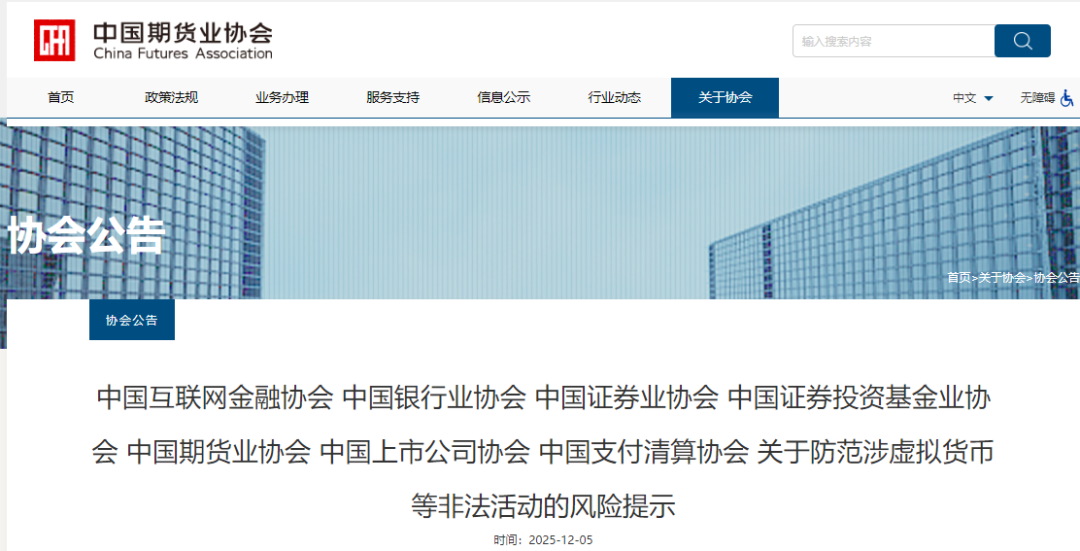
Core Viewpoint - The joint announcement by seven associations emphasizes the illegality of virtual currencies in China, warning the public against engaging in related activities and highlighting the risks associated with such investments [1][2]. Group 1: Regulatory Actions - The China Internet Finance Association and six other associations issued a risk warning regarding virtual currencies, stating they do not hold the same legal status as fiat currencies and cannot be circulated within China [1]. - The People's Bank of China has convened a meeting to coordinate efforts against virtual currency trading and has reiterated its stance on prohibiting virtual currency-related activities [1]. Group 2: Public Warnings - Member units are prohibited from participating in the issuance and trading of virtual currencies and real-world asset tokens within China, and they must not provide related services to clients [2]. - The associations urge the public to enhance their risk awareness and avoid involvement in virtual currency and real-world asset token activities, including illegal fundraising and securities issuance disguised as "mining" [2].
七家协会联合发布风险提示,事关防范涉虚拟货币等非法活动
Qi Huo Ri Bao· 2025-12-05 13:31
Core Viewpoint - The Chinese financial regulatory authorities have issued a risk warning regarding virtual currencies and related illegal activities, emphasizing that virtual currencies are not legal tender and warning the public against participating in such activities [1][4][5]. Group 1: Regulatory Actions - On December 5, multiple financial associations in China jointly released a risk warning to prevent illegal activities related to virtual currencies [1]. - The warning highlights that virtual currencies are not issued by monetary authorities and do not have the same legal status as legal tender, thus cannot be circulated or used within China [4]. Group 2: Risks Associated with Virtual Currencies - Recent trends show a rise in illegal activities related to virtual currencies, including illegal fundraising and Ponzi schemes, often disguised as stablecoins or asset-backed tokens [4]. - Specific tokens like π coin are identified as lacking substantial technological innovation and clear commercial applications, leading to significant fraud and market manipulation risks [4]. - The warning outlines that stablecoins currently do not meet requirements for customer identity verification and anti-money laundering, posing risks of being used for money laundering and illegal fundraising [4]. Group 3: Prohibitions for Financial Institutions - Domestic institutions and individuals are prohibited from engaging in activities related to the exchange of legal tender for virtual currencies and the issuance of asset-backed tokens [5][6]. - Financial institutions, including banks and payment service providers, are instructed not to offer any services related to virtual currencies or asset-backed tokens, including mining operations [6]. Group 4: Public Awareness and Precautions - The public is urged to remain vigilant against various forms of virtual currency and asset-backed token activities, which are often associated with speculation and illegal activities [7]. - Individuals are advised to enhance their risk awareness and avoid participating in any virtual currency-related activities, including those disguised as mining operations [7].