一拖多

Search documents
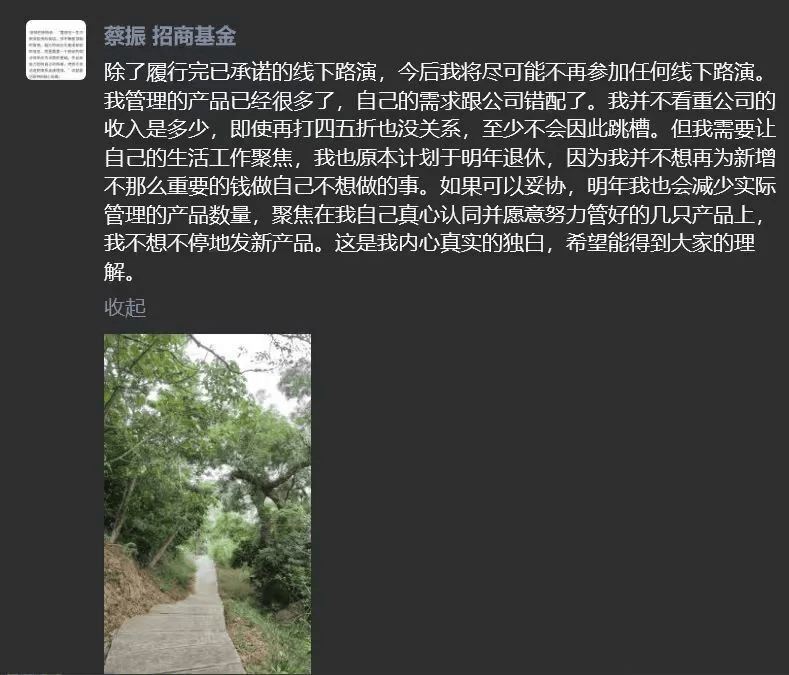
“一拖十二”压垮招商基金经理:朋友圈喊话“减负”!
Guo Ji Jin Rong Bao· 2025-11-26 15:41
Core Viewpoint - The recent comments by Cai Zhen, a fund manager at China Merchants Fund, highlight the increasing burden on fund managers due to the "one manager, multiple funds" phenomenon in the public fund industry, leading to calls for a reduction in the number of products managed by individual managers [1][2][3] Group 1: Fund Management Situation - Cai Zhen has expressed a desire to reduce the number of funds he manages, aiming to focus on a few products he truly believes in, rather than continuously launching new products [2][3] - As of the end of Q3 this year, Cai Zhen manages 12 funds with a total scale of 13.599 billion yuan, indicating a significant workload compared to the average of 3.57 funds per manager at China Merchants Fund [3][4] - The public fund industry has 289 managers overseeing more than 10 funds each, with some managing over 20, reflecting a widespread issue of overextension among fund managers [1][5] Group 2: Performance and Fund Types - Cai Zhen's management experience spans various fund types, including mixed bond funds and index funds, with notable performance in multi-asset and index products, achieving returns of 27.34% and 45.14% respectively [4][5] - However, his actively managed equity products have underperformed, with returns of 8.72% and 10.55%, which are below the average returns of their respective categories [5][6] - The disparity in performance raises questions about the effectiveness of managing multiple fund types simultaneously, particularly in the context of active equity funds that require deeper market research [6][7] Group 3: Industry Challenges - The "one manager, multiple funds" issue is symptomatic of a broader challenge in the public fund industry, where the average manager oversees 2.74 funds, yet many are burdened with excessive numbers [5][6] - The pressure to scale up and attract investments often leads to experienced managers being assigned multiple funds, which can dilute their focus and impact the quality of fund management [7] - The trend towards homogenized investment strategies among multiple funds managed by a single manager can undermine investor confidence and the perceived value of high-performing fund managers [7]
招商基金蔡振的一条朋友圈,戳中了公募的隐痛
Sou Hu Cai Jing· 2025-11-18 09:54
Core Viewpoint - The public discussion initiated by fund manager Cai Zhen highlights the mismatch between the increasing number of products managed by fund managers and the available research resources, emphasizing the industry-wide issue of "one manager, multiple funds" [1][7]. Group 1: Fund Manager's Perspective - Cai Zhen expressed a desire to reduce the number of products he manages, focusing on a few that he believes he can perform well with, indicating a personal struggle with the current workload [3][4]. - He currently manages 12 main funds, with the total number of products nearing 20, spanning various types including bond, enhanced index, and mixed funds, which reflects a broad asset allocation [3][6]. - Among 3,894 active fund managers, 290 manage more than 10 main funds, placing Cai Zhen in a high-pressure group, particularly as he is the only one focusing primarily on equity investments [3][8]. Group 2: Industry Dynamics - The "one manager, multiple funds" phenomenon is a response to the industry's growth logic, where fund companies expand product lines to increase management fees and market presence, but this creates significant pressure on fund managers [8][11]. - The public fund industry has historically prioritized scale, but as growth slows, the mismatch between product expansion and research capabilities is becoming more pronounced [8][11]. - The structural challenges faced by the industry are evident in the declining rankings of non-monetary fund sizes for companies like招商基金, which has seen its ranking drop from 9th to 11th in this category [9][10]. Group 3: Company-Specific Challenges - 招商基金's public management scale remains stable at approximately 950 billion yuan, ranking 12th in the industry, but its core competitive indicator, non-monetary fund size, has seen a decline [9][10]. - The company is experiencing a transitional phase in its management structure, with recent leadership changes that may impact the allocation of research resources and organizational optimization [12][13]. - The need for a more rational investment incentive mechanism and talent management logic is critical for 招商基金 to address the pressures of "one manager, multiple funds" and ensure long-term competitiveness [13].