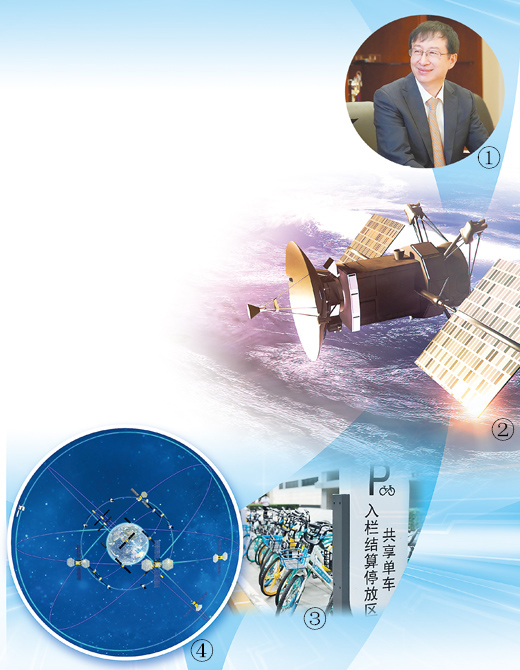
下一代北斗系统

Search documents
“十四五”我国北斗产业综合指数同比增长超60%
Zhong Guo Chan Ye Jing Ji Xin Xi Wang· 2025-11-26 00:20
Core Insights - The "2025 China Beidou Industry Development Index Report" indicates a robust growth trend in China's Beidou industry, with a comprehensive index reaching 1579 points by mid-2025, reflecting a year-on-year increase of 10.34% and over 60% growth compared to 2020 [1] Industry Overview - The report highlights that by mid-2025, the number of various types of Beidou terminal devices (excluding consumer electronics) has exceeded 33 million units, marking an increase of over 6 million units year-on-year, with a growth rate exceeding 22% [1] - The penetration rate of Beidou applications is approximately 90%, with over 30 million terminal devices applied in 14 key industry sectors, showing a year-on-year growth of over 27% [1] Consumer Sector - In the consumer sector, Beidou applications are deepening, with over 98% of domestic smartphones supporting Beidou positioning as of mid-2025, and 52 smartphone models defaulting to Beidou, with a shipment volume of 27.82 million units [2] - The shipment volume of passenger cars equipped with Beidou terminals exceeded 10 million units, and the daily active users of the Beidou network-assisted public service platform surpassed 100 million, reflecting a year-on-year increase of approximately 75% [2] Regional Development - The development of the Beidou industry is concentrated in five key regions: Beijing-Tianjin-Hebei, Guangdong, East China, the western region centered around Chengdu and Chongqing, and Central China around Zhengzhou, Wuhan, and Changsha [2] Industry Applications - The top five sectors for Beidou application index rankings are transportation, communication, natural resources, emergency response, and agriculture [3] Internationalization - Despite being the latest to start, the internationalization of Beidou shows significant potential, with the system gaining recognition in international standards organizations for civil aviation, maritime, mobile communication, and search and rescue [3] - The report notes a marked increase in overseas project numbers, the countries covered, overseas business revenue for Beidou enterprises, and internationalization policies, contributing to a significant rise in the internationalization index [3] Future Outlook - The report anticipates the completion of the comprehensive positioning, navigation, and timing (PNT) system and the next-generation Beidou system by 2035, which will be a critical milestone for the development of China's PNT and spatial service industry [3] - It emphasizes the need for effective evaluation of Beidou application efficiency and encourages deeper integration of Beidou across various sectors, promoting coordinated regional industrial development [3]
中国北斗的进化:从“天边”到“身边”
Ren Min Ri Bao· 2025-10-25 22:11
Core Insights - The Beidou satellite navigation system has entered a new phase of large-scale application, integrating into national infrastructure and various sectors including aviation and maritime [2][3] - The system has achieved significant advancements in precision and stability, with positioning accuracy improving from ten meters to sub-meter levels [3][4] - The next generation of the Beidou system aims to enhance technology and service quality, with plans for a lunar navigation system by 2035 [8][9] Technological Upgrades - The Beidou system has upgraded its onboard atomic clock and introduced new inter-satellite link terminals, enhancing timing precision to a level of one second error every 300 million years [4][5] - The new inter-satellite link technology allows for improved communication and data transmission between satellites, reducing the need for ground stations [4][5] - The system's Ka-band phased array inter-satellite link technology has improved orbit determination accuracy to centimeter-level [5] New Applications - The integration of the Beidou system with big data, AI, IoT, and 5G technologies has led to innovative applications across various industries [6] - An example includes the synchronization of traffic lights using Beidou's precise timing signals, improving traffic flow and efficiency [6][7] - As of the end of 2024, nearly 30 million Beidou terminal devices are expected to be in use, with over 2.3 billion compatible chips shipped [7] Future Trends - The next generation of the Beidou system is set to be more advanced, with key technology development already underway, aiming for a lunar navigation system by 2035 [8][9] - The establishment of a three-satellite constellation in the Earth-Moon space is a significant step towards creating a unified time-space reference for both Earth and lunar users [9]