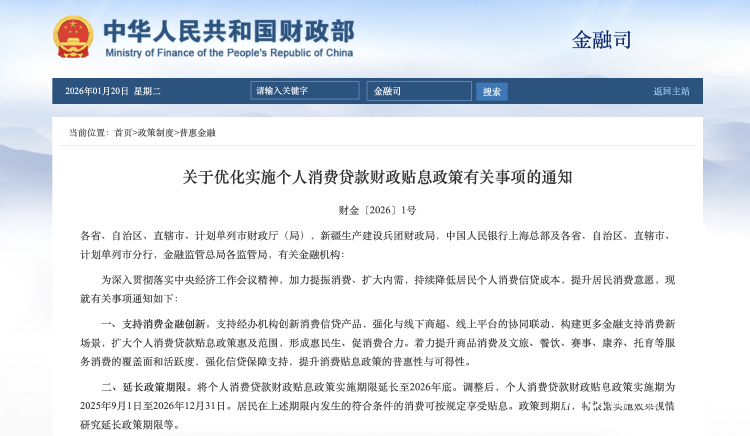
个人消费贷财政贴息政策

Search documents
个人消费贷“国补”政策再加码,消费贷实际利率跌入2%区间
Huan Qiu Wang· 2026-01-23 01:16
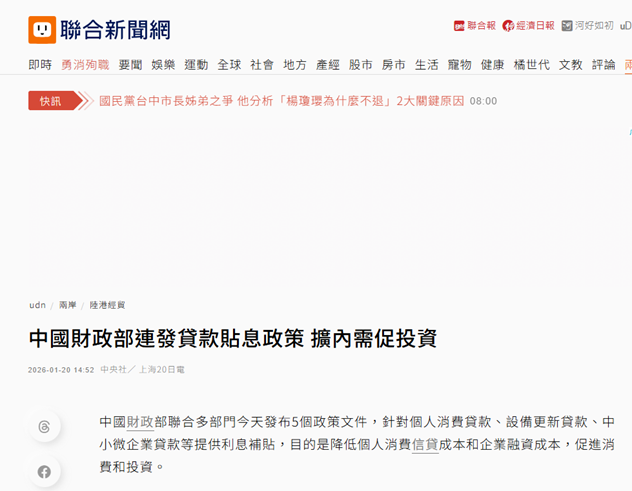
Group 1 - The core viewpoint of the article is that the Chinese government is extending the personal consumption loan interest subsidy policy until the end of 2026 to stimulate economic growth and consumer spending [1][3] - Six major state-owned banks have collectively announced the implementation of the personal consumption loan interest subsidy policy, optimizing related services, which allows some high-quality customers to enjoy actual interest rates as low as 2% after subsidies [1] - The policy aims to reduce the cost of personal consumption credit and corporate financing by providing interest subsidies for various loans, including personal consumption loans, equipment upgrade loans, and loans for small and micro enterprises [1][3] Group 2 - The Chinese government is supporting financial institutions to innovate consumer credit products and expand the scope of the personal consumption loan interest subsidy policy, including incorporating credit card installment payments and lowering the consumption amount threshold for subsidies [3] - A special guarantee plan for private investment has been introduced with a total quota of 500 billion yuan, to be implemented over two years, with a single credit guarantee limit of no more than 20 million yuan [3] - The plan encourages cooperation institutions to increase support for high-quality private enterprise investment projects that meet national strategic requirements, within the risk-controlled guarantee limit [3]

个人消费贷“国补”加码!信用卡账单分期纳入贴息范围
Guo Ji Jin Rong Bao· 2026-01-20 14:57
Core Viewpoint - The Ministry of Finance, the People's Bank of China, and the National Financial Regulatory Administration have announced an optimization of the personal consumption loan interest subsidy policy, extending its implementation period and expanding its scope to enhance consumer spending and improve living standards [1][3]. Group 1: Policy Adjustments - The implementation period for the personal consumption loan interest subsidy policy has been extended to December 31, 2026, with the new effective period from September 1, 2025, to December 31, 2026 [3]. - The scope of the subsidy has been expanded to include credit card installment payments, with an annual subsidy rate of 1% [3][4]. - The policy has removed previous restrictions on consumption areas, allowing consumers to enjoy subsidies for various types of spending as long as they meet the criteria [3][4]. Group 2: Financial Institutions and Support - The range of financial institutions eligible to provide subsidies has been broadened to include city commercial banks, rural cooperative financial institutions, foreign banks, consumer finance companies, and auto finance companies [5]. - The central and provincial finances will bear 90% and 10% of the subsidy costs, respectively, which is expected to reduce local fiscal pressure and directly impact local consumption data [5]. - The optimization of the policy is anticipated to stimulate consumption in third- and fourth-tier cities and rural areas, which are significant growth points for the consumer market [5][6]. Group 3: Implementation and Efficiency - The government emphasizes a coordinated approach to fiscal and financial policies to boost domestic demand, focusing on simplifying processes and ensuring direct benefits to consumers [8]. - Recommendations include enhancing the precision of policy design, improving execution efficiency, and fostering collaboration among related policies to create a sustainable consumer market [9][10]. - Local governments are encouraged to tailor subsidy models to their unique economic conditions and consumer behaviors, ensuring that the policies effectively stimulate local consumption [10].
事关消费者钱袋子!解读个人消费贷财政贴息新政
Nan Fang Du Shi Bao· 2026-01-20 11:53
Core Insights - The Ministry of Finance, the People's Bank of China, and the Financial Regulatory Administration have extended the personal consumption loan interest subsidy policy until the end of 2026, with the new implementation period from September 1, 2025, to December 31, 2026 [1] - The policy now includes credit card installment payments with an annual subsidy rate of 1%, broadening the scope of financial support for consumers [1][5] Policy Background - The personal consumption loan interest subsidy policy has been in development since 2025, with significant implementation success noted shortly after its introduction [2] - Banks in Guangdong quickly adapted to the policy, optimizing service processes and facilitating access to subsidies for over 5,800 new clients within a month, with total loans exceeding 100 million yuan [2] Expansion of Support Scope - The new policy notably expands the support scope by including credit card installment payments, allowing consumers to benefit from subsidies on various expenditures such as shopping, travel, and home renovations [5][6] - Financial institutions are encouraged to innovate consumer credit products and collaborate with offline and online platforms to enhance consumer spending [5] Increased Subsidy Standards - The updated policy removes previous limits on subsidy amounts, allowing for greater financial relief for consumers making large purchases [7][8] - The new structure maintains a cap of 3,000 yuan per borrower per year while eliminating previous restrictions, thus enhancing the attractiveness of the subsidy for consumers [9] Broader Participation of Financial Institutions - The policy now includes a wider range of financial institutions, allowing more local banks and non-bank entities to participate in the subsidy program [10] - This expansion aims to improve accessibility and choice for consumers, particularly in lower-tier cities where demand for consumer loans is growing [11] Recommendations for Future Optimization - Experts suggest further refining the policy to enhance its effectiveness, including improving the precision of policy design and execution processes [12] - There is a call for better integration of data between government and banks to streamline loan approval processes and ensure timely disbursement of subsidy funds [12]