
设备更新贷款

Search documents
热点思考 | 投资“开门红”可否持续?(申万宏观·赵伟团队)
赵伟宏观探索· 2026-03-30 17:08
Group 1 - The fixed asset investment growth rate rebounded significantly in early 2026, with a historical increase of 16.9 percentage points to 1.8% compared to December 2025, marking a rare turnaround after seven months of decline [1][8][123] - All four major investment categories—real estate, services, broad infrastructure, and manufacturing—showed substantial recovery, with increases of over 10 percentage points each [1][8][123] - The construction and installation investment, which had previously declined sharply, rebounded by 28.6 percentage points to 0.6%, significantly contributing to the overall fixed asset investment growth [1][13][123] Group 2 - Government and state-owned enterprise investments began to recover earlier than private investments, with government investment growth reaching 3.1% in early 2026 after a decline to -31.3% in October 2025 [2][19][124] - Private investment saw its first rebound in early 2026, increasing by 14.6% compared to December 2025, although it remained negative at -2.6% [2][19][124] Group 3 - The rebound in investment is attributed to improved conditions regarding previous issues of "lack of funds" and "lack of projects," with the easing of the "broad debt" effect on investment [3][31][125] - The issuance of special refinancing bonds improved the funding situation, while government fiscal spending increased, alleviating the pressure on investment funds [3][31][125] - Policies supporting private financing were implemented in early 2026, including a special quota of 1 trillion yuan for small and micro enterprises, which contributed to over 280 billion yuan in investment [3][50][125] Group 4 - The early 2026 launch of "two重" construction projects by the National Development and Reform Commission addressed the previous shortage of project reserves, with the number of projects increasing to 281 and funding raised to 220 billion yuan [4][63][125] - The investment growth rate for new and expanded projects rebounded to around 6% in early 2026, following a significant decline in the latter half of 2025 [4][63][125] Group 5 - The gap between fixed asset investment and historical trends is estimated to be close to 4 trillion yuan, with specific shortfalls in manufacturing, broad infrastructure, and real estate investments of 1.3 trillion, 1.2 trillion, and 0.7 trillion yuan respectively [5][67][125] - Incremental fiscal funds are expected to fill the investment gap, particularly in the new infrastructure sector, with a focus on integrating traditional infrastructure with digital and communication investments [5][78][125]

工商银行扎实做好五篇大文章深耕设备更新贷款领域
Qi Lu Wan Bao· 2026-03-13 12:47
Group 1 - The core viewpoint emphasizes the importance of large-scale equipment renewal loan business as a measure to implement central financial meeting policies and enhance the "Two New" policy [1] - In 2025, the bank approved 14 equipment renewal loan projects, achieving a loan disbursement of 4.6 billion yuan, supporting enterprises in technology upgrades and equipment renewal [1] - The bank has established a detailed target enterprise list and adopted a "one enterprise, one policy" service model to effectively lower financing costs for enterprises [1] Group 2 - The bank responded quickly to the Ministry of Industry and Information Technology's first batch of technical transformation project lists, forming a team to provide comprehensive financial services [2] - In 2024, the bank successfully signed and disbursed the first technical transformation and equipment renewal loan of 200 million yuan in Shandong Province [2] - The bank aims to continue supporting large-scale equipment renewal and integrate it with the "Five Major Articles" and the "14th Five-Year Plan" to contribute to the development of new productive forces in the city [2]

银行行业点评:政策托底持续发力,行业经营与风险化解双向向好
GOLDEN SUN SECURITIES· 2026-03-11 00:24
Investment Rating - The report maintains an "Increase" rating for the banking industry, indicating a positive outlook for the sector [4]. Core Insights - The report highlights a systematic policy deployment for the banking industry, focusing on four main areas: supporting the real economy, capital replenishment for banks, risk prevention and resolution, and optimizing financial market order [1]. - The monetary policy is characterized by a dual approach of "total easing + fiscal collaboration for credit repair," which is expected to benefit the banking sector by lowering funding costs and enhancing credit support to the real economy [2][3]. - The issuance of CNY 300 billion in special government bonds to support state-owned commercial banks' capital replenishment is a key measure to enhance the stability of the banking system and improve its capacity to serve the economy [7][9]. Summary by Sections Monetary Policy and Banking Fundamentals - The government aims for an economic growth target of 4.5%-5% and a consumer price increase of around 2%, continuing a moderately loose monetary policy [2]. - The policy shift from single total easing to a dual approach is expected to provide substantial liquidity support for credit issuance [2][3]. Fiscal Policy and Credit Growth - The issuance of CNY 300 billion in special government bonds is part of a broader strategy to enhance the capital base of major state-owned banks, ensuring their ability to expand credit [7][9]. - A new CNY 1 trillion fiscal-financial collaborative fund aims to stimulate consumer spending and support small and micro enterprises, potentially unlocking significant credit growth [10][11]. Industry Competition and Quality Improvement - The report emphasizes the need to regulate competition among financial institutions and reduce irrational competition, particularly among smaller banks, to promote high-quality development [14][15]. - The focus on "reducing quantity and improving quality" for small financial institutions is expected to stabilize the banking sector and enhance its service to the real economy [15]. Risk Resolution in Key Areas - The report outlines ongoing efforts to address risks in three critical areas: small financial institutions, local government debt, and the real estate sector, with a focus on stabilizing the financial system [16][18]. - The government has made significant progress in reducing the number and scale of financing platform debts, indicating a clearer path for local government debt risk resolution [17]. Investment Recommendations - The report recommends focusing on two main investment themes: high-dividend stocks with stable earnings and strong dividend policies, and quality growth stocks in regional banks with solid fundamentals [19].
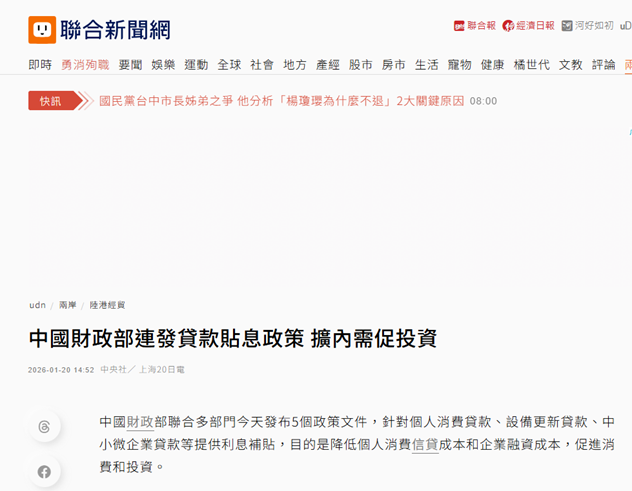
财政部新设、优化一揽子贷款贴息政策
Ren Min Ri Bao Hai Wai Ban· 2026-02-05 06:32
Core Viewpoint - The recent upgrades to loan interest subsidy policies aim to enhance consumer and business financing, thereby stimulating domestic demand and supporting the real economy through fiscal and financial collaboration [1][2][4]. Group 1: Consumer Loan Subsidy Policies - The upgraded consumer loan subsidy policies provide a 1% interest subsidy on personal consumption loans and loans for service industry operators, significantly benefiting consumers in large expenditure scenarios such as car purchases and home renovations [2][3]. - The inclusion of credit card installment payments in the subsidy scope has been well-received, allowing consumers to benefit from subsidies without needing to take out separate loans [3][4]. - The policies are designed to be more convenient and long-lasting, with automatic application of the latest subsidy terms to existing loan agreements [2][10]. Group 2: Support for Small and Micro Enterprises - A new loan interest subsidy policy for small and micro enterprises addresses the challenges of high financing costs, offering a subsidy of 1.5% on loans for up to two years, with a maximum loan amount of 50 million yuan [7][8]. - The policy targets key industries such as new energy vehicles, industrial robots, and medical equipment, aiming to reduce interest expenses significantly for businesses [7][9]. - The expansion of the equipment update loan subsidy policy includes more sectors and types of loans, further alleviating financial burdens on enterprises [8][9]. Group 3: Implementation and Efficiency - The policies are set to be effective until December 31, 2026, with potential for extension based on their effectiveness [10][12]. - Efforts are being made to streamline the application process for subsidies, aiming for a seamless experience where consumers automatically receive subsidies upon loan repayment [11][12]. - The focus is on ensuring that the policies effectively reach key sectors and demographics, enhancing consumer purchasing power and reducing financing barriers for businesses [11][12].
财政部新设、优化一揽子贷款贴息政策——贷款贴息“红包”更大了
Sou Hu Cai Jing· 2026-02-05 02:40
Core Viewpoint - The recent upgrades to loan interest subsidy policies aim to enhance consumer and business access to financing, thereby stimulating domestic demand and supporting the real economy [1][2]. Group 1: Consumer Loan Subsidy Policies - The upgraded consumer loan subsidy policies provide a 1% interest subsidy on personal consumption loans and loans for service industry operators, benefiting both consumers and businesses [2][3]. - The policies have been optimized to extend the subsidy period until December 31, 2026, enhancing convenience for consumers who can automatically apply the new subsidy terms to existing agreements [2][9]. - The inclusion of credit card installment payments in the subsidy scope has been well-received, allowing more consumers to benefit from the interest subsidy [3][4]. Group 2: Support for Small and Micro Enterprises - A new loan interest subsidy policy for small and micro enterprises addresses the challenges of high financing costs, offering a subsidy of 1.5% on loans for up to two years, with a maximum loan amount of 50 million yuan [6][8]. - The policy targets key industries such as new energy vehicles, industrial robots, and medical equipment, aiming to reduce financing costs and enhance investment capacity for enterprises [6][7]. - The expansion of the equipment update loan subsidy policy includes more sectors, providing additional support for businesses in upgrading their facilities [6][7]. Group 3: Policy Implementation and Efficiency - The government emphasizes the need for efficient policy implementation, aiming for a seamless connection between loan interest payments and subsidies, with a focus on simplifying processes for consumers and businesses [9][10]. - The goal is to ensure that consumers and businesses can easily access the benefits of the subsidy without complex application procedures, enhancing the overall effectiveness of the policy [10].
财政部新设、优化一揽子贷款贴息政策 贷款贴息“红包”更大了
Zhong Guo Xin Wen Wang· 2026-02-05 02:28
Group 1 - The core viewpoint of the article is the expansion and optimization of loan interest subsidy policies by the Ministry of Finance to stimulate domestic demand and support the real economy, particularly through consumer and small to medium-sized enterprise loans [1][2][4] - The upgraded consumer loan subsidy policies provide a 1% interest subsidy on personal consumption loans and service industry loans, enhancing affordability for consumers and businesses [2][3] - The policies now include credit card installment payments for subsidies, broadening the scope of financial support for consumers [3][4] Group 2 - The new small and medium-sized enterprise loan subsidy policy offers a 1.5% interest subsidy for loans up to 50 million yuan, targeting key industries such as new energy vehicles and medical equipment [6][7] - The equipment update loan subsidy policy has been expanded to include fixed asset loans related to equipment updates and technology innovation, providing similar interest subsidies [6][7] - The Ministry of Finance aims to reduce financing costs for enterprises, thereby enhancing their investment capacity and willingness [6][8] Group 3 - The policies are designed to facilitate a seamless connection between loan interest payments and subsidies, aiming for an efficient implementation process [10][11] - The Ministry of Finance plans to continuously optimize these policies to create a favorable consumption environment and provide tangible benefits to more enterprises and residents [11]
北京银行关于落实财政金融促内需一揽子政策工作的公告
Xin Lang Cai Jing· 2026-02-04 10:01
Core Viewpoint - The company is actively implementing policies to support consumer loans, credit card installment plans, and financing for small and micro enterprises, in line with government directives to boost consumption and reduce financing costs [1][2][3] Group 1: Policy Implementation - The company is advancing the implementation of personal consumption loans, credit card installment plans, loans for service industry entities, small and micro enterprises, and equipment upgrade loans [1][2] - The implementation is based on several government notifications aimed at optimizing fiscal subsidy policies for personal consumption and business loans [1][2] Group 2: Operational Guidelines - The company will adhere to market-oriented and legal principles, optimizing business processes and simplifying procedures to expedite policy rollout [1][2] - Specific channels and operational guidelines for these policies will be published through the company's official website, WeChat account, and local branches [1][2] Group 3: Customer Advisory - The company will not charge any service fees for the aforementioned loans and has not partnered with any loan intermediaries or individuals [3] - Customers are advised to remain vigilant against potential scams [3]

2025年国开行向长江经济带沿江省市发放贷款超1万亿元
Xin Hua Cai Jing· 2026-01-23 02:57
Core Insights - The National Development Bank plans to issue over 1 trillion yuan in loans to provinces along the Yangtze River Economic Belt by 2025, focusing on pollution reduction, carbon reduction, green growth, infrastructure connectivity, and industrial optimization [1] Group 1: Environmental Initiatives - The Jiangxi branch of the National Development Bank will provide 1.6 billion yuan in loans by 2025 to support the integrated renovation and expansion of sewage treatment plants, pollution control facilities, and underground comprehensive pipeline construction, contributing to the improvement of water quality in the Jiujiang section of the Yangtze River [1] - The Jiujiang section has maintained Class II water quality for seven consecutive years, with key water bodies like the Gan River and Xiu River meeting quality standards, and 100% compliance for drinking water sources at the county level [1] Group 2: Innovation and Development - The Jiangsu branch will invest 110 million yuan in 2025 to support the construction of the National Intelligent Sensor Center in Jiangsu, aiming to create a platform for sensor technology and promote the integration of the entire industry chain [1] - The Anhui branch has issued a total of 2.47 billion yuan in loans to support Chery's research and development of new energy vehicles, automation upgrades, and key component improvements, leading to a 54.9% year-on-year increase in sales of Chery's new energy vehicles in 2025 [1] Group 3: Transportation and Infrastructure - The Shanghai branch will provide 1.8 billion yuan in loans in 2025 to support the Shanghai Automotive Group and its subsidiaries in vehicle research and development and technology upgrades, enhancing the new energy product matrix [2] - Various branches, including those in Sichuan, Chongqing, Hubei, Guizhou, Hunan, and Yunnan, will support the construction of a comprehensive transportation corridor along the Yangtze River, facilitating regional collaboration and economic coordination [2] - The Ningbo branch will utilize various financial products to support infrastructure construction and logistics network development at the Ningbo-Zhoushan Port, addressing diverse financial service needs [2] Group 4: Cultural Heritage - The Suzhou branch has formed a syndicate to provide 20.8 billion yuan in special credit for the high-quality protection and enhancement of Suzhou's historical and cultural sites, with a cumulative issuance of 11.923 billion yuan [2]
个人消费贷“国补”政策再加码,消费贷实际利率跌入2%区间
Huan Qiu Wang· 2026-01-23 01:16
Group 1 - The core viewpoint of the article is that the Chinese government is extending the personal consumption loan interest subsidy policy until the end of 2026 to stimulate economic growth and consumer spending [1][3] - Six major state-owned banks have collectively announced the implementation of the personal consumption loan interest subsidy policy, optimizing related services, which allows some high-quality customers to enjoy actual interest rates as low as 2% after subsidies [1] - The policy aims to reduce the cost of personal consumption credit and corporate financing by providing interest subsidies for various loans, including personal consumption loans, equipment upgrade loans, and loans for small and micro enterprises [1][3] Group 2 - The Chinese government is supporting financial institutions to innovate consumer credit products and expand the scope of the personal consumption loan interest subsidy policy, including incorporating credit card installment payments and lowering the consumption amount threshold for subsidies [3] - A special guarantee plan for private investment has been introduced with a total quota of 500 billion yuan, to be implemented over two years, with a single credit guarantee limit of no more than 20 million yuan [3] - The plan encourages cooperation institutions to increase support for high-quality private enterprise investment projects that meet national strategic requirements, within the risk-controlled guarantee limit [3]
阳谷金融监管支局搭建三维支持体系,精准滴灌小微企业茁壮成长
Qi Lu Wan Bao· 2026-01-22 11:01
Core Insights - The article highlights the effective financial support system for small and micro enterprises in Yanggu County, which has led to significant loan growth and improved access to financing for local businesses [1][2][6] Group 1: Financial Support and Growth - As of December 2025, the balance of inclusive loans for small and micro enterprises in Yanggu County reached 94.58 billion yuan, an increase of 14.72 billion yuan or 18.43% from the beginning of the year [1] - The financial regulatory bureau has established a "policy + product + service" support system to continuously nourish the development of small and micro enterprises in the region [1][6] Group 2: Financing Mechanisms - A "dual-track list" model has been implemented to match financing needs, where the development and reform department identifies key enterprises while banks are encouraged to discover potential small and micro enterprises [2] - The county has conducted market visits to 13,630 businesses, granting credit to 7,122 enterprises totaling 73.31 billion yuan, with 7,063 loans amounting to 67.98 billion yuan at an average interest rate of 3.92% [2] Group 3: Innovative Financing Products - The introduction of "intellectual property pledge loans" allows companies like Shandong Yanggu Hengchang Cable Group to use patents as collateral, facilitating access to 2.8 million yuan in loans for production line upgrades [4] - Customized loan products such as "Agricultural Assistance Loans" have been developed to support agricultural enterprises, enabling a cooperative to secure 350,000 yuan for expanding high-standard greenhouses [4] Group 4: Service Efficiency Improvements - The financial regulatory bureau has streamlined loan processes, reducing the time for loan approval from 8 days to 3 days, significantly enhancing service efficiency for businesses [5] - A comprehensive approach has been adopted to ensure that financial services are delivered effectively, including on-site visits by bank managers and a closed-loop process for tracking loan progress [5][6]