中华文明突出特性

Search documents
吴越文化蕴含的中华文明突出特性
Xin Lang Cai Jing· 2026-02-13 19:33
Core Viewpoint - The article discusses the significance of the Wu-Yue culture during the Five Dynasties and Ten Kingdoms period, highlighting its contributions to social stability, economic development, cultural integration, trade, and peaceful governance, which collectively shaped the character of Jiangnan culture and contributed to the continuity of Chinese civilization [1][6]. Group 1: Social Stability and Continuity - Wu-Yue culture reflects continuity through social stability, originating from the Spring and Autumn period and inheriting the openness of Tang culture, ultimately forming a unique regional characteristic [2]. - The Wu-Yue state adopted strategies of "protecting the territory and ensuring the people's safety," leading to a prolonged period of stability in the Zhejiang region, which laid the foundation for the prosperity of the Yangtze River Delta [2]. - Historical figures like Su Shi acknowledged the peaceful life of Wu-Yue citizens, emphasizing the state's significant contributions to history [2]. Group 2: Economic Development and Innovation - The Wu-Yue state implemented practical strategies to encourage agriculture and handicrafts, leading to the flourishing of industries such as silk, ceramics, and tea, which were crucial for the economic rise of the Song Dynasty [3]. - Innovations like the "bamboo cage stone pond method" for flood control were developed, influencing engineering practices for centuries [3]. - The urban planning of Hangzhou, characterized by its harmonious integration with natural landscapes, set a precedent for water network cities in Jiangnan [3]. Group 3: Cultural Integration and Unity - The integration of Yue and Wu cultures resulted in a unified Wu-Yue culture, flourishing in arts such as poetry and painting due to the stable social environment [4]. - Wu-Yue culture emphasized the fusion of technology and art, contributing to advancements in architecture and astronomy, which influenced later works [4]. - The state played a significant role in the cultural exchange of Buddhism with neighboring regions, promoting the sinicization of Buddhism [4]. Group 4: Trade and Inclusiveness - Wu-Yue's geographical advantage facilitated extensive trade, making it a prosperous region during turbulent times, with exports including tea, silk, and ceramics [5]. - The state maintained close trade relations with the Central Plains and foreign regions, exporting goods that were well-received internationally [5]. - The flourishing overseas trade contributed to cultural exchanges and laid the groundwork for the maritime Silk Road during the Song and Yuan dynasties [5]. Group 5: Peaceful Governance - The Wu-Yue state established a governance strategy focused on "protecting the territory and ensuring the people's safety," maintaining allegiance to the Central Plains [6]. - The peaceful transition of power and the decision to integrate into the Song Dynasty exemplified the state's commitment to national unity and stability [6]. - This historical decision not only brought peace to the people but also established a model for future governance in the Jiangnan region [6].


建体系、强协调,广州历史文化名城保护最新规划“新”在哪?
Nan Fang Du Shi Bao· 2025-08-13 15:59
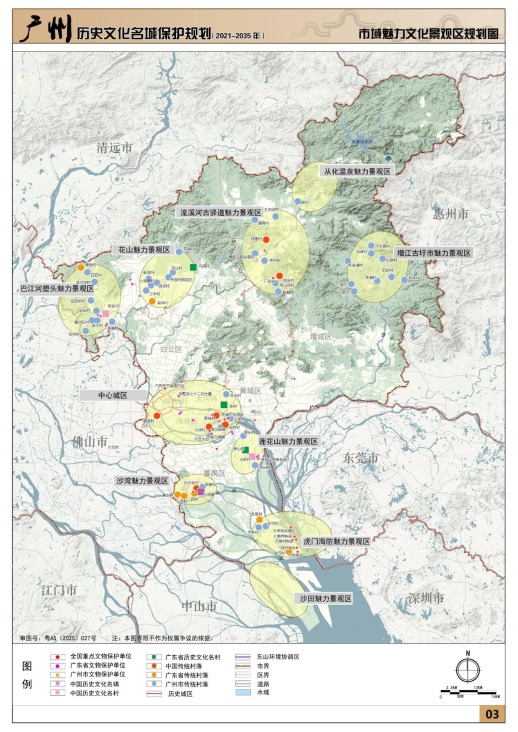
Core Points - Guangzhou has officially issued the "Historical and Cultural City Protection Plan (2021-2035)" which serves as a top-level design and guiding document for the protection and inheritance of its historical culture [1] - The plan integrates national and regional development strategies, optimizing the five major historical cultural values and six major city characteristics, while enhancing the historical and cultural protection system [1][3] - The plan aims to incorporate historical and cultural heritage protection into urban and rural construction, creating a world-class city with classic charm and contemporary vitality by 2035 [1] Summary by Sections Historical and Cultural Values and City Characteristics - The five major historical cultural values identified include: 1. Political and military center of the Lingnan region and a gateway for foreign exchanges 2. A thousand-year-old commercial hub and an important birthplace of the Maritime Silk Road 3. A cultural center reflecting the diverse and unified characteristics of Chinese civilization 4. A frontline for anti-imperialism and anti-feudalism, and a source of democratic revolution 5. A pioneering city in modern development and a leader in reform and opening up [3][2] - The six major city characteristics include: 1. A town pattern interwoven with mountains, fields, and seas 2. An urban environment characterized by clouds, mountains, and rivers 3. An ancient city layout with a thousand-year continuity and layered culture 4. A commercial hub with distinctive architectural styles 5. A blend of Lingnan charm and Western architectural styles 6. An open and inclusive city with vibrant cultural heritage [2][3] Overall Structure and Protection Framework - The plan proposes a new spatial structure for cultural and ecological integration, termed "One River, One River, One City, Nine Districts," which includes the Pearl River cultural belt and the Liuxi River cultural belt [5][4] - The "One City, Nine Districts" concept integrates historical culture and natural ecological resources, forming a central urban area and nine scenic areas rich in resources [5][4] Heritage Protection and Expansion - The plan expands the scope of heritage protection to include agricultural, industrial, and water heritage, such as the Guangdong Lingnan lychee planting system and historical sites like Guanggang and Guangchuan [9][8] - It emphasizes the protection of 9,961 ancient trees and various historical sites, enhancing resource identification and protection efforts [9][8] Historical Urban Area Protection - The historical urban area covers 20.39 square kilometers, with specific protection requirements for historical docks and water systems [11][12] - The plan maintains the traditional urban structure of "One Ring, Two Axes, Multiple Veins, and Multiple Points," emphasizing the preservation of historical features [12][14] Cultural Network and Regional Cooperation - The plan establishes a cultural network system for the Guangdong-Hong Kong-Macao Greater Bay Area, highlighting Guangzhou's role as a cultural center [18][17] - It encourages cultural innovation and the development of creative industries, integrating modern creative sectors with historical cultural promotion [18][17]