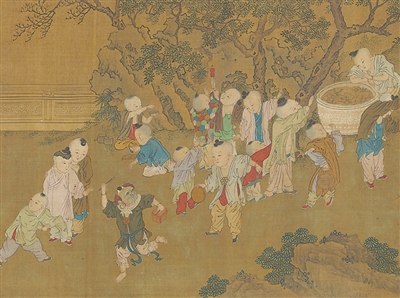
中国画儿童题材画作

Search documents
探寻中国画里的童趣(新语)
Ren Min Ri Bao· 2025-06-02 22:02
Core Viewpoint - The article highlights the evolution and significance of children's theme paintings in Chinese art, showcasing their cultural and social relevance across different historical periods [2][3][4]. Group 1: Historical Development - The earliest known children's theme painting, "婴戏图," dates back to the Three Kingdoms period, depicting children in playful scenarios [2]. - During the Song Dynasty, children's paintings became more realistic and detailed, exemplified by Su Hancheng's "长春百子图卷," which captures various seasonal activities of children [2]. - The Ming Dynasty introduced innovative styles, with works like Xia Kui's "婴戏图" reflecting the lively atmosphere of children's play [3]. - In the Qing Dynasty, artists like Sha Fu depicted children's learning environments, emphasizing Confucian values [3]. Group 2: Modern and Contemporary Trends - The modern era saw a diversification in artistic expression, with artists like Feng Zikai focusing on everyday moments of children's lives, while Zhang Leiping's "三毛流浪记" highlighted the struggles of underprivileged children [3]. - After the establishment of New China, children's theme paintings flourished, with notable works like "我们热爱和平" and "鸡毛信" becoming widely recognized [3]. - Currently, children's theme paintings are integrating with technology, leading to new forms such as digital art and animations, while artists continue to explore the inner worlds of children [4].