中小银行IPO

Search documents
海南银行等三家中小银行推进上市,中小银行IPO赛道升温
Sou Hu Cai Jing· 2026-01-12 14:13
Group 1 - The core viewpoint of the articles highlights the recent activity in the IPO market for small and medium-sized banks in China, particularly focusing on Hainan Bank, Dongguan Bank, and Nanhai Rural Commercial Bank, driven by the need for capital replenishment and the favorable policies of the Hainan Free Trade Port [2][3][5] - Hainan Bank is positioned to become the first local bank to list on the capital market after the full closure of the Hainan Free Trade Port on December 18, 2025, which will facilitate cross-border finance and trade [3] - Dongguan Bank and Nanhai Rural Commercial Bank have resumed their IPO processes after facing multiple setbacks, with Dongguan Bank's listing journey spanning 17 years and Nanhai Rural Commercial Bank encountering issues related to equity changes and rising non-performing loan rates [5][6] Group 2 - Hainan Bank's IPO is closely linked to the policy benefits of the Hainan Free Trade Port, with the bank aiming to enhance its capital and risk resilience through the listing [3] - As of the third quarter of 2025, Dongguan Bank's core Tier 1 capital adequacy ratio has dropped to 9.13%, nearing the regulatory threshold, while Nanhai Rural Commercial Bank's non-performing loan ratio has risen to 1.55%, above the industry average [5][6] - The current trend of small and medium-sized banks pursuing IPOs aligns with the central government's push for financial reform, emphasizing the need for these banks to establish long-term capital replenishment mechanisms through listings and bond issuance [6]


A股银行IPO四年僵局,东莞银行与南海农商行能否破冰?
Sou Hu Cai Jing· 2026-01-06 14:28
Core Viewpoint - The IPO prospects for Dongguan Bank and Nanhai Rural Commercial Bank remain uncertain as they are the only two banks still queuing for listing on the Shenzhen Stock Exchange after several others have withdrawn their applications. The A-share banking sector has not seen a new member for four years, highlighting the challenges faced by small and medium-sized banks in the current economic environment [1][6]. Financial Performance - Both Dongguan Bank and Nanhai Rural Commercial Bank reported significant declines in net profit for the third quarter of 2025, with Dongguan Bank's net profit down by 20.88% year-on-year and Nanhai's down by 17.08%. Additionally, both banks experienced an increase in non-performing loan ratios and a decrease in provision coverage ratios, adding pressure to their IPO prospects [3][8]. IPO Process Challenges - Since the implementation of the comprehensive registration system in 2023, both banks have had their IPO applications suspended four times due to expired financial data, reflecting the strictness of the IPO review process. They must update their financial data every six months to maintain their review status, and failure to do so could lead to another suspension by March 31, 2026 [4][8]. Market Environment - The A-share banking sector has been stagnant, with the last successful IPO occurring on January 17, 2022, when Lanzhou Bank was listed. The withdrawal of other banks, such as Guangzhou Bank and Shunde Rural Commercial Bank, further emphasizes the difficulties faced by small banks in the current economic climate [5][6]. Regulatory Landscape - The stringent regulatory environment, particularly after the implementation of the comprehensive registration system, has made it increasingly difficult for small and medium-sized banks to meet the requirements for IPOs. Factors such as declining profitability and rising asset quality issues have contributed to this challenge [8][10]. Future Outlook - The ability of Dongguan Bank and Nanhai Rural Commercial Bank to break the four-year IPO deadlock will depend on their capacity to improve profitability and asset quality, as well as navigate the uncertainties of the review process. The overall economic recovery and market sentiment towards bank stocks will also play a crucial role in their potential listing [9][10].

重返A股排队序列,东莞银行、南海农商银行再度重启IPO
Sou Hu Cai Jing· 2026-01-05 10:58
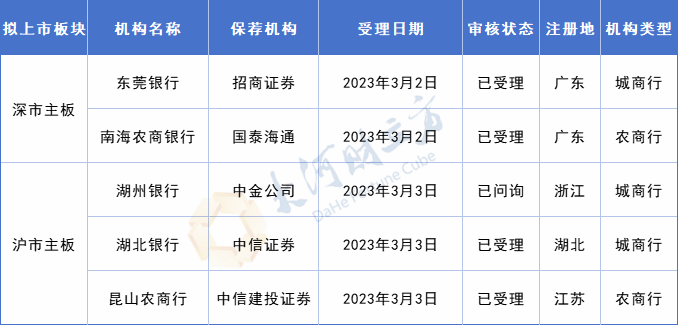
Core Viewpoint - Dongguan Bank and Nanhai Rural Commercial Bank have restarted their IPO processes after multiple suspensions, marking a rare positive signal in the currently quiet bank IPO market [1][2]. Group 1: IPO Process - Dongguan Bank's IPO journey has spanned 17 years, with its first application submitted in 2008 and multiple interruptions due to incomplete disclosures and financial data expiration [2]. - Nanhai Rural Commercial Bank initiated its IPO preparations in 2018, facing similar challenges with its application transitioning to the main board of the Shenzhen Stock Exchange [2]. - Both banks have faced four interruptions due to financial data issues, but have now resumed their "accepted" status as of late 2025 [2]. Group 2: Financial Performance - Dongguan Bank reported revenues of 10.279 billion CNY, 10.587 billion CNY, and 10.197 billion CNY for 2022, 2023, and 2024 respectively, with net profits of 3.648 billion CNY, 3.765 billion CNY, and 3.503 billion CNY [3]. - Nanhai Rural Commercial Bank's revenues for the same years were 6.986 billion CNY, 6.861 billion CNY, and 6.429 billion CNY, with net profits of 2.728 billion CNY, 2.382 billion CNY, and 2.453 billion CNY [3]. - For the first three quarters of 2025, Dongguan Bank's revenue decreased by 9.39% year-on-year to 6.918 billion CNY, and net profit fell by 20.66% to 2.544 billion CNY [3]. - Nanhai Rural Commercial Bank's revenue for the same period dropped by 8.73% to 4.277 billion CNY, with net profit declining by 17.08% to 1.865 billion CNY [3]. Group 3: Asset Quality - As of the end of Q3 2025, Dongguan Bank's core Tier 1 capital adequacy ratio was 9.13%, down from 9.38% in mid-2025 [3]. - Nanhai Rural Commercial Bank's non-performing loan ratio increased to 1.55% in mid-2025, surpassing the national average of 1.49% [4]. Group 4: Shareholding Structure - Both banks lack a controlling shareholder, with Dongguan Bank's largest shareholder being the Dongguan Municipal Finance Bureau, holding 21.16% [5]. - Nanhai Rural Commercial Bank has a more fragmented shareholding structure, with only three shareholders holding over 5% as of mid-2025 [5]. - The stability of Nanhai Rural Commercial Bank's shareholding has raised concerns, particularly due to the financial troubles of its fifth-largest shareholder, Nengxing Holdings [5][6]. Group 5: Market Environment - The overall bank IPO market is currently subdued, with only five banks remaining in the queue for listing as of late 2025, down from ten at the start of the year [8]. - The IPO process for many banks has been hindered by macroeconomic conditions, market fluctuations, and internal governance issues [10]. - Despite the challenges, the resumption of the IPO review for Dongguan Bank and Nanhai Rural Commercial Bank is seen as a significant development, potentially serving as a reference for other small and medium-sized banks aiming to go public [10].
中小银行IPO辅导报告密集披露透露新消息
Sou Hu Cai Jing· 2025-10-21 11:07
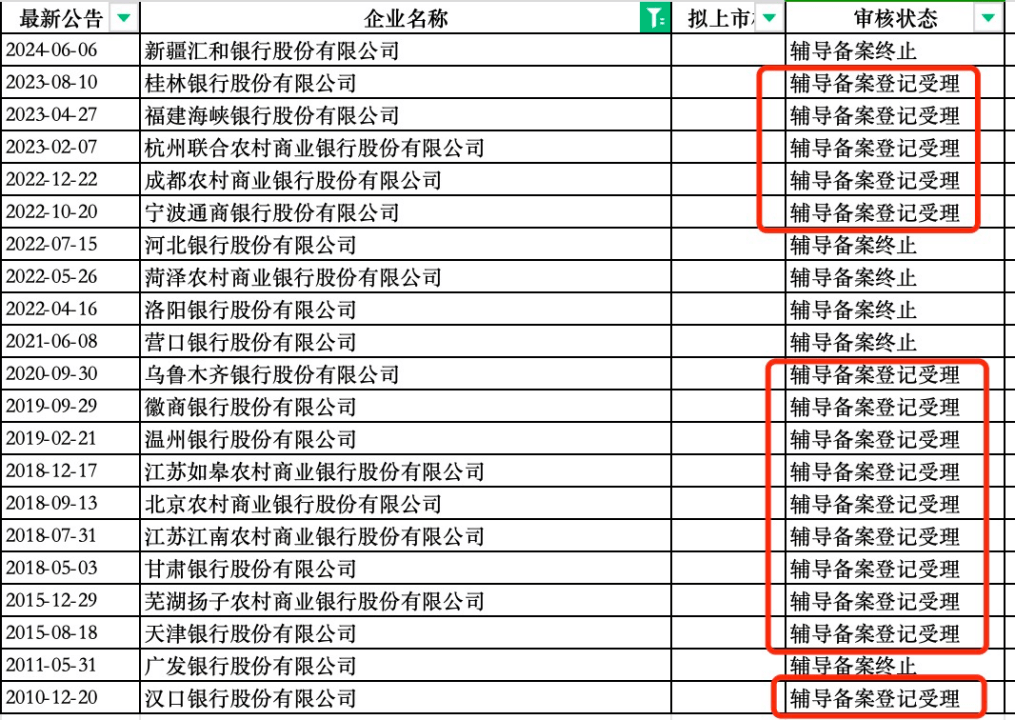
Core Viewpoint - Several banks are facing challenges in their IPO preparations, including capital replenishment pressure, asset ownership issues, and the need for optimization of shareholding structures [1][3]. Group 1: IPO Progress and Challenges - Multiple banks, including Urumqi Bank, Chengdu Rural Commercial Bank, Fujian Strait Bank, Ningbo Tongshang Bank, and Jiangsu Rugao Rural Commercial Bank, are currently undergoing IPO guidance, facing common issues such as capital pressure and complex shareholding structures [1][2]. - As of October 21, 15 banks, including Guilin Bank and Hankou Bank, are in the IPO guidance registration period, with durations ranging from over 2 years to 15 years [1]. - The main challenge among these banks is the irregular shareholding structure, with Urumqi Bank facing historical complexities and Jiangsu Rugao Rural Commercial Bank dealing with issues of shareholding pledges and frozen shares [2][3]. Group 2: Asset Ownership Issues - Asset ownership flaws are significant issues, with banks like Guilin Bank and Gansu Bank having unregistered properties and pending legal disputes affecting their operations [3]. - The irregular shareholding structures and asset ownership flaws are identified as the two main barriers preventing small and medium-sized banks from entering the capital market [3]. Group 3: Recommendations for Improvement - Experts suggest that banks should collaborate with advisory institutions to clarify shareholding structures and address issues related to judicial freezes and high pledge ratios [3][4]. - Establishing special rectification teams to resolve asset ownership issues and ensuring compliance with legal and evaluation standards is recommended to enhance governance transparency [3][4]. Group 4: Market Context and Trends - Since the successful IPO of Lanzhou Bank in January 2022, the banking sector has seen no new entrants, with several banks, including Guangdong Shunde Rural Commercial Bank and Guangzhou Bank, withdrawing their IPO applications [4][5]. - The shrinking pool of banks preparing for IPOs indicates a growing difficulty for small and medium-sized banks to pursue public offerings amid increasing regulatory scrutiny and compliance requirements [5].