中心—外围经济关系

Search documents
拉美拓展合作渠道消减对美依赖
Jing Ji Ri Bao· 2025-12-18 06:14
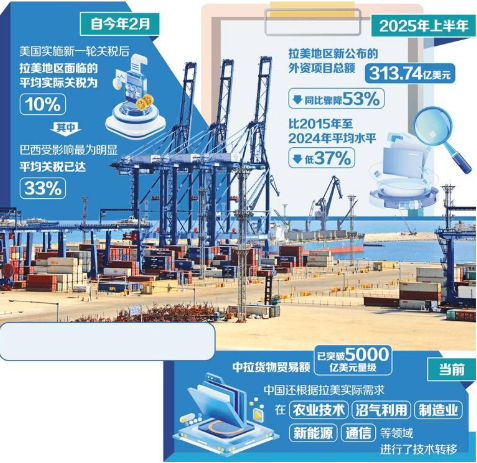
Core Viewpoint - The global tariff increase policy implemented by the U.S. government has significantly impacted the Latin American region, which is highly integrated with the U.S. economy. The UN Economic Commission for Latin America and the Caribbean (ECLAC) emphasizes the urgent need for these countries to reduce their trade dependence on the U.S. and pursue market diversification strategies [1][2]. Trade Dependency Challenges - Since the U.S. imposed a new round of tariffs in February, the average actual tariff faced by Latin America has reached 10%, with Brazil being the most affected at 33%. Despite a projected 5% growth in goods exports by 2025, structural risks remain [2]. - The current trade resilience is largely due to U.S. importers engaging in "front-loading" to avoid anticipated tariffs, indicating that this short-term prosperity is unsustainable. The negative impacts of tariffs are expected to become more pronounced by 2026 [2]. - Foreign investment attractiveness has been severely undermined, with new foreign investment projects in Latin America totaling only $31.374 billion in the first half of 2025, a 53% year-on-year decline and 37% below the average from 2015 to 2024. Investment in export-oriented industries targeting the U.S. market has contracted significantly, with declines exceeding 60% in sectors like automotive, consumer goods, and metal minerals [2]. Structural Transformation Setbacks - The deep dependence of Latin America on the U.S. market is rooted in over a century of "center-periphery" economic relations, with the Monroe Doctrine shaping U.S. policies towards the region. This has led to a dependency on primary product exports, resulting in weak industrial manufacturing and development capabilities [6]. - Despite efforts to promote industrial transformation, the region remains heavily reliant on primary product exports, particularly to the U.S. market, where a significant portion of imports in categories like bananas, sugar, and refined copper comes from Latin America [6]. - Internal structural challenges, such as high informal employment rates, tax system flaws, and inadequate infrastructure, complicate the path to reducing market dependency [7]. Diversified Cooperation for Solutions - To address tariff escalations and dependency issues, ECLAC recommends that regional countries deepen trade relations with diverse partners, including China, the EU, India, and ASEAN, while enhancing regional infrastructure connectivity and trade facilitation [8]. - The current U.S. administration's "America First" policy, characterized by exclusivity, poses challenges to Latin America's ability to collaborate with other major powers. However, the rise of the Global South offers new strategic opportunities for Latin America [8]. - Latin American countries are actively seeking diversified cooperation channels, focusing on practical collaboration with major economies and enhancing South-South cooperation through multilateral platforms [9]. Regional Integration Revitalization - Latin American regional integration is experiencing a resurgence, with leaders focusing on strengthening regional cooperation to collectively address external interventions and hegemonic actions. Countries like Brazil and Colombia are promoting regional integration processes in key areas such as security and energy connectivity [9].