
中老铁路发展

Search documents
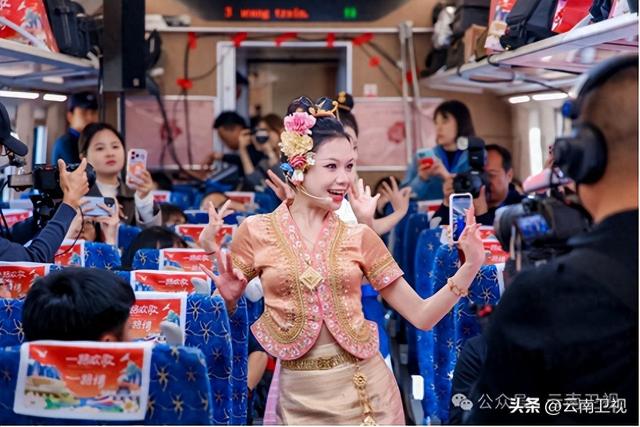
双向奔赴!《2026一路欢歌一路情》中老铁路跨国春节联欢 大年初三锁定云南卫视
Xin Lang Cai Jing· 2026-02-20 10:22
Core Viewpoint - The news highlights the cultural and cooperative significance of the China-Laos Railway, showcasing various performances and stories that reflect the deep friendship and collaboration between China and Laos during the Spring Festival celebrations [1][5][13]. Group 1: Cultural Activities - The program featured a four-hour live broadcast titled "2026 Journey of Joy and Affection," emphasizing the cultural beauty and warmth along the Silk Road [1]. - Artists from both China and Laos performed together, presenting a variety of shows that included local Yunnan characteristics and cultural elements from both countries [1][5]. - The event included performances such as "Fun Dai," "Railway Love: Civilized Journey," and traditional songs, creating a vibrant atmosphere filled with applause and laughter [1][5]. Group 2: Personal Stories - The news focuses on ordinary individuals along the railway, sharing stories that highlight the warmth of bilateral exchanges, such as a flower researcher promoting local varieties and a traveler witnessing the transformation brought by the railway [5]. - The narrative includes a British blogger promoting the railway as a "happy road" and a Laotian technician ensuring safety on cross-border journeys, illustrating the human connection fostered by the railway [5]. Group 3: Sports and Tourism Integration - The event showcased the integration of sports and tourism, with performances by cheerleaders and the introduction of "fan trains" to enhance the travel experience for football fans [7][8]. - This initiative aims to promote cultural and tourism development through sports, demonstrating the vibrant synergy between culture, sports, and travel along the Silk Road [7][8]. Group 4: Economic and Development Opportunities - The program illustrated the new development opportunities brought by the China-Laos Railway, including improved customs efficiency and cross-border cooperation in agriculture, education, and trade [13]. - The railway is positioned as a "golden channel" for mutual benefit and friendship, enhancing connectivity and collaboration between the two nations [13]. Group 5: Broadcast Information - The program aired on Yunnan TV during prime time on February 19, coinciding with the Spring Festival, aiming to celebrate the new year and the journey of friendship [16].

“四区”联动引高校智库进磨憨
Xin Lang Cai Jing· 2025-12-19 22:31
Core Viewpoint - The signing of the strategic cooperation framework agreement between Kunming University and the Mohan-Deng Economic Cooperation Zone aims to enhance regional development and support the construction of the Mohan International Port City, aligning with national strategies and the "Four Good" construction of the China-Laos Railway [1] Group 1: Strategic Cooperation - The cooperation will focus on think tank cultivation, talent development, platform construction, and research collaboration, establishing a long-term and comprehensive partnership [2] - A think tank cultivation plan will provide precise decision-making consultation and technical support on key issues such as cross-border economy and livelihood development [2] - A talent development plan will establish training bases and promote practical training for international talents, contributing to the cultivation of practical talents [2] Group 2: Report Release - The "China-Laos Railway Development Report (2025)" was released concurrently, aiming to provide systematic intellectual support for high-quality development and regional cooperation [2] - The report systematically reviews the institutional innovation achievements since the operation of the China-Laos Railway and constructs a scientific development index for the railway [3] - The China-Laos Railway Development Index focuses on six areas: railway construction, trade openness, port economy, digital economy, rural revitalization, and tourism industry, serving as the first systematic evaluation index for the railway [3] Group 3: Recommendations and Impact - The report highlights the significant improvement in cross-border logistics and supply chain integration, promoting coordinated development in trade investment, digital economy, green development, and cultural exchange [3] - It suggests comprehensive policies to optimize trade investment structure, promote cultural and tourism integration, enhance cultural exchanges, and drive technological empowerment for future development [3]
中老铁路开通运营以来已发送旅客5900万人次
Zhong Guo Xin Wen Wang· 2025-09-20 11:00
Core Insights - The China-Laos Railway has operated since December 3, 2021, and as of September 20, 2025, it has transported a total of 83,000 passenger trains, carrying 59 million passengers, with 48.6 million in China and 10.4 million in Laos, including 580,000 cross-border passengers [1][2] Passenger Traffic Growth - In 2022, the railway transported 8.246 million passengers, which increased to 16.598 million in 2023, marking a 100% year-on-year growth. The forecast for 2024 is 19.114 million passengers, reflecting a 15% increase [1] - From January 1 to September 20 of the current year, the railway operated 18,900 passenger trains, sending 14.5 million passengers, with 11.9 million in China and 2.6 million in Laos, representing a year-on-year growth of 3.2% [1] Capacity Expansion - Since its opening, the railway has continuously increased its capacity, with domestic train services rising from an initial 8 trains per day to a peak of 86, while international services increased from 4 to a maximum of 18 trains per day [1] - On April 13, 2023, the first passenger train from Kunming South to Vientiane was launched, followed by the opening of a train from Xishuangbanna to Luang Prabang on April 13, 2024, which will extend to Pu'er on April 13, 2025 [1] International Service Enhancements - On July 18 of this year, the railway expanded its international service range, extending the route from Pu'er to Luang Prabang to include Kunming to Vientiane, creating a second international passenger train service [2] - The number of cross-border passenger seats has increased from an initial 250 to 390, and currently to 420 seats per train, with daily cross-border passenger numbers rising from 300 to a peak of 1,300 [2]