
主流宇宙学模型

Search documents
宇宙“质量地图”发布 揭示一百亿年间暗物质如何塑造星系
Huan Qiu Wang Zi Xun· 2026-01-27 01:41
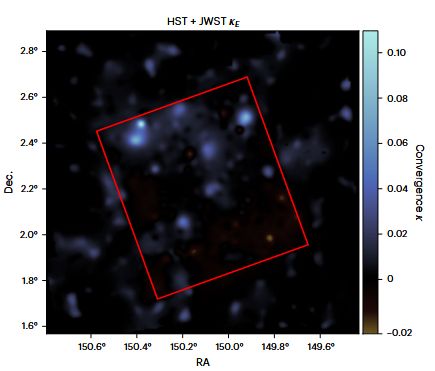
Core Viewpoint - Astronomers have created the most detailed and highest resolution cosmic "mass map" to date, revealing how dark matter has shaped galaxy development over the past 10 billion years [1][5]. Group 1: Dark Matter and Its Significance - Dark matter constitutes approximately 85% of the total mass of the universe and is difficult to detect as it neither emits nor absorbs light, making it invisible to traditional telescopes [3]. - The gravitational influence of dark matter affects the light paths of distant galaxies, allowing scientists to trace the distribution of this unseen mass by measuring the slight distortions in the shapes of numerous distant galaxies [3][5]. Group 2: Methodology and Findings - The research team from the California Institute of Technology utilized imaging data from the James Webb Space Telescope to measure the shapes of about 250,000 galaxies, reconstructing the most detailed mass map of the universe's continuous regions to date [3][4]. - This map not only reveals large mass galaxy clusters but also presents a network of dark matter filaments, which serve as the cosmic skeleton where gas and galaxies are distributed [3][5]. - The structures depicted in the map align with predictions from mainstream cosmological models, suggesting that galaxies formed at high-density nodes within the dark matter filament network [3]. Group 3: Implications for Future Research - The newly created mass map is expected to be a valuable resource for studying galaxy evolution and the development of cosmic structures [4]. - The consistency of the map's structures with current cosmological models provides guidance for understanding the origins of the universe and reinforces the scientific community's efforts in the search for dark matter [5].

宇宙“质量地图”发布
Ke Ji Ri Bao· 2026-01-27 01:33
Core Insights - Astronomers have created the most detailed and highest resolution cosmic "mass map" to date, revealing how dark matter has shaped galaxy development over the past 10 billion years [1][4] - The map's resolution is more than double that of previous maps and extends to earlier stages of cosmic evolution, providing a benchmark for studying dark matter properties and modeling the galaxy environment during the peak star formation period (approximately 11 to 8 billion years ago) [1] Group 1 - The map was constructed using imaging data from the James Webb Space Telescope, measuring the shapes of approximately 250,000 galaxies [2] - It reveals not only massive galaxy clusters but also the filamentous network of dark matter bridges, which gas and galaxies distribute along, forming the cosmic skeleton [2] - The structures observed in the map align with predictions from mainstream cosmological models, suggesting that galaxies formed at high-density nodes between dark matter filaments [2] Group 2 - The research team believes this map will serve as a valuable resource for studying galaxy evolution and the development of cosmic structure [3] - The findings provide guidance for understanding the origins of the universe and reinforce scientists' efforts in the search for dark matter [4]