人工智能+基层医疗

Search documents
群众就近享受优质贴心健康服务,怎么做到的?
Xin Hua She· 2025-11-27 23:51
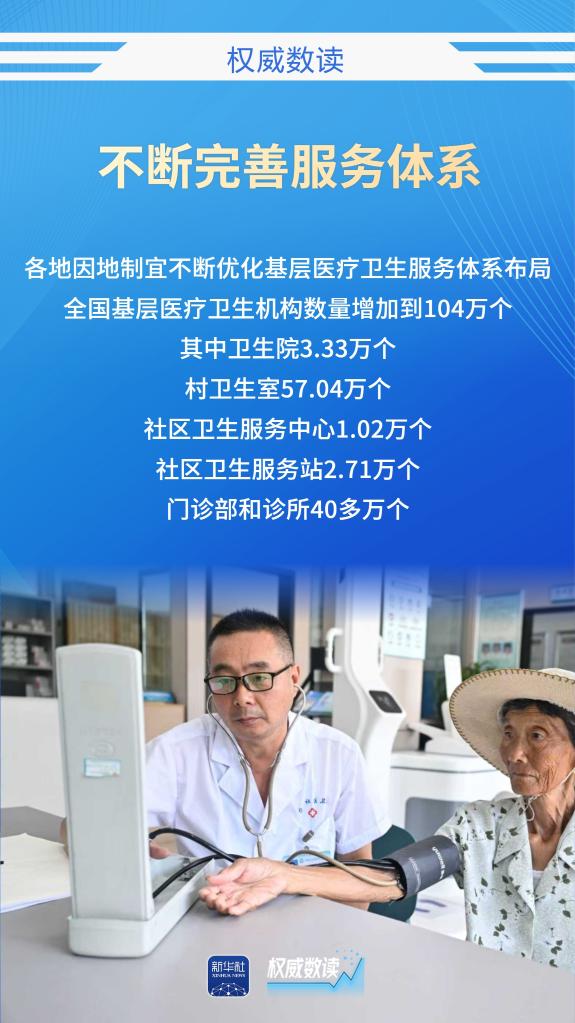
Core Viewpoint - The National Health Commission emphasizes the progress and effectiveness of grassroots medical and health services, aiming to provide convenient and efficient healthcare close to home for the public [1] Group 1: Service System Improvement - The number of grassroots medical and health institutions has increased to 1.04 million, including 33,300 health centers, 570,400 village clinics, 10,200 community health service centers, 27,100 community health service stations, and over 400,000 outpatient departments and clinics [2] - Localities are continuously optimizing the layout of grassroots medical and health service systems according to their specific conditions [2] Group 2: Service Capability Enhancement - As of the end of 2024, there are 2.078 million licensed physicians and assistant physicians in grassroots medical institutions, with over 90% of township health centers and community health service centers meeting basic service capability standards [5] - 93% of grassroots medical institutions can provide pediatric diagnosis and treatment services, and the average number of drug varieties equipped in township health centers and community health service centers has reached around 300 [5] Group 3: Service Model Optimization - 95% of community health service centers and township health centers can provide long-term prescriptions for chronic diseases, and they also offer extended service hours or holiday clinics [7] - 85% of community health service centers and township health centers provide weekend vaccination services, with several provinces like Shanghai, Zhejiang, Jiangsu, and Tianjin implementing family bed services [7] Group 4: Integrated County Medical Community Development - A total of 3,099 tightly-knit county medical communities have been established across 2,199 counties (cities, districts), serving as a key approach to promote a hierarchical medical system [10] - Approximately 18,000 personnel from urban hospitals will be dispatched to support 1,750 counties, and 80% of counties have initially established resource-sharing centers for imaging, electrocardiograms, and testing [10] - Over 97% of administrative villages with village clinics are included in the medical insurance designated coverage [10]

中国医生需要怎样的AI?GPT-5、OpenEvidence都输掉实战后,我们有了答案
机器之心· 2025-11-12 13:23
Core Viewpoint - The article emphasizes the importance of AI in grassroots healthcare, highlighting the need for safety, effectiveness, and human-AI collaboration as essential criteria for successful implementation [2][4][44]. Policy and Market Context - On November 4, the National Health Commission issued a document outlining the core goal for the next five years: "AI + grassroots application," placing it at the forefront of the eight key directions for "AI + healthcare" [4]. - The document aims for "intelligent auxiliary applications in grassroots diagnosis and treatment to achieve basic coverage by 2030" [5]. Current Challenges - Despite the policy push, there is a significant gap in AI adoption at the grassroots level, with over 80% of grassroots doctors not using AI, and those who do often rely on generic models that lack precision [7]. - The article notes a "reverse situation" where major hospitals are rapidly adopting AI, while grassroots healthcare remains largely untouched by the AI wave [7]. AI Product Features - The "Future Doctor AI Studio" is presented as a reliable tool that aligns with the policy blueprint, focusing on safety and effectiveness [9]. - MedGPT, the underlying model of the Future Doctor AI Studio, has been rigorously tested for safety and effectiveness, outperforming five major global models in clinical scenarios [12][14]. Safety and Effectiveness - MedGPT achieved the highest scores in safety (0.912) and effectiveness (0.861) during evaluations, significantly surpassing other models [17]. - The article stresses that true medical AI must prioritize safety and effectiveness, with clinical value as the benchmark for technological iterations [11][13]. Human-AI Collaboration - The article highlights the importance of human-AI collaboration, stating that AI should serve as a "super assistant" to doctors, enhancing their capabilities rather than replacing them [39][40]. - The Future Doctor AI Studio's clinical decision-making assistant is designed to support grassroots doctors by providing structured decision reports based on high-level medical evidence [22][25]. Clinical Decision Support - The clinical decision AI assistant can generate comprehensive decision reports for complex cases, demonstrating expert-level reasoning and reliable decision-making [23][30]. - Recent evaluations showed that the assistant outperformed competitors in various clinical scenarios, confirming its effectiveness in real-world applications [27]. Patient Follow-Up - The patient follow-up AI assistant addresses the critical "last mile" of healthcare, ensuring continuous patient management and communication [32][35]. - It automates follow-up tasks, provides personalized health management plans, and alerts doctors to high-risk signals, thereby enhancing patient care [36][38]. Conclusion - The article concludes that the integration of AI in grassroots healthcare represents a best practice for empowering medical professionals and improving patient outcomes, with a strong emphasis on safety, effectiveness, and collaboration [44].