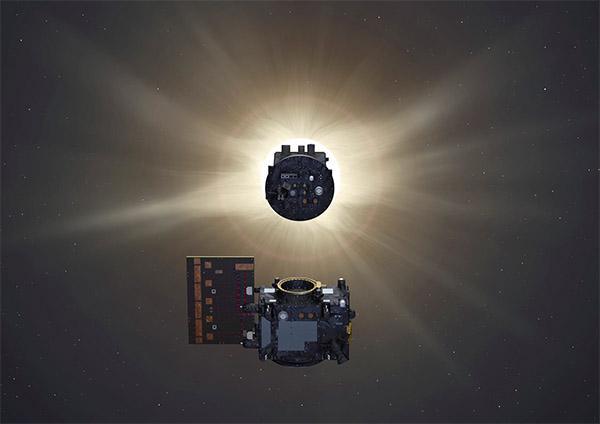
人造日食

Search documents
【特稿】欧洲航天局为研究日冕“人造”日食
Xin Hua She· 2025-06-18 06:24
Group 1 - The European Space Agency (ESA) successfully created a man-made solar eclipse using two satellites, showcasing advanced satellite formation flying capabilities and providing valuable data for studying the solar corona [1][2] - The project cost approximately $210 million and has successfully simulated solar eclipses 10 times, with the longest lasting 5 hours [2] - The satellites, named "Occulter" and "Coronagraph," maintained a distance of 150 meters during the simulation, achieving a positioning accuracy of less than 1 millimeter [1][2] Group 2 - The project aims to extend the total duration of totality to 6 hours during scientific observations starting in July, with an estimated 200 simulations planned over the next two years, averaging about two per week [2] - The data collected from these simulations will be significant, as natural solar eclipses occur only every 18 months and last only a few minutes [2]
欧空局完成首次“人造日食”,发回太阳日冕图像
Guan Cha Zhe Wang· 2025-06-17 15:44
Core Viewpoint - The European Space Agency (ESA) announced the successful completion of the Proba-3 mission, which achieved the first "artificial solar eclipse" in space, allowing for clearer observations of the solar corona [1][10]. Group 1: Mission Overview - Proba-3 consists of two satellites: a coronagraph and an occulter, launched in December 2022, designed to simulate a total solar eclipse in orbit [1][3]. - The two spacecraft maintained a distance of 150 meters with a positional accuracy of within one millimeter during the mission [3]. - The mission aims to help scientists study solar phenomena such as solar wind and coronal mass ejections by capturing images of the solar corona without interference from sunlight [1][9]. Group 2: Observational Achievements - The first images captured during the mission show the inner corona in green, similar to how it appears through a green filter during a natural eclipse [3][5]. - Subsequent images included artificially colored representations of the corona, highlighting different spectral lines and temperature regions, such as the deep green for the green line of the corona and purple for polarized white light [5][7]. - The artificial eclipse can last up to six hours, significantly longer than natural solar eclipses, which typically last only a few minutes [9][10]. Group 3: Scientific Implications - Observations from Proba-3 can provide insights into the high temperatures of the solar corona, which exceed one million degrees Celsius, a phenomenon that has puzzled scientists [9][11]. - The mission is expected to last for two years, after which the satellites will safely re-enter the Earth's atmosphere and burn up, avoiding becoming space debris [11].