价值匹配

Search documents
理性审视RedCap:从800%的激增到400亿的未来,是机遇还是尴尬?
3 6 Ke· 2025-12-03 09:26
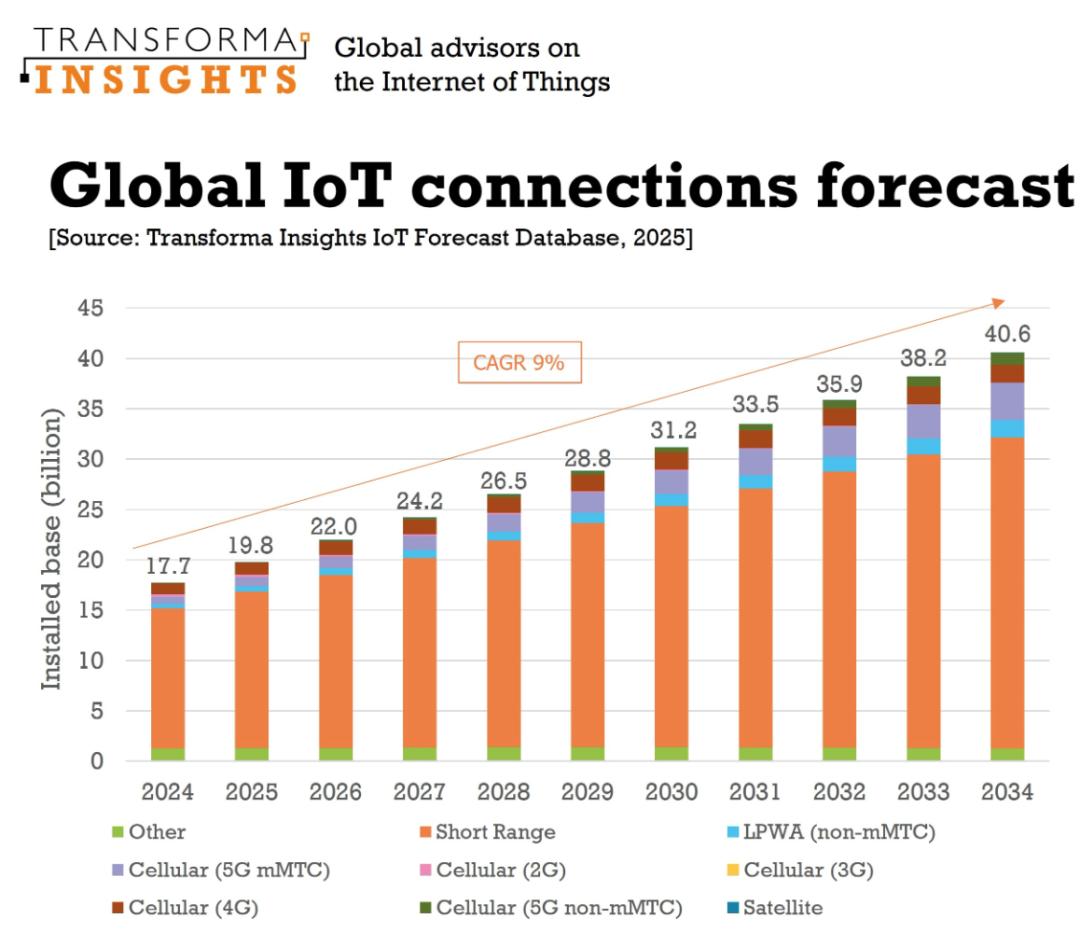
Core Insights - The report from Counterpoint Research indicates a remarkable year-on-year increase of nearly 800% in the shipment of 5G RedCap modules in Q2 2025, signaling the commencement of RedCap commercialization [1] - By the end of 2025, the shipment volume of 5G RedCap is expected to exceed 10 million units across various fields such as wearables, automotive, MiFi, and CPE, with new terminal types like AI companions in development [1] - Transforma Insights predicts that by 2034, the total number of global IoT connections will surpass 40 billion, with cellular IoT connections growing more than threefold to reach 6.7 billion [1] Market Dynamics - The significant percentage growth is largely attributed to a very low base from the previous year, indicating a shift from a non-existent market to an emerging one rather than a mature explosion [4] - RedCap is positioned as a crucial piece in filling the gaps in the 5G IoT landscape, yet it faces multiple challenges related to cost, ecosystem, and market positioning [4] Value Proposition - RedCap is not a revolutionary technology but a pragmatic "subtraction" project aimed at addressing a structural gap in the early commercialization of 5G [5] - It finds its niche in the middle ground between high-end eMBB and URLLC technologies and low-power NB-IoT, catering to the growing mid-speed IoT demand [5] - By optimizing 5G capabilities through cost-effective adjustments, RedCap aims to balance cost, power consumption, and performance, serving as a "filler" rather than a replacement [6] Challenges Ahead - The first challenge is the "chicken or egg" dilemma regarding cost and scale, where the current cost of RedCap modules remains significantly higher than mature 4G Cat.1 modules, hindering widespread adoption [8] - The second challenge is the inertia of the mature 4G ecosystem, where many applications find Cat.1 sufficient, making it difficult to convince customers to switch to RedCap despite its advantages [9] - The third challenge involves the time lag in achieving network coverage and ecosystem maturity comparable to 4G, as RedCap is still in its early stages of development [10] Path to Success - To overcome these challenges, strategic investments rather than market-driven efforts are essential to break the cost deadlock [12] - Focusing on value creation rather than mere parameter comparisons is crucial for RedCap's promotion, emphasizing unique capabilities that Cat.1 cannot provide [13] - Bridging the ecosystem gap requires an open and empowering approach, with clear roadmaps and support for developers to foster innovation [14] Long-term Outlook - The future of RedCap is characterized as a "marathon" rather than a "sprint," emphasizing the need for patience and collaboration across the industry to address commercial implementation challenges [15] - By focusing on creating irreplaceable value for customers and fostering a supportive ecosystem, RedCap can effectively translate its technological potential into market success [16]

你终会明白:所有关系的背后,都是精准匹配
洞见· 2025-08-14 12:35
Group 1 - The core idea of the article emphasizes that relationships are fundamentally based on mutual benefit and value exchange, rather than pure emotional connections [6][13][30] - The article discusses the concept of "利益匹配" (interest matching), illustrating how relationships often depend on what individuals can offer each other, as seen in the story of Jensen Swispen, who lost friends when he could no longer provide value [10][12][13] - It highlights the importance of "圈层匹配" (circle matching), where individuals tend to associate with those in similar social or professional circles, as demonstrated by the anecdote of a class reunion where attendees divided into groups based on their career status [23][24][25] Group 2 - The article introduces "价值匹配" (value matching), using the example of Yang Jiang's friendships, which were based on shared intellectual pursuits and mutual respect, indicating that deep connections require a balance of values and interests [28][30] - It concludes that enduring relationships are nourishing and resilient, built on either mutual benefits, resource sharing, or deep intellectual connections, reinforcing the idea that all long-lasting relationships involve some form of exchange [29][30]