传统数据治理

Search documents
为什么传统数据治理模式不再适用于人工智能/机器学习
3 6 Ke· 2026-01-26 07:32
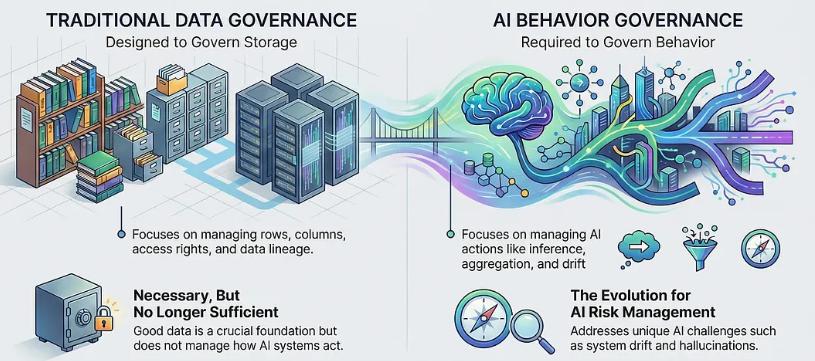
Overview - The article discusses the inadequacy of traditional data governance in managing AI/ML systems, emphasizing the need for a shift towards AI governance frameworks that address the dynamic and probabilistic nature of these technologies [2][3]. Core Friction: Deterministic vs. Probabilistic - Traditional governance models are designed for static, structured data, assuming data can be managed through controlled creation, storage, access, and modification [4]. - AI governance must focus on the behavior of AI systems, which are dynamic and can interpret and infer information in non-programmatic ways, leading to risks even when underlying data is accurate [5]. Key Implementation Failure Points - The article identifies specific failure points in traditional governance when applied to AI systems, such as "vector blind spots" and "mosaic effects" [11]. - "Vector blind spots" occur when personal identifiable information (PII) is embedded in vector databases, making it invisible to traditional data loss prevention tools [12]. - The "mosaic effect" refers to the risk of AI models synthesizing information from fragmented data, potentially leaking sensitive information even when direct access is restricted [14]. - The "time freeze" issue highlights that AI models may operate on outdated information until retrained, leading to governance challenges [17]. Enhanced Governance Framework - The article proposes an "enhanced governance" framework that integrates existing data investments with new AI control standards, such as the NIST AI RMF and ISO 42001 [3][18]. - Key components of this framework include: 1. Input Governance: Protecting unstructured data before it interacts with models [19]. 2. Feature and Fairness Governance: Ensuring fairness and preventing implicit bias during feature transformation [20]. 3. Model Transparency Governance: Ensuring model decisions are interpretable and defensible [24]. 4. Model Governance: Treating models as black boxes requiring external validation [26]. 5. Model Lifecycle Governance: Monitoring model performance and managing concept drift [28]. Alignment with Industry Frameworks - The article emphasizes the necessity of transitioning from data-centric to model-centric governance, aligning with frameworks like NIST AI RMF and ISO/IEC 42001 [45][46]. - NIST highlights the importance of measuring trustworthiness features such as interpretability and fairness, which are often absent in traditional governance [46]. - ISO/IEC 42001 mandates continuous improvement and transparency, requiring organizations to document not only the data used but also the rationale behind parameter choices [47]. Conclusion - The future of AI governance lies in enhancing rather than replacing traditional data governance, focusing on behavior-driven governance models that ensure compliance and trust while fostering innovation [49].