住房公积金归集与增值

Search documents
一线城市公积金集体破“万亿”
Mei Ri Jing Ji Xin Wen· 2025-10-24 04:00
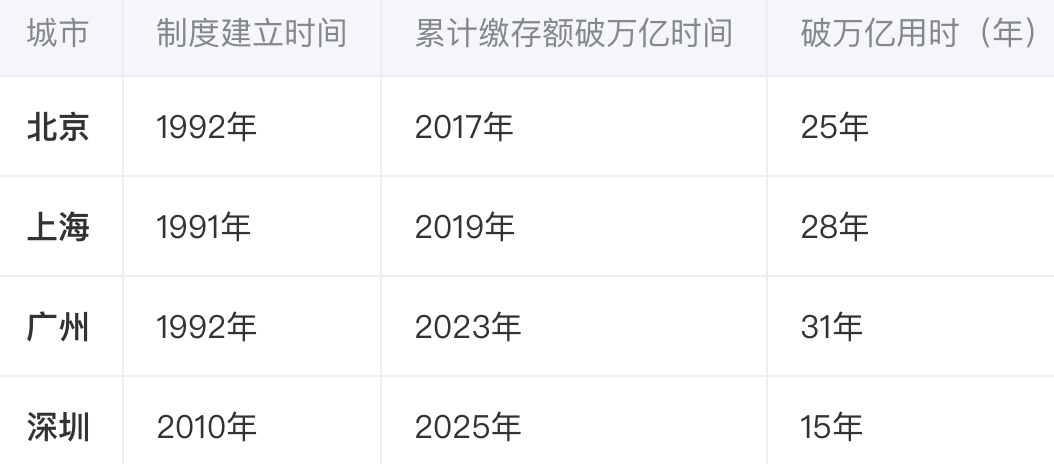
Core Insights - Shenzhen has achieved a historic milestone by accumulating over 1 trillion yuan in housing provident fund contributions in less than 15 years, significantly faster than other major cities like Beijing, Shanghai, and Guangzhou [1][3][4] Group 1: Accumulation Timeline - Beijing established its housing provident fund system in 1992 and reached the 1 trillion yuan mark in 2017, taking 25 years [2] - Shanghai's system began in 1991, with the 1 trillion yuan milestone achieved in 2019, taking 28 years [2] - Guangzhou, also starting in 1992, is projected to reach this milestone in 2023, taking 31 years [2] - Shenzhen, which implemented the system in 2010, is expected to reach the 1 trillion yuan mark by 2025, taking only 15 years [2] Group 2: Factors Contributing to Rapid Growth - Shenzhen's rapid accumulation is attributed to two main pillars: continuous expansion of the coverage of the system and ongoing upgrades in management capabilities [2][4] - The city has broadened its coverage to include non-public enterprises and flexible employment groups, leading to a larger contributor base [4] - The demographic structure in Shenzhen, with a younger population and many new residents, contributes to a "net contributor" status, where contributions exceed withdrawals and loans [4] Group 3: Fund Management and Utilization - As of September 2025, over 2.6 billion yuan has been withdrawn for rent payments, with the total withdrawal amount reaching 600 billion yuan, of which over 87% is for housing consumption [5] - Shenzhen has optimized its extraction and loan policies, including innovative models like "commercial to public" loans with minimal documentation requirements [6] - A comprehensive risk prevention and control system has been established to safeguard the funds, enhancing the efficiency of fund utilization [6] Group 4: Value-Added Earnings - In 2024, the value-added earnings from housing provident funds varied across cities, with Shanghai leading at 13.71 billion yuan, followed by Beijing at 11.77 billion yuan, Guangzhou at 4.69 billion yuan, and Shenzhen at 4.57 billion yuan [8] - The distribution of value-added earnings primarily supports risk reserves for loans, management expenses, and funding for public rental housing construction [8]