
体育政治化

Search documents
离大谱!美国要征收谷爱凌 100% 个人所得税,政客推动全新体育法案
Sou Hu Cai Jing· 2026-02-27 15:12
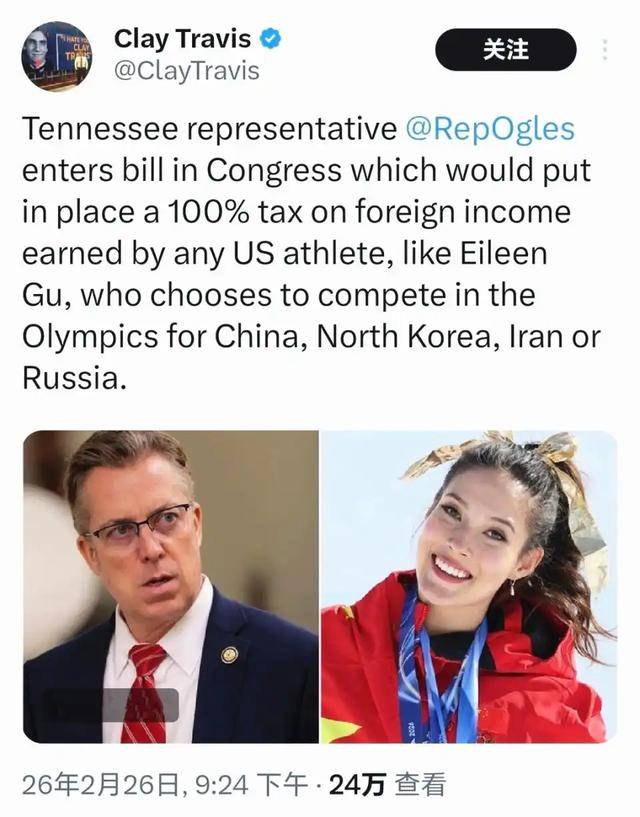
Core Viewpoint - The introduction of the "Olympic Act" by U.S. Congressman Andy Ogles targets American citizens and green card holders representing specific foreign entities, imposing a 100% tax on their earnings from international sports events, directly naming athlete Eileen Gu as a focal point [3][6][9]. Group 1: Legislative Context - The "Olympic Act" aims to tax all earnings from competitions and sponsorships for U.S. citizens and permanent residents representing "concerned foreign entities," which include China, Russia, North Korea, and Iran [6][7]. - The legislation is seen as a political maneuver, coinciding with the peak popularity of Eileen Gu following the Milan Winter Olympics, suggesting an intent to gain attention and support from conservative voters [14][21]. Group 2: Impact on Eileen Gu - Eileen Gu's commercial value is significant, with an annual income of $23 million (approximately 159.5 million RMB), predominantly from endorsements, which could be entirely taxed under the proposed law [11]. - The proposed legislation threatens to erase years of her hard work and commercial success, while also undermining the spirit of sportsmanship by linking athletic performance to nationality [11][13]. Group 3: Public and Expert Reactions - Public opinion in China largely views the legislation as an "open robbery," supporting Gu's right to choose her representation and criticizing the narrow-mindedness of the U.S. [16]. - Tax and economic experts argue that a 100% tax rate violates principles of tax neutrality and could be unconstitutional, likely failing to generate additional revenue while damaging the U.S.'s international image [16][18]. Group 4: Broader Implications - The situation highlights the politicization of sports, which could ultimately backfire, as the movement of top talent should not be constrained by narrow political views [21][23]. - The narrative surrounding Eileen Gu reflects a broader theme of individual dreams, sportsmanship, and the intersection of personal choice with political agendas, emphasizing that sports should transcend national boundaries [23].

惊爆!美国欲征谷爱凌100%个税,体育政治化闹剧上演
Sou Hu Cai Jing· 2026-02-27 04:33
Core Viewpoint - A proposed bill in the U.S. aims to impose a 100% personal income tax on American athletes representing "foreign entities," specifically targeting Eileen Gu, a prominent athlete representing China [1][3][5]. Group 1: Legislative Details - The bill, named the "Olympic Act," seeks to tax all income earned by U.S. citizens or permanent residents representing countries like China, Russia, North Korea, and Iran in major international events [3][5]. - The income types affected include competition-related earnings such as prize money and appearance fees, as well as sponsorship income [3][5]. - The bill's sponsor, Congressman Andy Ogles, explicitly stated the intent to "almost confiscate" the earnings of athletes like Gu, framing it as a matter of national loyalty [5][8]. Group 2: Eileen Gu's Profile - Eileen Gu, a 22-year-old athlete, has achieved significant success, winning three gold and three silver medals across two Winter Olympics, and has a total income of $23.1 million, primarily from endorsements [3][7]. - Gu's background includes being born in the U.S. to an American father and a Chinese mother, and she officially became a Chinese citizen in 2019 [5][7]. - Her commercial value has skyrocketed, with partnerships with major brands like Coca-Cola and Tiffany, alongside her academic achievements at Stanford University [7][8]. Group 3: Political and Social Reactions - The proposed legislation has sparked a strong sense of injustice among American athletes, who feel that Gu's nationality choice allows her to benefit disproportionately from resources and honors [8][9]. - Political figures have used Gu's situation to express broader sentiments about national loyalty, with Vice President Vance and Treasury Secretary Basent making pointed remarks about her choices [8][9]. - The bill reflects a growing political trend to leverage sports narratives for ideological battles, particularly in the context of U.S.-China relations [10][11]. Group 4: Implications and Context - If passed, the "Olympic Act" would set a precedent for taxing specific income types at an unprecedented rate, contradicting international tax neutrality principles [9][10]. - The bill's introduction highlights a significant shift in public perception of Gu, who has become a symbol of the complexities surrounding global talent mobility and national identity [10][11]. - The situation illustrates the intersection of sports and politics, where athletes' personal choices are scrutinized through a lens of national loyalty, complicating the essence of competitive sports [11].

离大谱!美国要征收谷爱凌100%个人所得税,政客提出全新体育法案
Sou Hu Cai Jing· 2026-02-27 02:57
Core Viewpoint - The proposed "OLYMPICS Act" aims to impose a 100% federal income tax on American athletes representing certain countries, specifically targeting Eileen Gu, a prominent athlete who has chosen to represent China instead of the USA [1][3][5]. Legislative Details - The "OLYMPICS Act" is designed to tax U.S. citizens or lawful permanent residents (green card holders) at a 100% rate on income earned while representing countries deemed as "foreign entities," including China, Russia, North Korea, and Iran [3][5]. - The bill encompasses earnings from major global sports events, such as the Olympics and World Cup, where athletes compete under national representation [6]. Eileen Gu's Financial Profile - Eileen Gu's projected income for 2025 is $23.1 million (approximately 165 million RMB), with only about $100,000 (less than 0.5% of total income) coming from competition prizes, while over 99.5% is derived from endorsements and commercial activities [6][5]. - Her endorsement portfolio includes over ten brands, spanning both Chinese companies like Anta and international luxury brands like Porsche [6]. Tax Implications and Legal Considerations - Gu's complex nationality and tax status complicate the situation; she is considered a Chinese citizen under Chinese law but may still be subject to U.S. taxes as a U.S. citizen unless she formally renounces her citizenship [9][11]. - Tax experts suggest that Gu may qualify as a non-resident for Chinese tax purposes, meaning she would primarily pay taxes on income earned within China [11]. Political Context and Reactions - The proposal reflects a broader sentiment among some U.S. politicians and media, who view Gu's representation of China as a betrayal, leading to calls for punitive measures against her [13][19]. - Critics, including economists, argue that the bill is economically flawed and could be challenged constitutionally as an excessive fine rather than a legitimate tax [15][21]. Broader Implications - The situation highlights the politicization of sports in the U.S., where athletes' choices are scrutinized and leveraged for political agendas, potentially harming the integrity of sports and athletes' interests [19][21]. - The dual standards in the treatment of athletes representing other countries versus Gu's case reveal underlying biases and political motivations [19].
世界反兴奋剂机构主席:将继续大胆指出美国反兴奋剂体系缺陷
Xin Hua She· 2025-05-30 14:57
Group 1 - The core viewpoint is that the newly re-elected WADA President, Banka, criticizes the US for its unfounded accusations against WADA while ignoring its own serious issues in anti-doping systems [1] - Banka emphasizes that the US has attempted to undermine his leadership at WADA and has lost influence due to its withdrawal of funding [1] - He points out that developed Western countries, including the US and Germany, often criticize others without addressing their own systemic problems in anti-doping [1] Group 2 - Banka and Yang Yang were first elected as WADA President and Vice President in 2020, with their current term set to end on December 31, 2025, and a potential third term starting on January 1, 2026 [2]