供需策略调整

Search documents
“潮玩之王”业绩狂飙,股价却大幅回调丨港美股看台
Zheng Quan Shi Bao· 2025-10-27 15:00
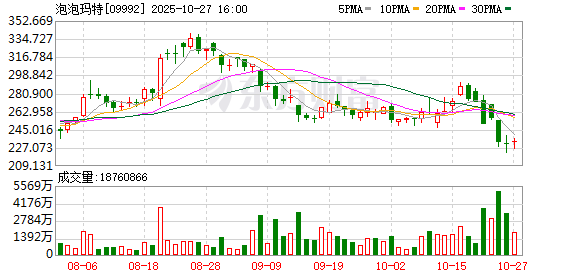
Core Viewpoint - The LABUBU secondary market prices have plummeted, leading to a significant decline in the stock price of Pop Mart, despite the company's strong fundamentals and impressive revenue growth [2][9]. Group 1: Market Performance - As of October 27, Pop Mart's stock price closed at HKD 233.40 per share, down over 30% from its historical peak, resulting in a market capitalization loss exceeding HKD 140 billion [2][7]. - The LABUBU series, once a hot commodity in the secondary market, saw its average transaction price drop from over HKD 1,100 to around HKD 200, with specific hidden variants falling to approximately HKD 700 [7][9]. Group 2: Financial Performance - Pop Mart reported a staggering revenue increase of 245% to 250% year-on-year for Q3 2025, continuing the high growth trend from the first half of the year [9][11]. - Revenue growth was particularly strong in the Chinese market, with a year-on-year increase of 185% to 190%, and online channels experiencing a growth rate of 300% to 305% [9][11]. - The overseas market showed even more remarkable performance, with a year-on-year revenue surge of 365% to 370%, particularly in the Americas, which saw a growth rate of 1265% to 1270% [9][11]. Group 3: Analyst Ratings and Predictions - Following the impressive earnings report, several brokerage firms raised their profit forecasts for Pop Mart, with target prices and ratings reflecting a positive long-term outlook [9][11]. - High-profile analysts, including those from Goldman Sachs and JPMorgan, have adjusted their ratings and earnings predictions upward, citing strong IP momentum and supply capacity expansion as key drivers [11][12]. Group 4: Market Sentiment and Investor Behavior - The decline in LABUBU prices has led to a rational reflection on the sustainability of high growth, causing some investors to sell off shares, while others, particularly mainland investors, have shown a strong willingness to buy during the dip [2][13][15]. - There is a notable divergence between mainland and foreign investors, with mainland funds increasing their holdings while foreign institutions have been reducing their positions in Pop Mart [13][15].