促进生育

Search documents
解决‘不愿生’难题,需加大补贴力度
Nan Fang Du Shi Bao· 2026-01-26 03:24
Group 1 - The article highlights the significant pressures on long-term population balance due to declining birth rates and increasing aging population trends in Guangdong [1] - It emphasizes the systemic issues in the "fertility, upbringing, and education" sectors, which contribute to the reluctance of the youth to have children [1] - The need for Guangdong to explore effective solutions to the "three育" challenges is framed as both a national strategic necessity and a requirement for high-quality development [1] Group 2 - Suggestions for constructing a supportive fertility policy system include increasing financial subsidies to alleviate direct family burdens associated with childbirth and upbringing [2] - Recommendations include providing one-time cash subsidies or progressive childcare subsidies until the child reaches three years old, along with tax deductions for childcare costs [2] - To address the issue of "unattended children," it is proposed to include childcare availability in government performance assessments and support the establishment of childcare facilities [2] - To alleviate educational anxiety and promote educational equity, the article suggests expanding quality educational resources through group schooling and increasing investment in preschool education [2]
广东省政协委员林周胜:解决“不愿生”难题,需加大补贴力度
Nan Fang Du Shi Bao· 2026-01-25 05:38
Core Viewpoint - The article discusses the declining birth rate and increasing aging population in Guangdong, emphasizing the need for effective policies to support childbirth and parenting to address these demographic challenges [1][2]. Group 1: Current Challenges - There is a significant issue among the youth regarding reluctance to have children, attributed to high systemic costs in "childbirth, parenting, and education" [1]. - The existing maternity benefits do not align with the actual income of working women, leading to inadequate coverage for women in flexible or informal employment [1]. - The burden of childcare and educational expenses, along with the pressure of entrance exams during basic education, contributes to families' hesitance to have more children [1]. Group 2: Proposed Solutions - It is suggested that Guangdong increase financial subsidies and provide one-time cash bonuses or progressive childcare subsidies until the child reaches three years old [2]. - To address the issue of "unattended children," it is recommended that the number of childcare spots per thousand population be included in government performance assessments, and support for the establishment of childcare facilities should be enhanced [2]. - To alleviate educational anxiety and promote equity, the article advocates for the expansion of quality educational resources through group schooling, district governance, and teacher rotation systems, alongside increased investment in preschool education [2].
贵州:落实国家育儿补贴政策 制定本省促进生育措施
Di Yi Cai Jing· 2025-08-01 07:21
Core Viewpoint - The Guizhou Provincial Government has issued an implementation plan for a special action to boost consumption, focusing on enhancing support for childbirth and childcare [1] Group 1: Childbirth and Childcare Support - The plan emphasizes increasing the strength of childbirth and childcare support measures [1] - It includes the implementation of the national childcare subsidy policy and the development of provincial measures to promote childbirth [1] - The plan aims to ensure maternity insurance coverage for flexible employment individuals, migrant workers, and new employment form practitioners participating in basic medical insurance [1] Group 2: Healthcare Services - The initiative includes pilot programs for childcare services in public medical institutions, exploring a "1+N" model for infant and toddler care [1] - It encourages qualified organizations to provide childcare services for employees [1] - The plan also implements an annual action for pediatric services, supporting infrastructure and equipment updates in pediatrics, optimizing hierarchical medical services, and promoting the opening of night pediatric outpatient services during peak seasons for children's seasonal diseases [1]
贵州:落实国家育儿补贴政策,制定本省促进生育措施
news flash· 2025-08-01 07:20
Core Viewpoint - The Guizhou Provincial Government has issued an implementation plan for a special action to boost consumption, focusing on enhancing support for childbirth and childcare services [1] Group 1: Childbirth and Childcare Support - The plan emphasizes increasing the strength of childbirth and childcare support measures [1] - It includes the implementation of national childcare subsidy policies and the development of local measures to promote childbirth [1] - The plan aims to ensure maternity insurance coverage for flexible employment individuals, migrant workers, and new employment form practitioners participating in basic medical insurance [1] Group 2: Childcare Services and Infrastructure - The initiative includes pilot programs for childcare services in public medical institutions, exploring a "1+N" model for infant care [1] - It encourages qualified organizations to provide childcare services for employees [1] - The plan also implements a pediatric service annual action, supporting pediatric infrastructure and equipment updates, optimizing hierarchical diagnosis and treatment, and promoting the opening of night pediatric outpatient services during peak seasons for children's seasonal diseases [1]
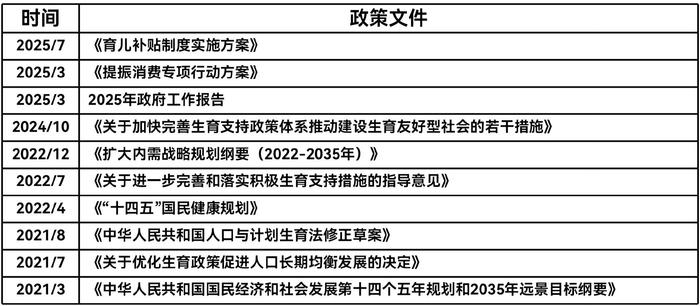
每年1200亿!育儿补贴对低收入地区的消费拉动或更明显
Xin Lang Cai Jing· 2025-07-30 02:05
Core Points - The implementation of the child-rearing subsidy policy aims to address the declining birth rate in China by providing a cash subsidy of 3,600 yuan per child per year starting from January 1, 2025 [1][2] - The total annual expenditure on child-rearing subsidies is estimated to be between 100 billion to 120 billion yuan, which is expected to have a positive impact on birth rates and consumer spending [1][2] - The policy is designed to be inclusive, allowing families with one, two, or three children to apply for the subsidy, which marks a significant shift from previous local policies that primarily targeted families with two or more children [1][2] Summary by Category Policy Overview - The child-rearing subsidy will be distributed in cash, reflecting a long-term commitment to investing in human capital [1] - The central government will share the financial burden of the subsidies with local governments, with a proposed funding ratio of 9:1 [2] Economic Impact - The subsidy is projected to increase social retail sales growth by approximately 0.14-0.2 percentage points, with a more pronounced effect in low-income regions [1] - The estimated total subsidy amount for 2025 is around 120 billion yuan, based on projected birth rates [2][4] Demographic Insights - Recent statistics indicate a decline in newborns, with figures of 9.56 million in 2022, 9.02 million in 2023, and an estimated 9.54 million in 2024 [5] - The subsidy is expected to have varying effects on different income groups, with lower-income families benefiting more significantly from the financial support [5] Systemic Support Recommendations - Analysts suggest that in addition to cash subsidies, a comprehensive support system should be established, including employment rights for women, affordable childcare services, and improved healthcare for mothers and children [6] - Future policies may also focus on legislative measures to protect women's rights during pregnancy and breastfeeding, as well as flexible work arrangements [6]