信托关系

Search documents
论投资型寿险独立账户基金属性的规范因应
Sou Hu Cai Jing· 2025-12-18 02:01
Core Viewpoint - Investment-linked insurance and variable annuities combine insurance protection with investment functions, featuring a separate account that reflects investment performance, thus mitigating inflation impacts [2][4]. Group 1: Legal Interpretation of Investment-linked Insurance - Investment-linked insurance possesses both traditional insurance attributes and innovative design, with variable payouts based on investment performance rather than fixed amounts [4]. - The independent account in investment-linked insurance resembles a contractual securities investment fund, sharing characteristics such as pooled funds for investment purposes and risk-sharing among investors [5][6]. - The independent account's structure allows for asset segregation, ensuring that funds are not mixed with other insurance products, thus providing legal protection for policyholders in case of insurer bankruptcy [7]. Group 2: Institutional Arrangements for Investment-linked Insurance - The relationship between the insurance component and the independent account should be understood as a contractual linkage, allowing for the application of different legal rules to each component [9]. - Comparative legal frameworks, such as those in the U.S. and Japan, recognize the dual nature of investment-linked insurance, suggesting that it should be regulated under securities law to protect investor rights [10][11]. - The legal classification of investment-linked insurance should avoid rigid categorization as either insurance or securities, as this could lead to regulatory gaps and misapplication of laws [12]. Group 3: Legislative Improvements for Independent Accounts - Legislative improvements should include provisions in the Insurance Law to address the unique characteristics of investment-linked insurance and its independent accounts, reflecting the regulatory experience accumulated over the years [13]. - Expanding the definition of "asset management products" in the Securities Law is necessary to encompass investment-linked insurance, ensuring that it aligns with current market practices [14]. - Regulatory focus should address specific risks associated with independent accounts, including sales fraud, information asymmetry, and fiduciary duties of insurers [15]. Group 4: Risk Management and Regulatory Obligations - Financial institutions should adhere to suitability obligations to prevent mismatches between product risks and customer capabilities, thereby reducing sales fraud risks [16]. - Information disclosure obligations must be strengthened to ensure transparency in investment-linked insurance products, drawing from securities governance rules [18]. - Insurers, as fiduciaries, must fulfill their duties diligently, managing independent account assets in the best interest of policyholders, with legal consequences for breaches of trust [19].
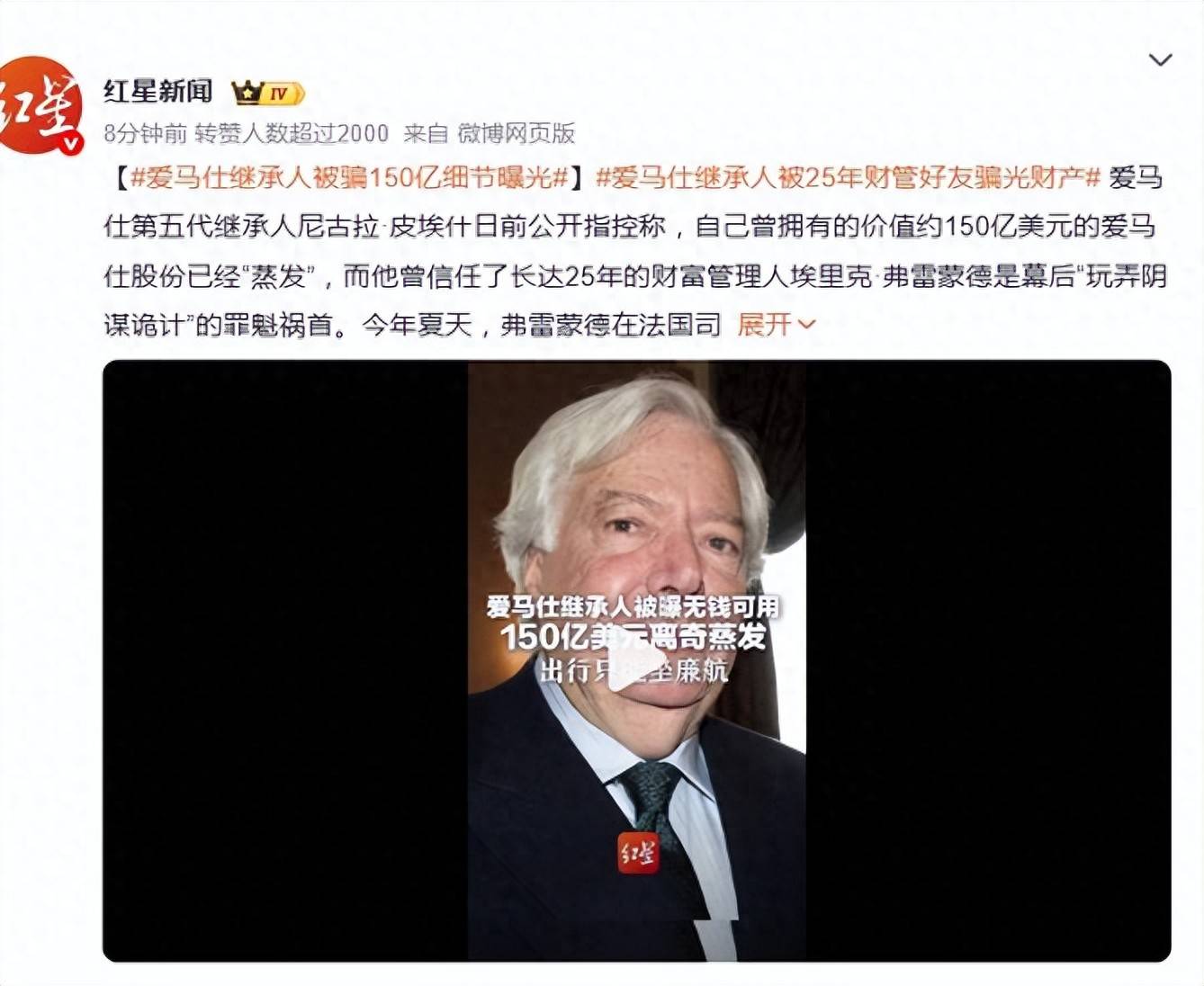
爱马仕继承人被骗150亿美元,陷入“无钱可用”
Sou Hu Cai Jing· 2025-12-01 02:49
Core Insights - The shocking news about Nicolas Puech, the fifth-generation heir of Hermès, reveals that his $15 billion stake in the company has "evaporated," leading him to travel on budget airlines in economy seats. This situation is linked to his long-trusted wealth manager, Eric Fremont, whose mysterious death in the Swiss Alps has turned this saga into what is described as "one of the most epic financial legends of the century" [1]. Group 1: Background of Eric Fremont - Eric Fremont entered the Swiss financial scene in 1989 through marriage and worked at a private bank associated with his father-in-law, gaining access to elite clients. He met Nicolas Puech through this connection and quickly became a close friend and personal assistant [4]. - Over more than two decades, Fremont took control of Puech's life and finances, managing everything from travel arrangements to property management and daily bill payments, gaining unrestricted access to Puech's residences in Switzerland and Spain [5]. Group 2: The Fraud Unveiled - The turning point occurred around 2000 when, under Fremont's persuasion, Puech transferred his Hermès shares to Switzerland as "bearer shares" and signed a "power of attorney" agreement, granting Fremont full control over his assets [5]. - Puech lived under the illusion created by Fremont, who falsely claimed that the assets were "stably appreciating" and even produced fake reports to reassure him. In reality, Fremont had secretly sold most of Puech's Hermès shares to competitor LVMH and misappropriated funds through fraudulent investments and art transactions [7]. - The fraud was exposed dramatically in 2022 when Puech inquired about a CHF 1 million transfer to a gardener, leading to an audit that revealed the disappearance of his billion-dollar assets and the freezing of his bank accounts [7]. Group 3: Aftermath and Legal Proceedings - Fremont had a history of regulatory violations, including a past insider trading penalty, yet managed to manipulate this high-profile fraud for years due to his complex network. Following Puech's lawsuit in 2024, Fremont died in a train incident in the Swiss Alps, initially ruled as suicide, leaving the recovery of Puech's assets uncertain [9]. - Despite the French police's involvement and multiple fraud charges against Fremont, his death has significantly diminished the chances of asset recovery. Reports indicate that Puech is now in a "no money available" situation, having to fly on budget airlines and occupy inconspicuous middle seats [11].