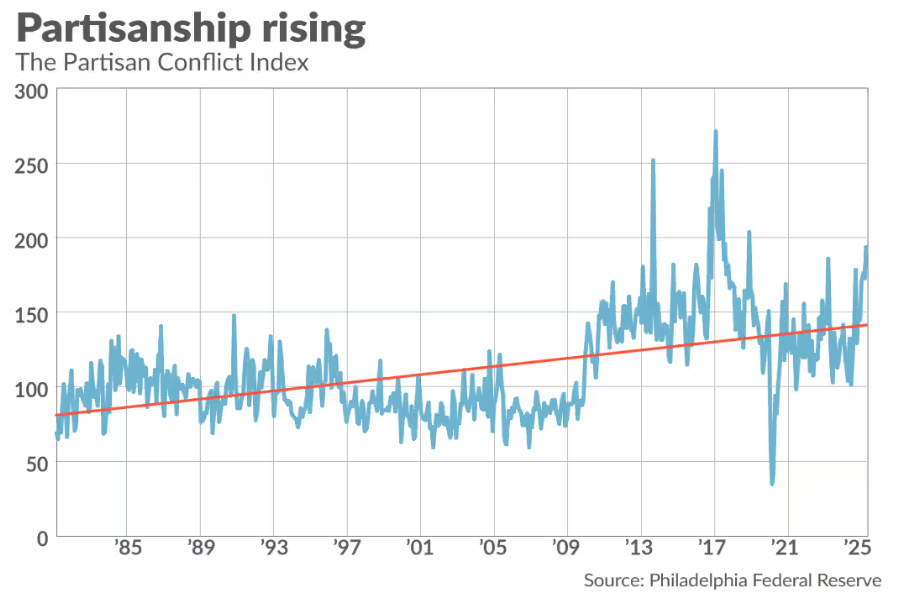
党派冲突指数(PCI)

Search documents
美国政府停摆:长期经济增长的“杀手”
Jin Shi Shu Ju· 2025-10-15 05:45
Group 1 - The core argument is that political polarization in the U.S. is leading to a significant reduction in corporate investment, which will adversely affect long-term economic growth [1][2] - A study by Marina Azzimonti found a negative correlation between the partisan conflict index (PCI) and domestic private investment, indicating a causal relationship [2][5] - Azzimonti's research highlights that 27% of the decline in corporate investment from 2007 to 2009 can be attributed to increased partisan conflict [2] Group 2 - The long-term trend of the PCI is steadily increasing, currently more than double the levels seen during the 2007-2009 period, suggesting that corporate investment would be higher without government dysfunction [5] - Political polarization creates greater economic uncertainty, which diminishes the likelihood of returns on capital investments, leading to delays in investment decisions [5] - Political polarization also reduces the likelihood of timely legislative responses to economic crises, negatively impacting expected returns and suppressing corporate investment [5][6] Group 3 - Azzimonti's findings contradict the belief that corporate America prefers political gridlock, as it actually leads to poorer stock market performance [6] - Research indicates that stock market returns are better under unified government control, with annualized returns being 8.7 percentage points higher from 1927 to 2020 during unified government periods [8] - The impact of government dysfunction may not be immediately visible in economic data, but historical trends suggest that future U.S. economic growth rates are likely to be significantly lower [8]