全域场景融合

Search documents
国有大行主导手机银行市场,生态嵌入构筑护城河
Jing Ji Guan Cha Wang· 2026-02-18 05:47
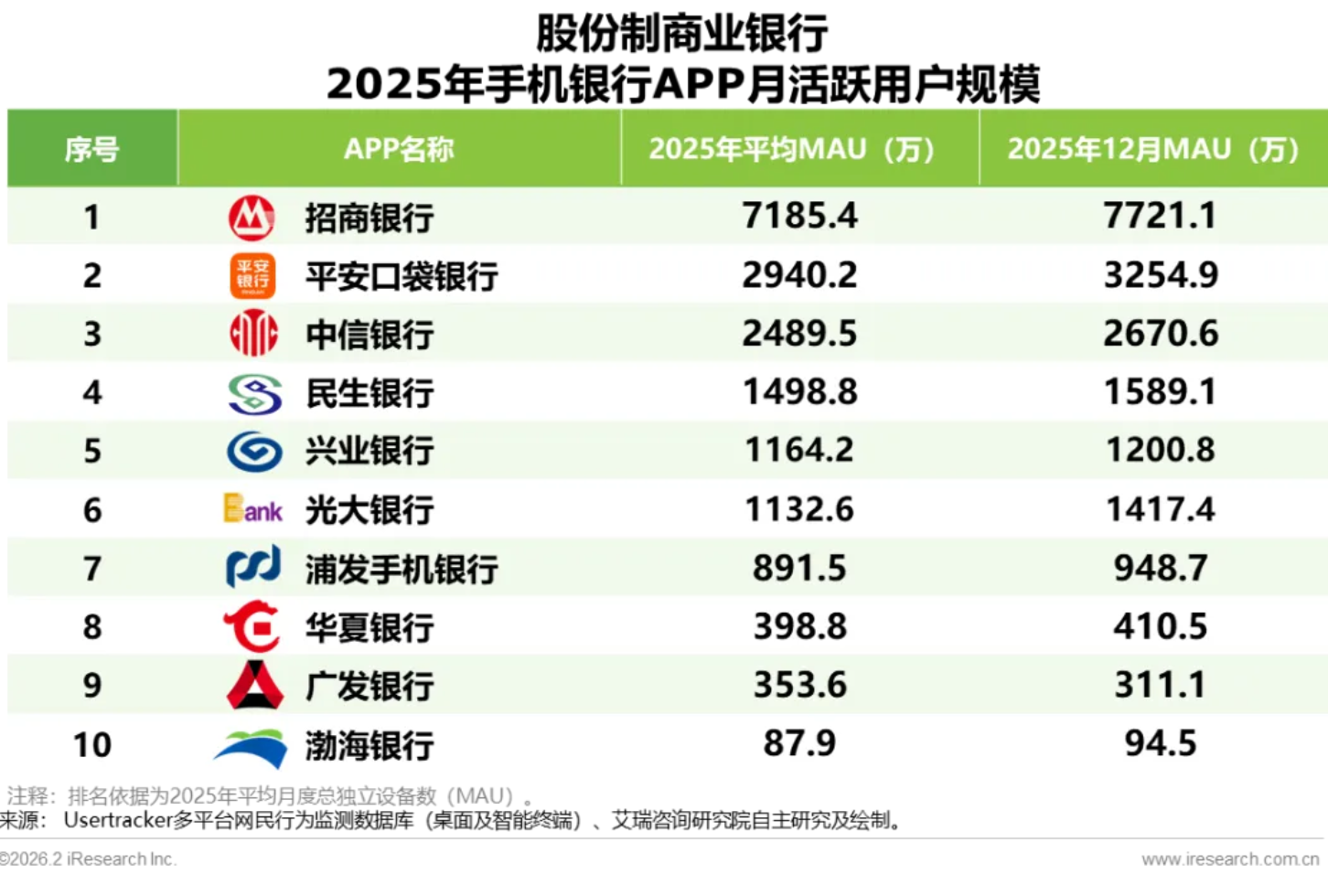
Core Insights - The Chinese mobile banking market is entering a stage of stock competition in 2025, with monthly active users (MAU) stabilizing between 648 million and 739 million [2] - State-owned commercial banks dominate the market due to their ecological embedding advantages, with Agricultural Bank of China leading at 249 million MAU, followed by Industrial and Commercial Bank of China (194 million) and China Construction Bank (109 million) [2] - Private banks are expected to collectively exit the top 50 MAU rankings in 2025 due to a lack of offline branch support and local living ecosystems [2] Group 1: Major Players - Agricultural Bank of China has the highest MAU at 249 million, followed by Industrial and Commercial Bank of China with 194 million and China Construction Bank with 109 million, forming the first tier of banks [2] - China Bank and Postal Savings Bank have MAUs exceeding 50 million, constituting the second tier [2] - China Merchants Bank leads the joint-stock banks with 71.85 million MAU, while Ping An Bank and CITIC Bank form the second tier, with other joint-stock banks generally below 20 million MAU [2] Group 2: Market Dynamics - The core advantage of state-owned banks lies in their "full-scenario integration" capabilities, embedding services deeply into high-frequency life scenarios such as government affairs, social security, healthcare, and education [2] - Agricultural Bank of China extends its services to rural areas through intelligent service matching and customer customization, while Industrial and Commercial Bank of China utilizes its "Gong Xiao Zhi" model for interactive service [2] - Regional banks like Jiangsu Bank, Beijing Bank, and Ningbo Bank show stable performance by focusing on local markets, with some rural commercial banks like Fujian Rural Credit exceeding 4.5 million MAU, indicating the sustainability of localized operations in the stock market [2]