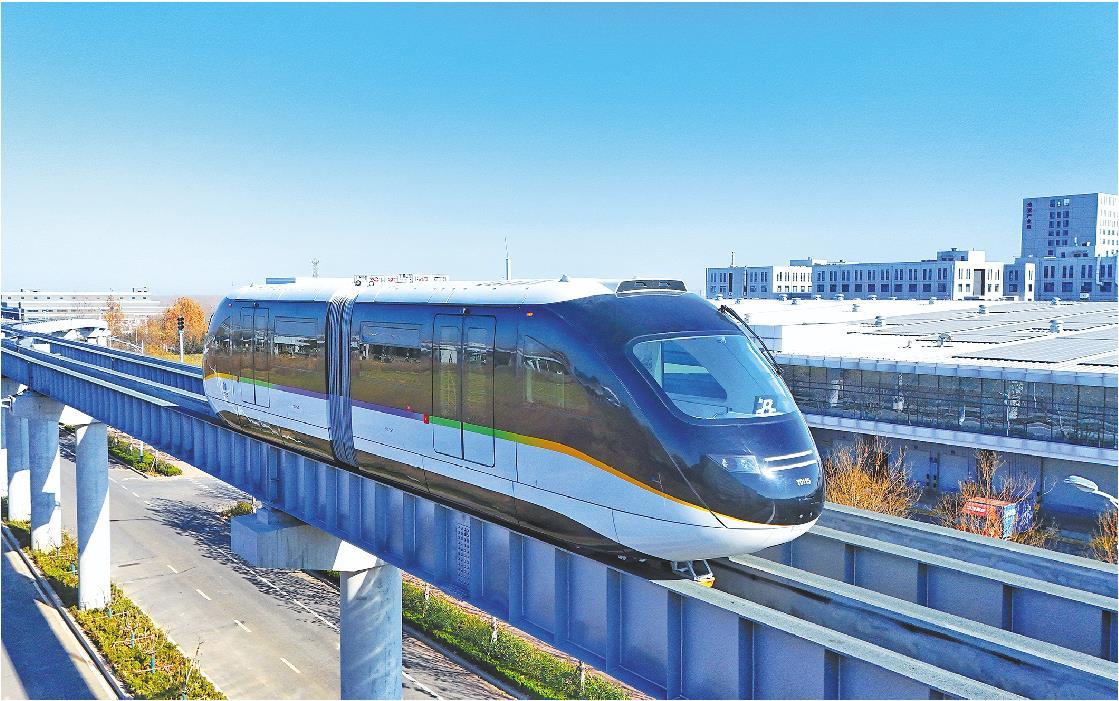
全自动无人驾驶

Search documents
地铁12号线列车:武汉制造武汉检修
Chang Jiang Ri Bao· 2026-01-29 00:52
Core Viewpoint - The Wuhan Metro Line 12, the longest metro loop in Asia, is undergoing trial runs and is expected to be operational by May this year, connecting seven central urban areas in Wuhan. Group 1: Technical Features of Line 12 - The trains are designed as "premium cars" with a focus on craftsmanship, featuring A-type aluminum alloy electric passenger cars with a maximum speed of 80 km/h [2] - The A-type cars have 10 doors per carriage compared to 8 in traditional B-type cars, providing more space [2] - The interior design includes hidden handrails for a more spacious feel, and eco-friendly water-based paint is used for the car body [2] - An intelligent operation and maintenance management system allows for daily self-checks of the trains, enhancing safety and efficiency [2] - The gap between adjacent components is meticulously controlled, with top plate gaps at 2.5 to 3.5 mm and side gaps at 2 to 2.5 mm, ensuring high standards of assembly [2][3] Group 2: Innovations and Improvements - The noise level of the trains has been reduced from 75 decibels to 73 decibels, improving passenger comfort [3] - The weight of the trains has been reduced by 5%, equating to a 4.5-ton reduction per train, leading to energy savings and improved braking [3] - The trains feature a new design inspired by traditional Chinese opera, enhancing their aesthetic appeal [3] Group 3: Manufacturing Process - The manufacturing process involves over 300 steps, with a focus on lean production methods that enhance efficiency [5][6] - The factory has transitioned to a "car moves, people do not" model, allowing for a more organized workflow and reducing time wastage [6] - The production rate is set to produce two train bodies every 14 days, equating to one train per week [5] Group 4: Maintenance and Lifecycle - Each train undergoes a "static adjustment" and "dynamic adjustment" process before delivery, ensuring all systems function correctly [9] - The trains have a lifespan of 30 years, with maintenance strategies aimed at achieving domestic solutions for all components [9][10] - The company has developed its own repair standards that exceed original manufacturer specifications, allowing for local maintenance without reliance on imports [10]
济南云巴开通运营 全长30.55公里起步价2元
Xin Hua Wang· 2025-12-06 00:42
Core Viewpoint - Jinan Yunba, the first cloud bus circular line in China, is set to open on December 6, aiming to address the "last mile" transportation challenge for citizens with its independent road rights and flexible efficiency [2][3] Group 1: Project Overview - The Jinan Yunba line spans 30.55 kilometers and includes 32 stations, making it the longest cloud bus line in the country [2] - It utilizes low-capacity guided rubber-tired vehicles and features an autonomous operation system powered by efficient and environmentally friendly batteries [2] Group 2: Technical Features - The system operates with a fully automated driverless technology, featuring a unique U-shaped track beam and lateral guiding rubber wheel design, which enhances safety and adaptability to complex terrains [2] - The vehicles are equipped with permanent magnet synchronous motors and energy recovery systems, significantly reducing energy consumption [2] - Noise levels during operation are effectively controlled through active noise reduction technology [2] Group 3: Operational Details - The service operates from 6 AM to 10 PM, with multiple departure points for the first train to facilitate passenger convenience [3] - During peak hours (7:00-9:00 and 17:00-19:00 on weekdays), the train frequency is approximately every 5 minutes, while off-peak times see a frequency of about 11 minutes [3] - The fare system follows a distance-based pricing model, starting at 2 yuan for the first 5 kilometers and capping at 5 yuan [3] Group 4: Regional Impact - The Jinan Yunba is expected to significantly enhance commuting convenience for residents and employees in the Jinan High-tech East District, promoting deeper integration of industry and urban development [3]