公开与私募市场融合

Search documents
私募信用五大关键趋势
Guo Ji Jin Rong Bao· 2025-12-26 10:08
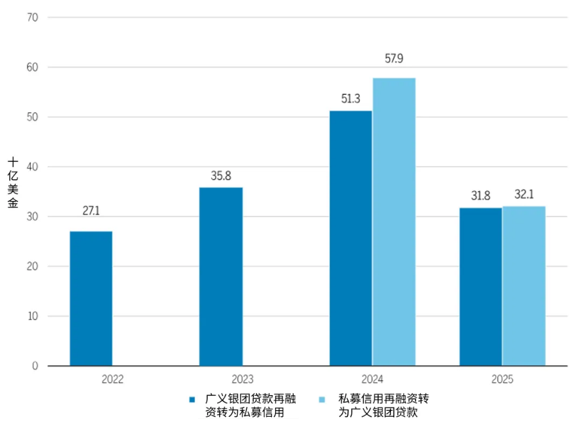
Core Insights - Private credit has become one of the most dynamic sectors in financial markets, with expectations for its role as a mainstream financing solution to deepen by 2026, evolving beyond traditional middle-market direct lending into a more diversified toolkit [1] Group 1: Expanding Opportunities - The potential investable market size for private credit exceeds $30 trillion, spanning various asset classes, with significant portions not belonging to traditional leveraged corporate debt [3] - Investors who can broaden their private credit perspectives and grasp market trends may find substantial opportunities to create value for clients [3] Group 2: Convergence of Public and Private Markets - The lines between public and private markets are increasingly blurred, creating ongoing opportunities as issuers utilize both markets to meet complex capital needs [4] - Notable examples include commercial real estate debt and large-scale data center financing, where issuers seek funds from both public and private markets, indicating a trend towards innovative financing solutions [4] Group 3: Changes in Credit Conditions - The convergence of public and private markets may intensify competition in certain areas, potentially impacting credit conditions, particularly in middle-market direct lending and broadly syndicated loan markets [5] - Over the past decade, middle-market direct lending has grown at a rate approximately five times that of the broader leveraged credit market, leading to increased competition [5] Group 4: Growth in Retail and Wealth Investor Demand - Asset owners are diversifying their public market risk exposure and capturing potential premiums from the illiquidity and complexity of the private credit market, with U.S. retail investor allocations currently around $100 billion, projected to grow to $2.4 trillion by 2030 at an annualized growth rate of nearly 80% [8] - Interval funds are expected to reach nearly $450 billion by mid-2025, with credit-focused strategies remaining the most popular allocation direction [8] Group 5: Evolution of Bank Roles - Due to tighter regulations, banks are reshaping their balance sheets, with disintermediation becoming a long-term trend in the credit market, although their role remains crucial [13] - Banks are increasingly partnering with market-based lenders, facilitating private credit growth through various collaborations, including financing and distribution of private credit products [13] - Recent data shows steady growth in loans to non-depository financial institutions, highlighting the evolving role of banks in the credit market [13]

万亿美元资管巨头:全球LP对私募市场仍持乐观态度
中国基金报· 2025-07-01 04:47
Core Insights - Wellington Management's survey indicates that despite geopolitical risks, global limited partners (LPs) remain optimistic about private market allocations, with 96% planning to increase or maintain their investments in the next year [2][3]. Group 1: Survey Findings - The survey, conducted at the SuperReturn International conference, included responses from 165 institutions, comprising 70 LPs, 46 general partners (GPs), and 32 service providers [3]. - A significant majority of LPs (96%) plan to either increase (53%) or maintain (43%) their private market allocations, with only 4% intending to reduce their investments [3]. - 51% of LPs believe that a blended strategy of public and private markets can enhance overall portfolio performance, with 63% considering this approach [3]. Group 2: Market Trends - Wellington Management's private investment director noted that despite challenges in the previous year, LPs continue to seek investment opportunities in the private market, with 45% citing "higher return potential" as a key advantage [4]. - Many LPs are diversifying their asset allocations, moving from traditional concentrated strategies to more diversified approaches, including private equity secondary markets and growth assets [6][7]. - Only 10% of LPs reduced their private market allocations in the past year, with 48% believing that political uncertainty will have the most significant impact on the private market in the next 12 months [8]. Group 3: Regional Insights - Among U.S. respondents, the highest proportion (73%) increased their private market allocations in the past year, while Europe and the Middle East showed strong optimism, with 65% and 64% of respondents, respectively, planning to increase allocations [8].