间隔基金

Search documents
私募信用五大关键趋势
Guo Ji Jin Rong Bao· 2025-12-26 10:08
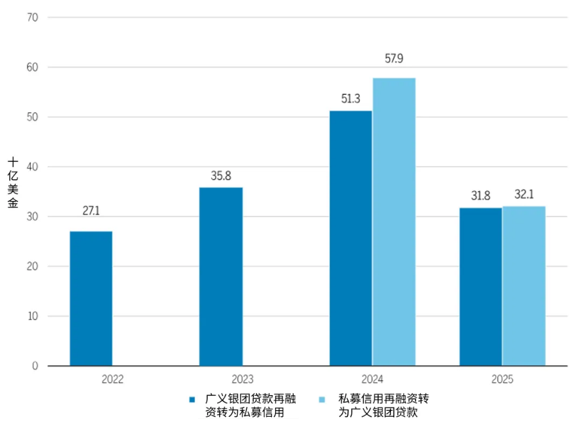
Core Insights - Private credit has become one of the most dynamic sectors in financial markets, with expectations for its role as a mainstream financing solution to deepen by 2026, evolving beyond traditional middle-market direct lending into a more diversified toolkit [1] Group 1: Expanding Opportunities - The potential investable market size for private credit exceeds $30 trillion, spanning various asset classes, with significant portions not belonging to traditional leveraged corporate debt [3] - Investors who can broaden their private credit perspectives and grasp market trends may find substantial opportunities to create value for clients [3] Group 2: Convergence of Public and Private Markets - The lines between public and private markets are increasingly blurred, creating ongoing opportunities as issuers utilize both markets to meet complex capital needs [4] - Notable examples include commercial real estate debt and large-scale data center financing, where issuers seek funds from both public and private markets, indicating a trend towards innovative financing solutions [4] Group 3: Changes in Credit Conditions - The convergence of public and private markets may intensify competition in certain areas, potentially impacting credit conditions, particularly in middle-market direct lending and broadly syndicated loan markets [5] - Over the past decade, middle-market direct lending has grown at a rate approximately five times that of the broader leveraged credit market, leading to increased competition [5] Group 4: Growth in Retail and Wealth Investor Demand - Asset owners are diversifying their public market risk exposure and capturing potential premiums from the illiquidity and complexity of the private credit market, with U.S. retail investor allocations currently around $100 billion, projected to grow to $2.4 trillion by 2030 at an annualized growth rate of nearly 80% [8] - Interval funds are expected to reach nearly $450 billion by mid-2025, with credit-focused strategies remaining the most popular allocation direction [8] Group 5: Evolution of Bank Roles - Due to tighter regulations, banks are reshaping their balance sheets, with disintermediation becoming a long-term trend in the credit market, although their role remains crucial [13] - Banks are increasingly partnering with market-based lenders, facilitating private credit growth through various collaborations, including financing and distribution of private credit products [13] - Recent data shows steady growth in loans to non-depository financial institutions, highlighting the evolving role of banks in the credit market [13]

散户“入场”还是“入坑”?美SEC拟开放私募与加密准入,是财富机遇还是信息差陷阱?
智通财经网· 2025-12-24 13:05
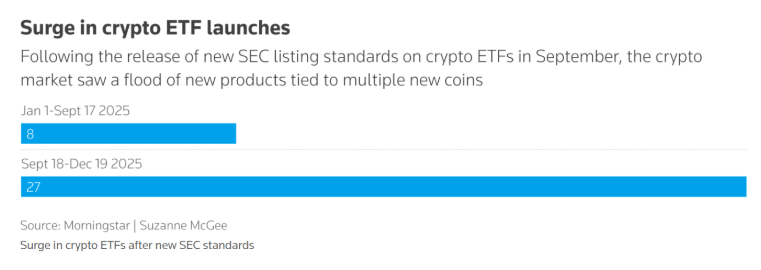
Group 1 - The Trump administration and SEC are pushing for market openness, allowing U.S. investors to access more investment products related to private credit and cryptocurrencies [1][3] - SEC Chairman Paul Atkins emphasizes the need for investor protection while providing more choices for high-return asset classes [1][2] - Investment advisors express concerns that individual investors may not fully understand the risks associated with new products, particularly those typically investing in stocks and bonds [1][3] Group 2 - The SEC is focused on ensuring investors receive robust information to make informed decisions about new products, while also establishing necessary safeguards for private asset access [2][3] - The introduction of general listing standards and accelerated launch of new ETFs aims to increase investor access to cryptocurrency investments [3][5] - The number of new cryptocurrency ETFs has increased since the introduction of general listing standards, with predictions of 100 additional products by 2026 [5][7] Group 3 - While ETFs and interval funds themselves may not represent high risk, the risk depends on the nature of the underlying assets [7] - Market participants suggest that opening up choices could benefit investors, with cryptocurrency potentially playing an important role in investment portfolios [7]