军工高端制造

Search documents
人民币升值背景下可以关注哪些投资方向?
Xin Lang Cai Jing· 2026-01-20 13:39
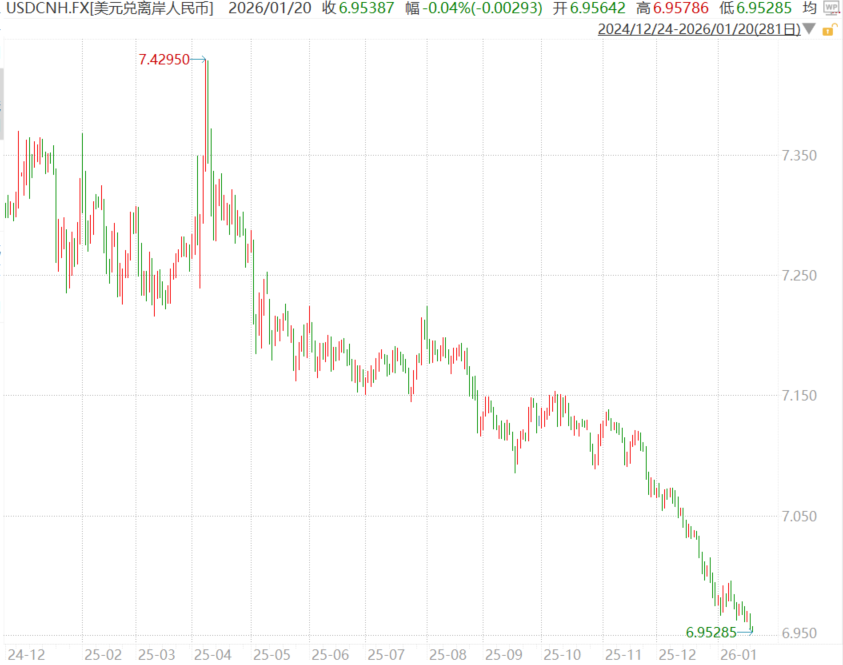
Core Viewpoint - The continuous strengthening of the RMB exchange rate against the USD, surpassing 6.96, is driven by multiple domestic and international factors, indicating a long-term trend rather than a short-term fluctuation. Understanding the reasons behind the RMB appreciation and its impacts on various industries and companies is crucial for investment decisions and asset allocation strategies [1][9]. Group 1: Drivers of RMB Appreciation - Internally, the high-quality development of the Chinese economy has laid a solid foundation for RMB appreciation, with a notable trade surplus of $1.076 trillion in the first 11 months of 2025, a 21.7% year-on-year increase, enhancing confidence in Chinese assets [3][11]. - Externally, the weakening of the USD, influenced by the Federal Reserve's interest rate cuts and a decline of over 9% in the dollar index last year, has diminished the relative advantage of USD assets, making RMB assets more attractive to global capital seeking diversification [3][11]. Group 2: Multi-dimensional Impacts of RMB Appreciation - The appreciation of the RMB is likely to attract international capital into the Chinese market, favoring blue-chip stocks and industry leaders, which can lead to higher valuations for these "core assets" [4][12]. - The trend may pressure traditional export-oriented companies, causing capital to flow from export sectors to those benefiting from RMB appreciation, such as import sectors. For ordinary residents, RMB appreciation enhances purchasing power for overseas goods and services, potentially stimulating consumption upgrades [4][12]. Group 3: Investment Directions - **Import-dependent Industries**: Sectors reliant on imported raw materials or core equipment, such as aviation, paper, and petrochemicals, will benefit from reduced procurement costs due to RMB appreciation [5][13][14]. - **Growth Sectors**: Focus on industries aligned with technological advancements, including AI, commercial aerospace, semiconductors, and new energy vehicles, which are expected to benefit from improved global liquidity and lower equipment costs [6][15]. - **Core Assets**: RMB appreciation increases the attractiveness of RMB-denominated assets, with foreign capital favoring low-valuation, high-dividend core assets, particularly in the financial sector, which is expected to see increased activity and valuation recovery [7][16]. - **Cyclical and Commodities**: The improvement in domestic economic fundamentals may benefit cyclical sectors, with RMB appreciation lowering import costs for raw materials, supported by global liquidity conditions [8][17].