
农村供水高质量发展

Search documents
水利部:加快建设“系统完备、安全可靠,集约高效、绿色智能,循环通畅、调控有序”的现代化水网
Zheng Quan Shi Bao Wang· 2026-01-15 10:50
Core Viewpoint - The Ministry of Water Resources emphasizes the importance of implementing the national water network construction and high-quality rural water supply development to ensure water security and support the progress towards socialist modernization [1] Group 1: National Water Network Construction - The meeting highlighted the need to accelerate the construction of a modern water network that is comprehensive, safe, efficient, green, intelligent, and capable of effective regulation [1] - The focus is on enhancing flood disaster prevention, water resource allocation, and urban-rural water supply security [1] - The Ministry aims to innovate financing mechanisms for water conservancy and improve the management of major water projects to ensure quality throughout the project lifecycle [1] Group 2: Rural Water Supply Development - There is a strong emphasis on strengthening legal protections for rural water supply and implementing standardized construction and management models [1] - The goal is to establish a comprehensive water safety assurance system from the source to the tap, ensuring the safety of rural water supply [1]
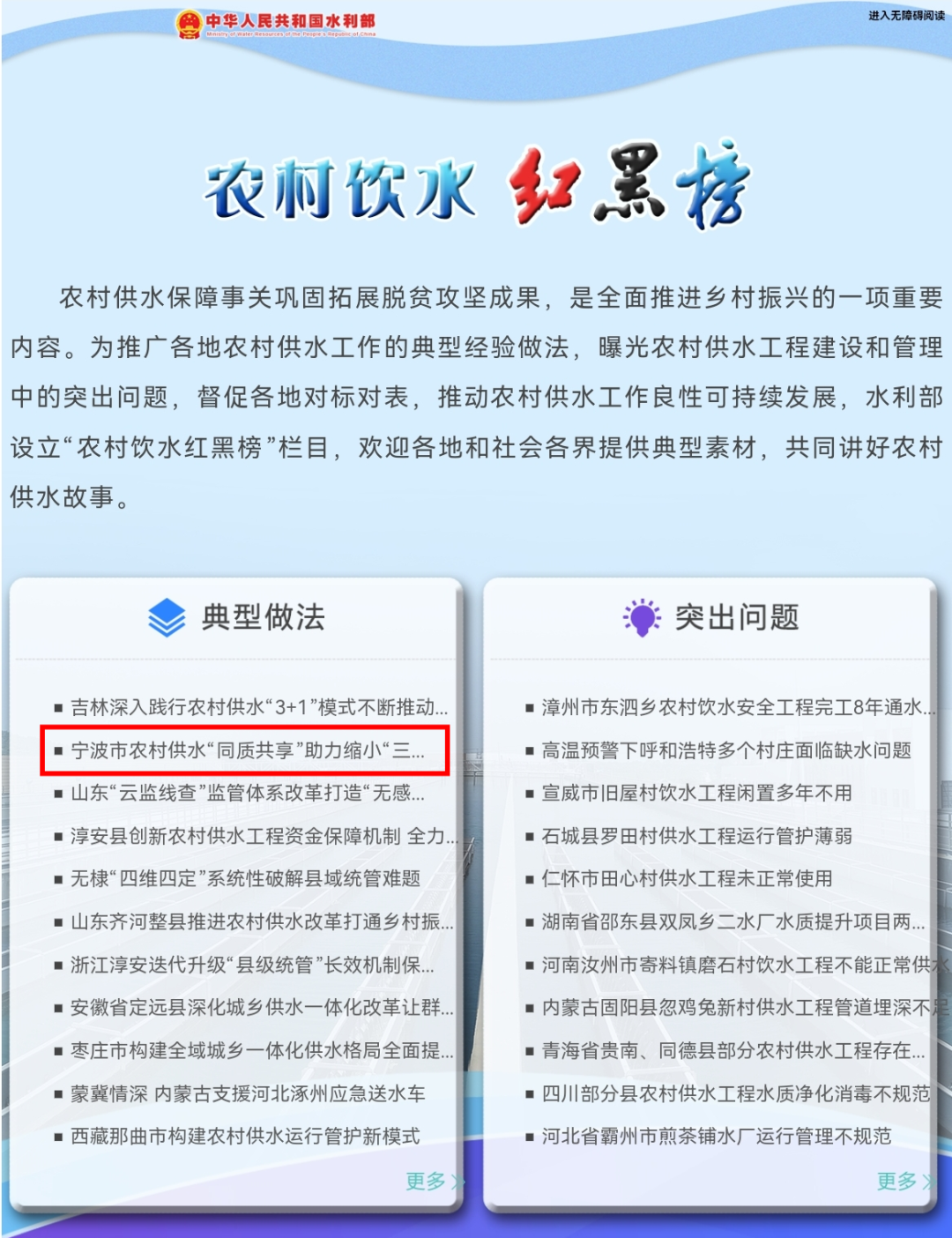
宁波农村供水“应通尽通”模式荣登水利部“农村饮水红榜”
Feng Huang Wang Cai Jing· 2025-12-18 07:02
Core Insights - The Ministry of Water Resources has established a "Rural Drinking Water Red and Black List" to promote sustainable rural water supply practices, with Ningbo's "All Connections" model recognized on the "Red List" [1] Group 1: Achievements in Rural Water Supply - Ningbo has significantly improved its rural water supply through the "All Connections" project, achieving a coverage increase from 93.5% to 96.09% since 2022, with 85 urban water plant pipeline extension projects completed [4] - A total investment of 990 million yuan has been made to upgrade 316 village water stations, benefiting 306,000 rural residents [4] Group 2: Water Quality Standards - 69% of the 279 village water stations in the city now use membrane treatment equipment, achieving a 98.5% urban-rural homogeneity in water supply quality [5] - The online monitoring coverage for water quantity is 100%, while water quality monitoring exceeds 80%, marking a transition from merely having access to water to ensuring high-quality water [5] Group 3: Service Efficiency Improvements - A new service system has been established, integrating urban water supply management with a 24-hour hotline, addressing the disconnect between construction and management of rural water supply projects [6] - The initiative aims to enhance the stability of rural water supply and ensure safe drinking water for residents [6] Group 4: Legal and Policy Framework - The implementation of the revised "Ningbo City Water Supply and Water Conservation Regulations" since July 1, 2023, provides a legal foundation for urban-rural water supply integration [7] - A series of policies have been introduced to support the entire lifecycle of rural water supply, promoting clear responsibilities and efficient services [7] Group 5: Infrastructure Development - The project focuses on both extending urban pipelines and upgrading village water stations, with over 150 km of new and renovated pipelines completed [8] - Enhancements to 316 village water stations include improvements in water source security, treatment facilities, supply networks, and digital management [8] Group 6: Management and Monitoring Innovations - A professional management system has been established, transferring the operation of village water stations to urban water supply companies for better maintenance and emergency response [9] - A digital monitoring platform has been created to integrate real-time data on water quantity and quality, facilitating proactive management [10] Group 7: Quality Control and Financial Sustainability - A three-tier water quality supervision system has been implemented, ensuring compliance with national standards and promoting a sustainable financial model for rural water supply [12] - The initiative encourages a shift towards a paid water usage model, fostering a self-sustaining approach to rural water supply [12]

海河水利委员会聚力推动农村供水高质量发展
Shui Li Bu Wang Zhan· 2025-12-17 10:00
Core Viewpoint - The article emphasizes the importance of rural water supply for public welfare and its role in achieving comprehensive rural revitalization and equalization of urban-rural public services, with a focus on high-quality development and effective management by the Haihe Water Conservancy Committee by 2025 [1][2][3][4] Group 1: Rural Water Supply Management - The Haihe Water Conservancy Committee aims to enhance rural water supply service levels by prioritizing concentrated rectification efforts and integrating party-building with water management practices [1][3] - A collaborative mechanism between disciplinary inspection and business management has been established to ensure effective political supervision and operational management [1][3] - The committee has resolved over 5,000 issues related to water quantity, quality, and fees through targeted guidance and quarterly progress tracking [1][3] Group 2: Emergency Response and Disaster Recovery - During extreme weather events, the committee quickly mobilized resources to ensure the safety and stability of rural water supply, addressing issues in over 1,400 affected villages [2] - An emergency response communication mechanism was established with four regions to assess disaster impacts and recovery processes [2] - Technical teams conducted on-site evaluations in disaster-affected areas to guide reconstruction efforts and improve emergency response systems [2] Group 3: Standardization and Quality Improvement - The committee is promoting a "3+1" standardized construction and management model for rural water supply, focusing on both hard investments and soft development [3] - Quality control measures are being implemented for project applications and construction, with ongoing tracking of 13 projects to address infrastructure gaps [3] - By the end of 2025, the goal is to achieve a rural tap water coverage rate of 98% and a scale engineering coverage rate of over 70% in the region [3] Group 4: Future Plans - The committee plans to continue advancing the "3+1" standardization and management model, enhancing political commitment and responsibility [4] - Strategic planning for 2026 and the 14th Five-Year Plan for rural water supply management will be developed to further strengthen the sector [4] - The committee aims to play a pivotal role in coordinating and supervising rural water supply initiatives for future improvements [4]
人民网:推进农村供水高质量发展 浙江绘就富“村”山居图
Shui Li Bu Wang Zhan· 2025-12-10 01:41
Core Insights - The completion of the last single village water station in Zhejiang marks the end of the province's initiative to improve water supply in remote areas, benefiting 2.42 million residents in 5,501 administrative villages [1][2] - The new water station in Zhang Village has a daily supply capacity of 900 tons and employs an automated operation model to ensure water quality and safety [1] - The initiative aims to provide urban-quality drinking water to rural populations, addressing long-standing issues of water access in mountainous and island regions [2] Group 1 - The Zhejiang government has committed to a "no village left behind" strategy, launching a comprehensive upgrade of single village water stations to ensure all residents have access to clean drinking water [2] - Over three years, Zhejiang has constructed 32 new "thousand-ton-per-day" water plants and extended urban water supply networks by 3,915 kilometers, achieving integration of urban and rural water supply systems [2] - The province has implemented a county-level management model for rural water supply, enhancing service response times and increasing resident satisfaction to 98.5% [2] Group 2 - The establishment of water stations has not only improved living conditions for villagers but also supported local agricultural development and increased the marketability of agricultural products [3] - Future plans include integrating water source protection and pipeline upgrades into the "14th Five-Year Plan" to ensure sustainable access to quality water for rural communities [3]

第六届农业节水和农村供水技术发展论坛暨第十届农业节水科技奖颁奖大会在广州举办
Nan Fang Nong Cun Bao· 2025-11-10 09:32
Core Points - The Sixth Agricultural Water Saving and Rural Water Supply Technology Development Forum and the 2024-2025 (10th) Agricultural Water Saving Science and Technology Award Ceremony were held in Guangzhou, highlighting advancements in agricultural water-saving technologies and rural water supply systems [2][3][4]. Group 1: Event Overview - The forum was organized by the China Agricultural Water Saving and Rural Water Supply Technology Association and the Agricultural Water Saving Science and Technology Award Committee [3]. - Key figures in attendance included the association president, academician Kang Shaozhong, and former association president Zhai Haohui, who delivered speeches emphasizing the importance of the event [4][5][12]. Group 2: Achievements and Developments - The association has witnessed significant growth over the past 30 years, contributing to the evolution of agricultural water saving and rural water supply in China [12][13]. - A report highlighted the need for mechanization, automation, and smart technologies in agriculture to address strict constraints on water usage metrics [15][16][18]. Group 3: Policy and Future Directions - The forum emphasized the association's role as a policy advisor, technology innovator, and service provider within the industry [20][22]. - Future focus areas include enhancing agricultural water efficiency, high-quality rural water supply development, and the modernization of irrigation systems [26][28]. Group 4: Data and Impact - Over the past decade, China's agricultural water usage has decreased by 185 billion cubic meters, while maintaining high levels of grain production [30][34]. - Guangdong province has invested over 10 billion annually in rural water supply construction, significantly improving irrigation capabilities [40][41]. Group 5: Awards and Recognition - The 10th Agricultural Water Saving Science and Technology Award recognized 49 technological achievements, including 12 first prizes and 17 second prizes [44][45]. - The event also featured the launch of a publication reviewing 30 years of agricultural water saving and rural water supply technology [49][50]. Group 6: Industry Collaboration - The forum included strategic cooperation agreements and discussions on industry collaboration to foster a new development pattern [50][61]. - Participants engaged in parallel sessions addressing key topics such as agricultural water saving and rural water supply, showcasing innovative practices and technologies [61][63].
