准天顶卫星系统

Search documents
日本确认导航卫星发射失败
Xin Hua She· 2025-12-22 07:45
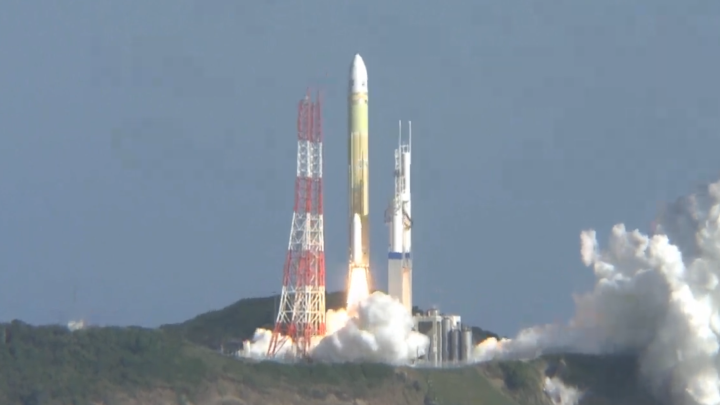
Core Viewpoint - The Japanese government confirmed the failure of the "Quasi-Zenith Satellite System" satellite "Michibiki 5" launched on December 22, 2023, due to the H3 rocket's second-stage engine burning prematurely, marking another setback for Japan's domestic launch capabilities following the H3 rocket's previous failure in March 2023 [1][2]. Group 1: Launch Failure Details - The H3 rocket's second-stage engine failed to ignite properly, leading to the satellite not reaching its intended orbit [1]. - This incident follows a previous failure in March 2023, where the H3 rocket was also unable to complete its mission due to an electrical system anomaly [2]. Group 2: Implications for Japan's Space Program - The failure of the "Michibiki 5" satellite launch may delay Japan's plans to achieve a fully independent navigation system, as the satellite was intended to be the sixth in a series that aims to reduce reliance on foreign GPS systems [1]. - The H3 rocket has now experienced two failures out of seven launches, which is a significant concern compared to the 98% success rate of its predecessor, the H2A rocket [2].
日本确认:发射失败 卫星未进入预定轨道!火箭发动机提前“结束燃烧” 抛物线坠下云端
Mei Ri Jing Ji Xin Wen· 2025-12-22 07:07
Core Points - The H3 rocket's 8th launch from the Tanegashima Space Center in Kagoshima Prefecture, Japan, failed to place the "Guide 5" satellite into its intended orbit due to an early shutdown of the second-stage engine during flight [1][2] - The launch was initially scheduled for December 7 but was postponed twice due to technical issues, including a malfunction in the inertial measurement unit and a cooling water supply problem [3] Group 1 - The H3 rocket is part of Japan's efforts to establish a domestic satellite positioning system, aiming to create a seven-satellite constellation that does not rely on foreign satellites for location information [3] - The "Guide" satellite is designed to enhance the accuracy of positioning information for devices like smartphones and to provide emergency earthquake alerts in areas without radio coverage [3]