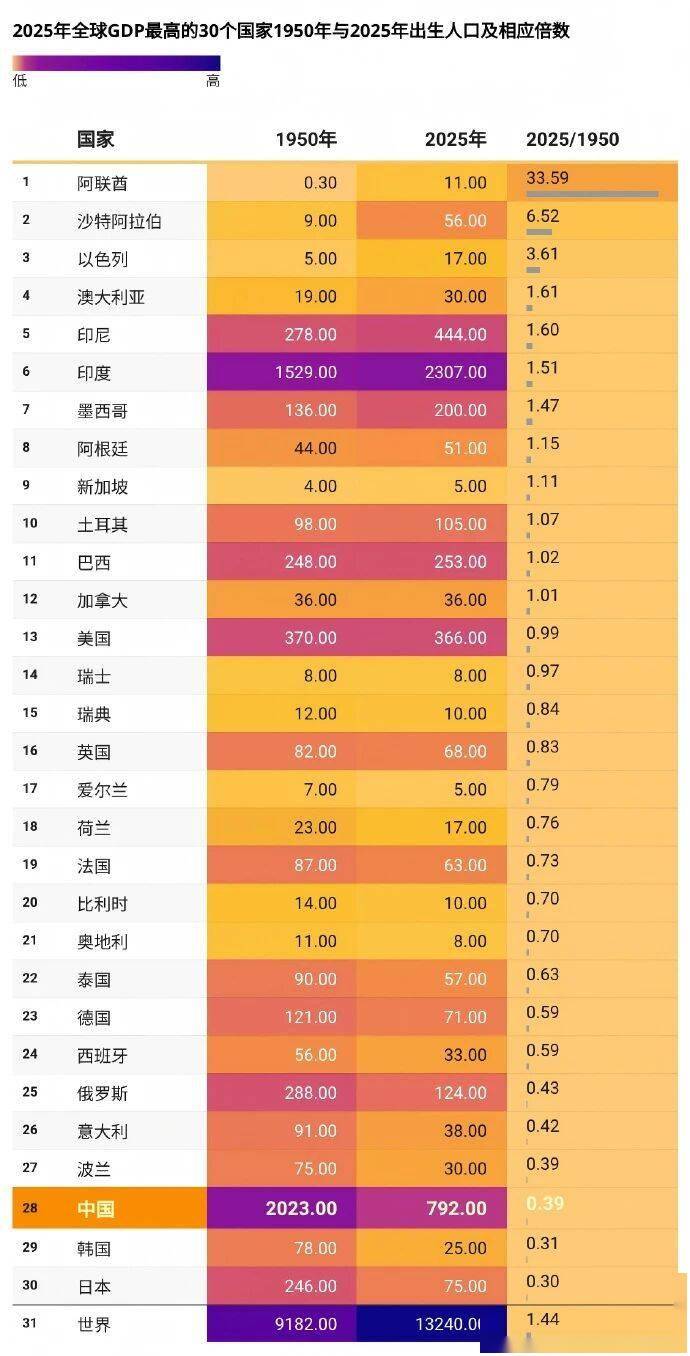
出生人口变化

Search documents
出生人口的变化更能反映人口趋势及长远影响
Sou Hu Cai Jing· 2026-02-14 23:31
Group 1 - The article highlights the significant changes in birth rates across various countries from 1950 to 2025, with a particular focus on the top 30 countries by GDP, showing that the global birth population in 2025 is 1.44 times that of 1950, driven mainly by increased life expectancy rather than birth rate growth [3][4]. - Countries like the UAE, Saudi Arabia, and Israel exhibit the highest birth rate increases, with multipliers exceeding 3, while developed nations generally show lower or stagnant growth rates [4][5]. - The data indicates that the relationship between economic development and birth rate decline is complex, as some high-income countries experience significant population shrinkage, while others with lower income levels do not [4]. Group 2 - China's birth population in 2025 is projected to be only 0.39 times that of 1950, significantly lower than the global average, indicating a severe decline in birth rates despite a large total population [3][4]. - The article emphasizes that the trends in birth rates are more indicative of long-term demographic changes than total population figures, which can be misleading due to their lagging nature [3]. - The analysis suggests that if the birth population changes from 1990 to 2025 were considered, China would rank as the fastest shrinking country in terms of birth rates [5].