人口趋势

Search documents
出生人口的变化更能反映人口趋势及长远影响
Sou Hu Cai Jing· 2026-02-14 23:31
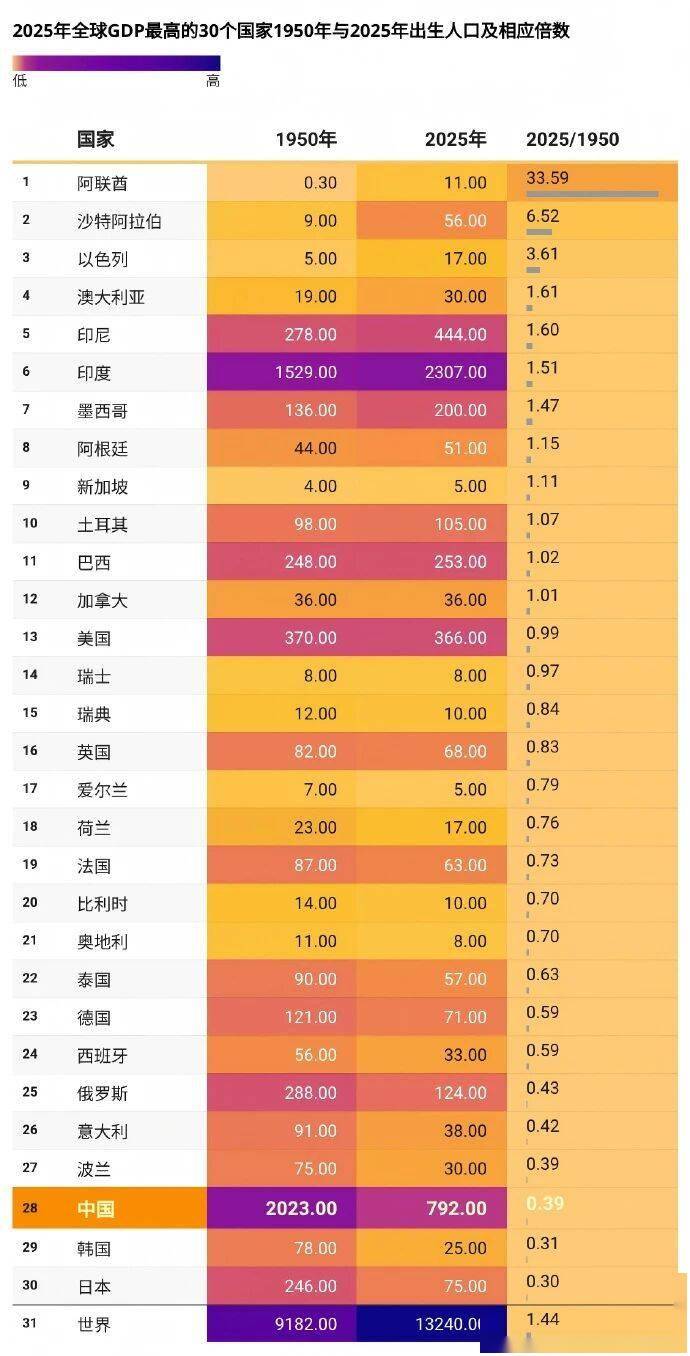
Group 1 - The article highlights the significant changes in birth rates across various countries from 1950 to 2025, with a particular focus on the top 30 countries by GDP, showing that the global birth population in 2025 is 1.44 times that of 1950, driven mainly by increased life expectancy rather than birth rate growth [3][4]. - Countries like the UAE, Saudi Arabia, and Israel exhibit the highest birth rate increases, with multipliers exceeding 3, while developed nations generally show lower or stagnant growth rates [4][5]. - The data indicates that the relationship between economic development and birth rate decline is complex, as some high-income countries experience significant population shrinkage, while others with lower income levels do not [4]. Group 2 - China's birth population in 2025 is projected to be only 0.39 times that of 1950, significantly lower than the global average, indicating a severe decline in birth rates despite a large total population [3][4]. - The article emphasizes that the trends in birth rates are more indicative of long-term demographic changes than total population figures, which can be misleading due to their lagging nature [3]. - The analysis suggests that if the birth population changes from 1990 to 2025 were considered, China would rank as the fastest shrinking country in terms of birth rates [5].

破防!生娃送房,开始了!
商业洞察· 2026-01-07 09:22
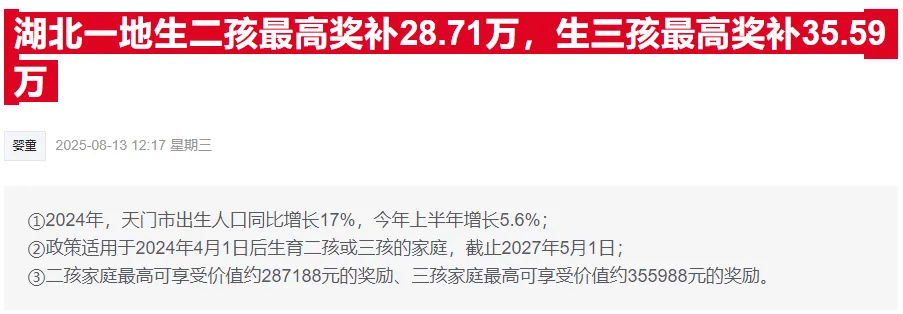
Core Viewpoint - The article discusses the recent birth incentive policies in Hubei province, particularly in cities like Tianmen and Zhushan, aimed at reversing declining birth rates and addressing population issues [4][5][15]. Group 1: Birth Incentive Policies - Tianmen City has introduced a comprehensive set of incentives for families having a second or third child, including financial rewards, housing purchase vouchers, and tax benefits, with potential total benefits reaching approximately 287,188 yuan for two-child families and 355,988 yuan for three-child families [6][7]. - Zhushan County has implemented a policy that retroactively benefits families who had a second or third child between June 1, 2021, and June 1, 2026, offering housing area subsidies and cash rewards for new births [9][11]. - The policies in both cities reflect a significant effort to encourage childbirth amid declining population trends, with Tianmen reporting that over 50% of its new births in 2024 were second or third children [28]. Group 2: Population Trends - Tianmen's population has decreased by 7.46 million from 2020 to 2024, indicating a troubling trend of both out-migration and natural population decline [17][18]. - Similarly, Zhushan's population peaked in 2017 and has been declining, with a birth rate that fell from 13.36‰ in 2017 to 4.88‰ in 2024, marking a significant demographic challenge [24][25]. - The article highlights that the declining birth rates and increasing death rates are not isolated issues but part of a broader national trend affecting many regions in China [26][31]. Group 3: Future Projections and Challenges - The United Nations predicts that China's newborn population may drop to around 8.71 million by 2025, reflecting a national crisis in birth rates [32][36]. - Despite some short-term fluctuations in birth rates due to policy changes, the underlying demographic trends suggest a continued decline in both marriage and birth rates, driven by economic pressures and changing social attitudes towards marriage and family [52][60]. - The article emphasizes that without substantial changes in economic conditions and social support systems, the effectiveness of current birth incentive policies may be limited [72][92].

破防!生娃送房,开始了!
Sou Hu Cai Jing· 2026-01-05 01:21
Group 1 - The core viewpoint of the article highlights the recent birth incentive policies in Hubei province, particularly in cities like Tianmen and Zhushan, aimed at reversing declining birth rates through various financial and social support measures [2][4][6] - Tianmen city has introduced a series of incentives for families having second and third children, including housing vouchers, tax benefits, and increased maternity leave, effective from April 2024 to May 2027 [2][3] - Zhushan county's policy includes retroactive benefits for families who had second or third children between June 2021 and June 2026, offering substantial housing subsidies and monthly childcare allowances [4][6] Group 2 - The article discusses the demographic challenges faced by Tianmen and Zhushan, noting significant population declines over the past decade, with Tianmen's population decreasing by 74,600 from 2020 to 2024 [8][10] - The birth rate in Zhushan has dropped from 13.36‰ in 2017 to 4.88‰ in 2024, indicating a critical demographic shift [14] - The article emphasizes that despite the introduction of these policies, the overall trend of declining birth rates may not be significantly altered, as the underlying issues affecting marriage and childbirth remain unresolved [16][24] Group 3 - The United Nations predicts that China's newborn population may fall to around 8.71 million by 2025, reflecting a broader national trend of declining birth rates [16][18] - The article outlines the relationship between marriage rates and birth rates, noting that the number of marriages has been declining since 2013, which directly impacts future birth rates [19][24] - The central government's recent statements indicate an urgent need to stabilize the birth population, with plans for more robust support measures anticipated in 2026 [29][32]