
创新要素流动

Search documents
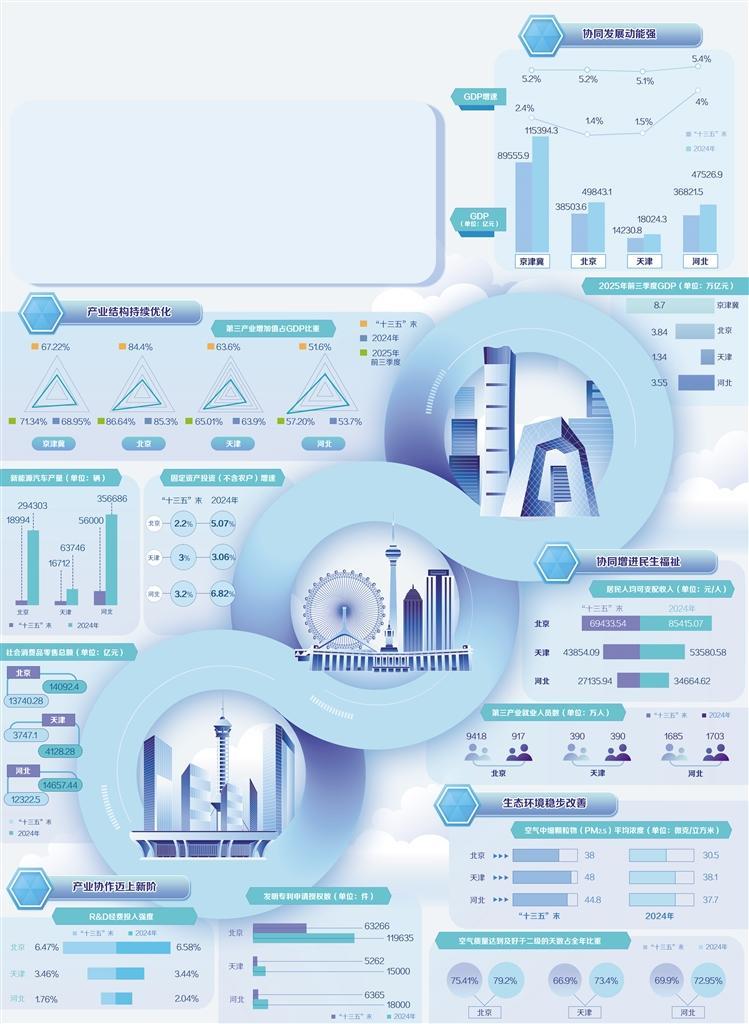
京津冀协同发展形成内生动能
Xin Lang Cai Jing· 2026-01-11 22:25
Core Viewpoint - The development of the Beijing-Tianjin-Hebei (Jing-Jin-Ji) region has transitioned from a policy-driven "cumulative effect" to a more stable and sustainable endogenous growth model, emphasizing self-supporting and self-reinforcing operational capabilities as the region enters a deeper phase of collaboration [3][4] Economic Synchronization - Since the beginning of the 14th Five-Year Plan, the economic growth of Beijing, Tianjin, and Hebei has shown a more synchronized and balanced trend, indicating that growth is supported by multi-regional collaboration rather than relying on single-point drivers [3] Industrial Structure and Regional Division - The region is witnessing a restructuring of its industrial framework, with an increasing emphasis on the service sector and strategic emerging industries, leading to a clearer gradient and specialization within the industrial system [3] - Industrial collaboration has evolved beyond simple division of labor to encompass comprehensive cooperation around complete industrial chains, forming a tighter industrial cooperation community [3] Innovation and Collaboration - The key to supporting industrial collaboration lies in the transformation of innovation factor flow, with more frequent technology transactions, industrial connections, and project collaborations among the three regions [4] - Changes in demand structure have further enhanced the sustainability of collaborative development, with notable regional interlinkages in consumption recovery [4] Cultural and Social Development - The collaboration in cultural tourism is being strengthened through innovative mechanisms, promoting consumption upgrades and industrial integration [4] - The focus on "investing in people" has led to continuous advancements in livelihood areas, optimizing employment structures, facilitating cross-regional medical services, and accelerating the interconnectivity of transportation infrastructure [4] Overall Significance - The significance of Jing-Jin-Ji collaboration extends beyond regional economic growth, aiming to reshape factor allocation methods through mature collaborative mechanisms, thereby enhancing overall development resilience [4] - The transition from "policy-driven" to "system operation" signifies that regional coordinated development has evolved from a temporary task to a capability that supports high-quality growth [4]

提升京津冀辐射带动作用
Jing Ji Ri Bao· 2025-05-29 22:23
Group 1 - The core viewpoint of the news highlights the significant growth in the import and export activities of the Beijing-Tianjin-Hebei region, with a total value of 1.43 trillion yuan in the first four months of the year, accounting for 10.1% of China's total import and export value [1] - The export value reached 445.46 billion yuan, marking a historical high for the same period, with a growth rate of 1.7% [1] - The implementation of the coordinated development strategy has led to an increase in innovation capabilities and development momentum in the region, with R&D expenditure as a percentage of GDP rising from 3.22% in 2013 to 4.27% in 2023, surpassing the national average by 1.62 percentage points [2] Group 2 - The region has seen the emergence of advanced manufacturing clusters, including integrated circuits and smart connected vehicles, with seven clusters recognized as national advanced manufacturing clusters [2] - The technology contract transaction volume from Beijing to Tianjin and Hebei increased from 7.12 billion yuan in 2013 to 84.37 billion yuan in 2024, indicating a significant rise in collaborative innovation [2] - There are still challenges to address, such as the need for improved spatial structure and balanced distribution of innovation resources, which hinder the region's overall development [3] Group 3 - The strategy emphasizes the need to construct a deep integration ecosystem of industrial chains, innovation chains, funding chains, and talent chains, aiming to enhance the quality and efficiency of national advanced manufacturing clusters [4] - The focus is on optimizing the flow of innovation elements in the region, establishing a market-oriented technology element allocation system, and promoting cross-regional technology transfer [4] - There is a call for strengthening cooperation with other major economic regions, such as the Yangtze River Delta and the Guangdong-Hong Kong-Macau Greater Bay Area, to enhance the integration of industrial and innovation chains [4]