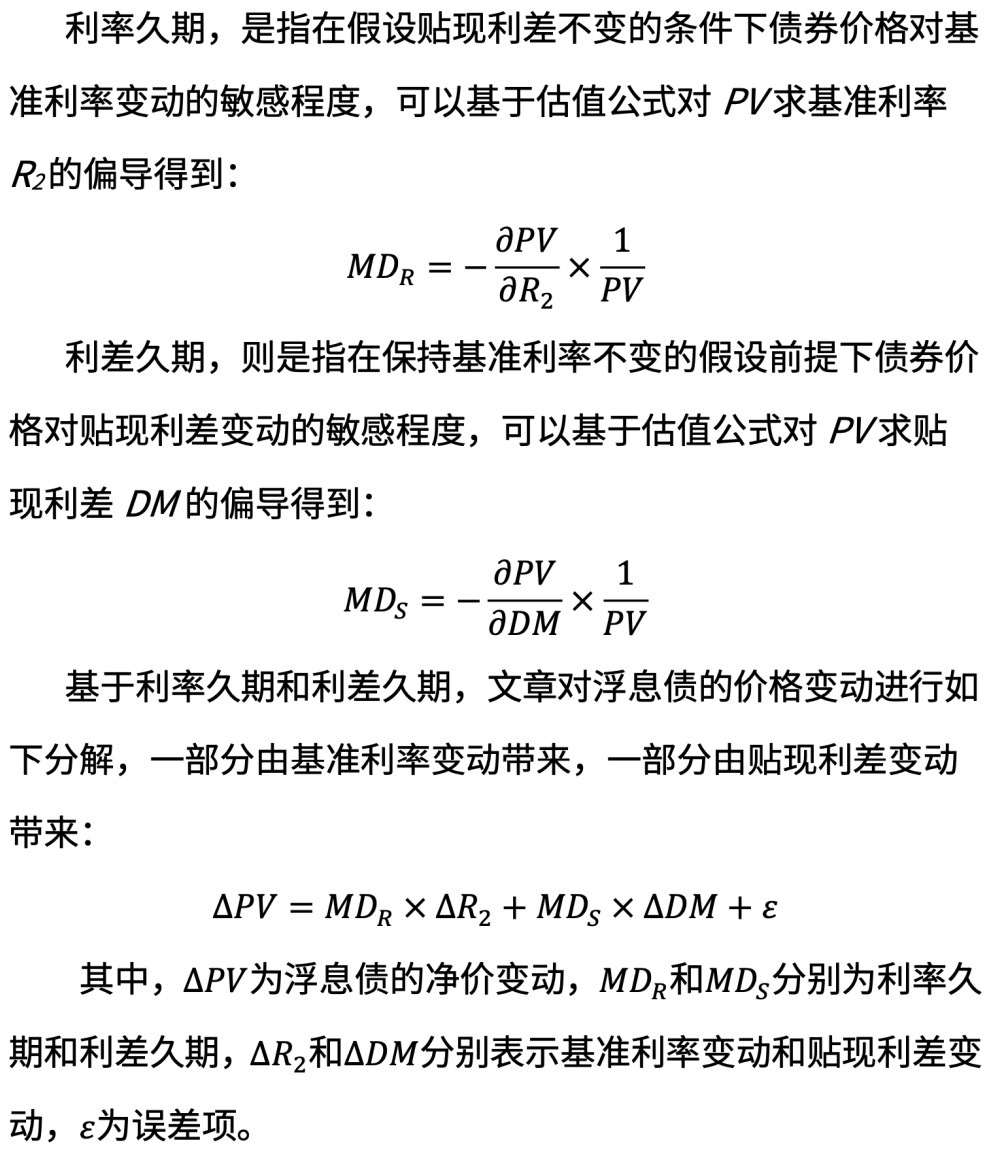
利差久期

Search documents
新刊速读 | 长期限浮息信用债价格影响因素的经验分析
Xin Hua Cai Jing· 2025-11-07 18:04
Core Analysis Framework: Valuation Formula and Duration Decomposition - The article introduces the valuation formula for floating rate bonds, highlighting three key elements: benchmark interest rate, issuance spread, and discount spread [2] - The benchmark interest rate is the market rate that the floating rate bond's coupon rate is based on, directly influencing future coupon levels [2] - The issuance spread is a fixed spread determined by investor bidding during the bond's issuance, generally remaining unchanged throughout the bond's life [2] - The discount spread measures the risk associated with the floating rate bond, influenced by the issuer's credit quality, liquidity, and bond terms, and together with the benchmark interest rate, constitutes the yield to maturity [2] - The price of floating rate bonds is primarily determined by the benchmark interest rate and discount spread, with "interest rate duration" and "spread duration" used to measure sensitivity to these factors [2] Main Research Findings - Spread duration dominates price fluctuations, with the spread duration of "24 Lingang Economic MTN003" being approximately 14.33 years compared to an interest rate duration of only 3.33 years, indicating that small changes in the discount spread significantly impact net price [6] - The combined or hedging effect of interest rate and spread changes can amplify price fluctuations when they move in the same direction, while opposite movements partially hedge price volatility [6] - The issuance spread acts as a buffer, influencing price stability; a higher issuance spread can provide a cushion against rising discount spreads, reducing the risk of net price falling below par [6] - Empirical evidence shows that for every 5 basis points increase in the issuance spread, the net price rises by approximately 0.5 yuan, and the holding period yield increases by about 55 basis points [6] - The reset cycle affects the risk structure; shorter reset cycles reduce interest rate duration and risk but may slightly increase spread duration and risk, necessitating a balance between interest rate and spread risks [6] Related Recommendations - For investors, evaluating the investment value of long-term floating rate bonds should include considerations of future benchmark interest rate trends and spread risk management [7] - In primary market subscriptions, investors should assess future expectations for benchmark interest rates, spread levels, and liquidity premiums to accurately evaluate the reasonable level of issuance spread [7] - For issuers, determining the reset cycle and benchmark interest rate for long-term floating rate bonds should involve a comprehensive analysis of issuer preferences, term matching, and market demand [7] - The article suggests promoting the issuance of long-term floating rate bonds for various types of government bonds to enhance market liquidity and establish benchmarks for long-term floating rate bond products [7]